
Paul Achleitner: «I Look at UBS with Great Admiration.»
Let’s turn to ESG. At first it was heavily promoted by politics. Now many players are pulling back and quietly deleting past pledges from their websites.
I believe we need to move away from the buzzwords. One of the reasons why the book has exceeded my own expectations is precisely this discussion of the legitimacy dimension. My thesis is: leadership today means finding the right balance between the performance dimension and the legitimacy dimension. We essentially understand performance. Legitimacy encompasses all the soft factors – likes, dislikes, emotions. Then you have government intervention, driven by politics, which is in turn influenced by emotions, the media, voters. You have to address this dimension today – more than ever in a world of social media. If you mishandle it, you will run into business problems. The headlines may change – ESG today, something else tomorrow – but the underlying issue is more important than ever.
You started your career at Bain and Goldman Sachs. Goldman in particular stands for performance and staff ownership. Were your early professional years firmly on the performance side of the spectrum?
Absolutely. And that was good for me. In the book, I talk about the «illusion of satisfactory underperformance» and the «privilege of self-imposed pressure». We tend to view our performance as satisfactory as long as it is better than last year’s or better than that of our colleagues. Whether it reflects our true potential often remains unexamined. I would venture to say: greetings to Germany as a society and an economy. For a long time, the country lived in the illusion of satisfactory underperformance and is now suddenly looking left and right and wondering what happened. My time at what were then private partnerships taught me to keep pushing myself and to make use of my potential.
What was your most important lesson from your time at Bain?
The idea of satisfactory underperformance comes from there. And I learned to listen. To listen carefully – not just pretend – and really understand where the other person is coming from. That is a very important quality in successful leadership. While you are talking, you are not learning anything new – some people manage even that, but that’s another topic.
«In a fluid world, failing to act in an agile way is not an option.»
Later, you built up Goldman Sachs in Germany.
Yes, in the German-speaking world. Back then, no one knew who Goldman Sachs was; no one knew what an investment bank was. I remember calling a secretary who replied: «Goldman Sachs – is this about the company outing?» Building that up and explaining it was a fantastic time.
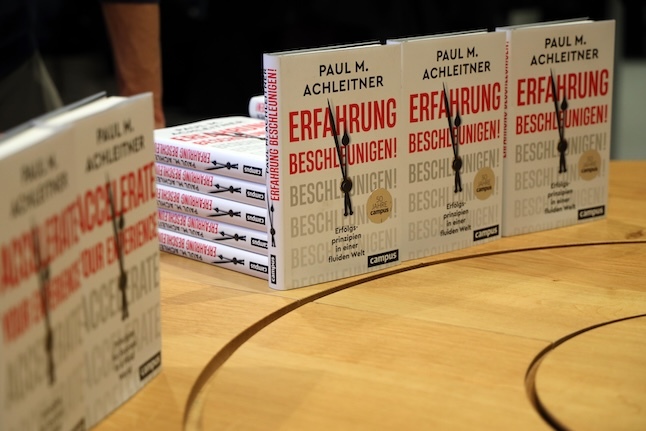
«Accelerate Your Experience»: Paul Achleitner’s new book. (Image: Courtesy)
That successful build-up was your entrepreneurial «claim to fame».
Definitely. But when I came to London, it was still a small team, an implant there as well. Everyone was looking for their market. Given my German language skills, I focused on the German and Central European activities.
Did Switzerland fall under that remit too?
Yes. I recently read that Goldman Sachs is now regarded as the best private bank in Switzerland. That makes me happy, because I sat on the board there when the business was still in its infancy.
But you didn’t actually found the Swiss unit yourself?
No, it already existed. I was later co-opted onto the board.
After that, you moved to the «Deutschland AG», joining Allianz and Deutsche Bank – a very different culture from Goldman. Did you know what you were getting into? Large supervisory boards, lots of politics...
You never fully know what you are getting into. My decision was this: I had been an adviser long enough, I enjoyed building things as we did at Goldman, and I wanted to move to the principal side and take direct responsibility. Allianz and Deutsche Bank are big tankers; there is a lot to learn. But the learning curve was very interesting.
At Allianz you had the Dresdner Bank, an all-finance conglomerate. Switzerland saw similar experiments with CS-Winterthur. Intellectually, the idea looked compelling; in practice, it didn’t work. Why?
Because the cultures are very different. It reminds me of the old quip: «The difference is that banks lend money to their clients, whereas insurers get money from their clients.» That is why they are different. An insurance model is relatively long-term in nature. That shapes the mentality, risk management and the people it attracts. Banks – at least parts of them, like trading – are much faster. That attracts a different kind of person. Bringing these two cultures under one roof is difficult. If you then add conflicts of interest – one side saying «Allocate the capital to me», the other saying «No, allocate it here for the long term» – leadership becomes very challenging.
«If the entire organization is convinced it is on the right path, it is hard for a chairman to sit at the top and say: ‹I’m not sure this is true.›»
A carriage with the horses pulling in different directions. In your book, you use the sale of Dresdner Bank as an example of the benefits of cutting complexity. How do you find the right balance between complexity and simplicity?
Companies grow and sprawl if you don’t trim them back every now and then. Announce a cost-cutting program and everyone is immediately against it: «Fine, but not in my area.» If you announce a complexity-reduction program, many people will say: «Finally, we can tackle the bureaucracy. I have ideas.» You can motivate employees to simplify processes – and you automatically reduce costs. If you weed regularly, you make life easier for yourself. Look at fintechs versus incumbents: a fintech on a greenfield site will say: «We don’t need this loop, we don’t need that one either.» For incumbents, it is much harder to abolish existing loops.
At Deutsche Bank, you also reduced complexity in practice and exited equities. It took several years to complete that move. How did your thinking evolve?
You have to go back two steps. Deutsche Bank was – along with Credit Suisse, incidentally – the only global bank to make it through the financial crisis without state aid. That shaped the mindset of the management teams. People were convinced they were the better risk-takers and had the better model. The markets confirmed this at the time. If the entire organization is convinced it is on the right track, it is hard, as chairman, to sit at the top and say: «I’m not sure this is true.» It took time until everyone on the supervisory board was prepared to acknowledge that under the new regulatory conditions, the old business model no longer worked. Then we began to renovate and rebuild it. That was open-heart surgery. Banks – and investment banks in particular – are fragile systems in which top performers are key. If you do it the wrong way, the good people leave and you are left with B-players. That’s when things really get dangerous. So we had to work our way forward carefully. Only when we had someone from within the organization in Christian Sewing could we say: «We will change our global footprint. We will remain globally competitive, but we don’t have to be everything for everyone everywhere.»
In the investment bank, equities – in effect proprietary trading – was the core business you exited.
Yes, that was the key component.
And that did not mean giving up the global ambition?
As you can see today, not at all. Deutsche Bank has defended its global footprint and is again in a stronger position.
Still, it remains part of a European banking sector that has brought less joy to shareholders than its US counterpart.
That’s true. There are structural reasons that create a genuine competitive disadvantage for Europe and European banks. In the US, finance has always been seen as a strategic industry and is strongly supported – despite all the political noise. In Europe, the focus is much more on control and risk containment.
In the US, the banking sector was effectively recapitalized by force during the crisis. Was that the better approach?
Yes. We have seen how successful it was. At the time, I was at Allianz and closely involved in German and European solutions. We have a different legal tradition and different options from the Americans. If Hank Paulson had not been Treasury Secretary back then – who knows if the US would have implemented it the way it did. It was not about «clever design» but the willingness to act. In hindsight, it was a very good thing.
Seen through the lens of your Deutsche Bank years – how do you view UBS today?
With great admiration. What UBS has achieved and the position it holds globally and in Europe is impressive.
Would you recommend that UBS scale back its investment bank in a similar way to Deutsche Bank?
The last thing active leaders need is people shouting advice from the sidelines. So I will refrain.
Looking back at your time at Deutsche Bank: Christian Sewing has proven his worth, the strategic shift was right. Yet the share price was higher when you joined than when you left. Does that bother you?
The share price is now back where it was when I started. Over that decade plus, we took more than one trillion euros off the balance sheet, reduced risk, replaced the top two management levels – and did all that without losing the bank’s global footprint. These are ongoing restructuring efforts which, in a bank – this is not a steel mill – take time and sensitivity. I am fully at peace with the fact that the institution today is in good shape and competitive globally.
Did you often have the feeling that markets and analysts did not understand what you were doing?
You have that feeling again and again. You try to explain, but markets and analysts follow different, more short-term criteria. Anyone who sold back then and bought again two years ago has done very well. You can’t blame them. You just must not run your company based on what is popular this quarter. You cannot ignore the market, but it must not be the decisive factor.
In Zurich, people like to say Deutsche Bank never really made money in Swiss private banking. Can you confirm that?
You cannot seriously expect me to answer that.
On the final page, read what Paul Achleitner says about the success of his book, the party «Alternative für Deutschland», and the leadership lessons of whitewater rafting.