Paul Achleitner: «I Look at UBS with Great Admiration.»
Among Europe’s financial executives, one name stands out: Paul Achleitner. He built up Goldman Sachs’ Central European business, later became chief financial officer of insurance group Allianz, steering it through the turmoil of the global financial and euro crisis. At Deutsche Bank, whose supervisory board he chaired from 2012 to 2022, he oversaw a far-reaching restructuring and helped bring in today’s chief executive, Christian Sewing, widely seen as a lucky strike.
finews.ch met Paul Achleitner in Switzerland last week. With Zeno Staub, President of the Board of Governors of the University of St. Gallen, in attendance, he presented his book published this year, in which he distills the lessons of his advisory and management career: «Accelerate Your Experience. Principles for Success in a Fluid World.» The book is designed as a catalyst to help readers learn from their own experience.
|
*** finews special *** Paul Achleitner is donating six copies of the largely sold-out book to finews.com readers. The first six people to contact the editorial team will receive the English original edition. A simple email including postal address to |
Mr. Achleitner, you write that as a young man you were enthusiastic about Che Guevara. What drew you to that figure?
On the one hand, of course – as it should be for every young man – it was the fight against injustice, or perceived injustice. And then also the idea of pushing boundaries and being willing to go your own way.
Yet you then went to the University of St. Gallen – right into the heart of capitalism. How did that happen?
In between, there was a very formative year as an exchange student in Grand Rapids, Michigan. That’s where a boy from the Austrian provinces was infected with the American dream – and my life changed course.
What impressed you so much about this «American dream»?
The virtually unlimited opportunities. The family I lived with was upper middle class, and compared with where I came from, that was very impressive. At the time, Gerald Ford was president, and he was from Grand Rapids. The idea that you are the architect of your own fortune and can achieve almost anything if you really go for it – that left a mark on me.
«If this government fails, we will face lasting political and economic problems.»
What did Grand Rapids look like back then?
It was a thriving mid-sized city of around 350,000 people, with a solid base of medium-sized industry and auto suppliers. If you go there today, you see that many parts are not doing well anymore.
Let’s move to St. Gallen. Like generations of students, you were exposed to the St. Gallen Management Model.
That was extremely important. I attended lectures by Professor Hans Ulrich, who was instrumental in developing the model, and doctoral seminars with Professor Fredmund Malik.
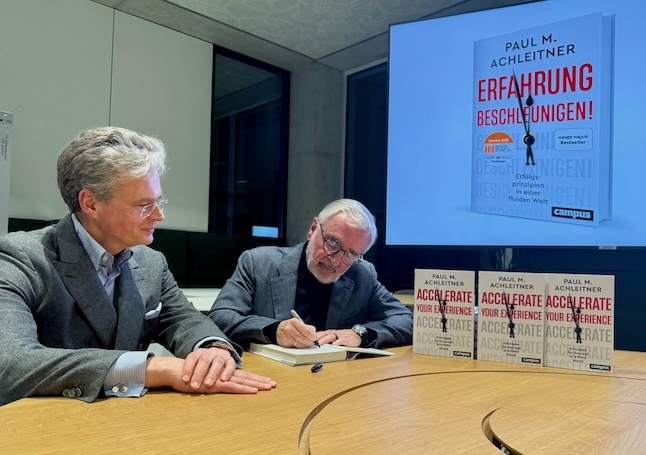
Book event at the University of St. Gallen: Paul Achleitner (right) and Zeno Staub, president of the university's Board of Governors. (Image: Courtesy)
Your book reads like a hands-on interpretation of that model: stakeholders, environmental spheres, the dissolution of the dichotomy between shareholder value and corporate ethics.
That’s how I see it too. The most important aspect was that holistic way of looking at things: understanding interdependencies, taking in other perspectives and looking at the same challenge from different angles. Then finding solutions that are broader in scope and do not just serve vested interests.
«The last thing active leaders need is people shouting advice from the sidelines.»
I found your suggestion especially striking that companies should rank stakeholders by their actual clout, because the influence of each group changes over time.
I call that «shakeholder value», as distinct from both stakeholder and shareholder value. It’s about the relative influence a stakeholder group can exert over management. In case of doubt, that is what matters. And those forces do change. If you are a well-run company, banks are not that important to you. If the water is up to your neck, all of a sudden, they are very important. That holds true for many stakeholder groups. It is a dynamic network, which is why I always found this pragmatic view more interesting than a purely theoretical stakeholder debate.
Critics would say this is an opportunistic approach.
«Opportunistic» is an interesting word. Opportunist – terrible. Agile – suddenly wonderful. If you can give me a precise definition of the difference, I’m all ears. In a fluid world, not acting in an agile manner is not an option. I struggle with that distinction. Power is exercised as a matter of fact. We see this at the geopolitical level as well. You have to deal with it.
On the next page, read what Paul Achleitner has to say about his career at Bain and Goldman Sachs, his view of UBS today, and the differences between banking and insurance.
- Page 1 of 3
- Next >>