
Paul Achleitner: «I Look at UBS with Great Admiration.»
Let’s talk about your book. Management guides are a dime a dozen – and now you’ve written one as well. What was your motivation?
Precisely not to write a management guide. I attach great importance to that. You cannot transfer your personal experiences to others; they are subjective. What you can do is use your own observations to accelerate other people’s experience. I have condensed more than 60 observations from four decades of professional life into short chapters. Each one ends with three or four questions for the reader – as a catalyst for personal reflection. No one has to read the book from cover to cover. You can pick any chapter that sounds interesting. It is not a recipe book, not a how-to manual, but a catalyst.
The book came out at the end of August. How has the response been?
It has exceeded my expectations – both for the English original and the German translation. I am being invited to readings; I was just in London, today we are here in St. Gallen. We are looking for a date in New York. Interestingly, companies are reaching out and asking whether I would speak with their leadership teams. I don’t yet know how far I want to take that. But I am pleased that the resonance is so strong – and I believe this legitimacy dimension really captures the current mood.
Is the publisher, Campus Verlag, happy too?
The publisher is very pleased – the book sold out relatively quickly.
«I first met Christian Sewing in Athens, ‹at the front›.»
You also write about the euro rescue. At the time, you were Allianz’s chief financial officer. You say that lasting personal ties and a certain esprit de corps emerged among the key players. Can you give an example?
Allianz is Europe’s largest institutional investor – with insurance assets alone, it is twice the size of Norway’s sovereign wealth fund. We were affected accordingly. We are proud to have come through the credit crisis and the sovereign debt crisis so well. As CFO, I was involved in many discussions. One example: I first met Christian Sewing in Athens, «at the front». He was a risk manager three levels below the management board. I was one of the few board members who – perhaps because of my Goldman history – rolled up their sleeves and worked in the war room rather than just waiting for reports. That is how you get to know many people well. A lot of them worked incredibly hard, sweating over solutions, being blocked by politicians, then going back to work again. That forges bonds.
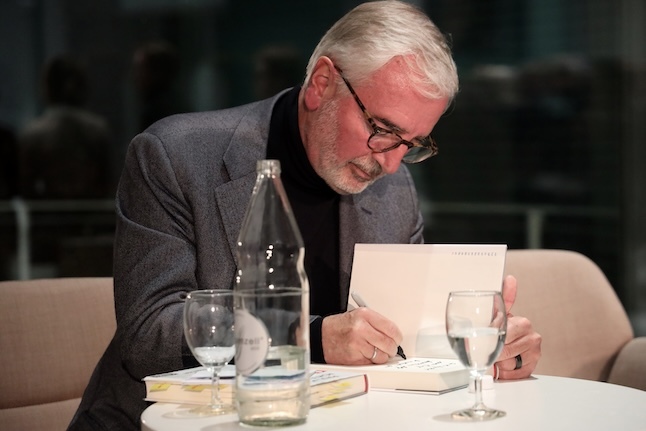
London, New York, St. Gallen: book author Achleitner. (Image: Courtesy)
How permanently has the sovereign debt crisis been resolved, especially with a view to France and the euro’s development versus the Swiss franc?
We have to distinguish: in terms of the acute crisis at the time – whether Greece or another country would leave the euro – the solution worked. Greece is in remarkably good shape today; a few others could take a leaf out of its book and apply some of the medicine they prescribed back then to themselves. Separately from that, we still face the general global problem of high debt. Public debt is as high as it has been at almost any point in history, at least in peacetime. Historically, debt has often been reduced through wars. Let’s hope that is not our path. There is ample reason for concern. The optimistic scenario would be productivity gains from new technologies, especially the broad application of AI. That could lift growth and make high debt easier to manage. But: «Hope is not a strategy.»
In the book, you are very analytical and descriptive without clearly taking sides on major battle lines – ESG, populism, identity politics. How should companies position themselves in polarized times?
I hope that shows I am not a missionary guru. A helpful example is US universities. Since the 1960s, the University of Chicago has had a policy of commenting only on issues directly related to its teaching mission. Harvard, MIT and others have, for example, taken public positions on Black Lives Matter. If they do that, they cannot then remain silent on the Palestine–Israel conflict. Companies face exactly the same problem. This doesn’t mean you shouldn’t have a view. But if you take an official stance, you must be aware that you will have to do so again next time. In today’s multi-layered landscape of interests, you will inevitably step on somebody’s toes – perhaps someone you didn’t even have on your radar. Whether you want that is a conscious decision, not something you should do intuitively because you happen to like a particular cause. The consistency of your external communication feeds into your legitimacy. Mistakes are punished.
My reading of you is that you tend to advise restraint.
I am more on the University of Chicago side. That does not mean you cannot do anything – support refugees, donate, that’s all fine. But you don’t have to parade it like a monstrance, which often has to do with the egos of leaders. The question is always: do you control your ego, or does your ego control you?
Deutsche Bank rents prestigious premises «Unter den Linden» in Berlin. The business association «Die Familienunternehmer» used them until it held an event there with an AfD member of parliament. The lease was then terminated. Is that understandable?
It will not surprise you that I will refrain from any comment.
«The consistency of your external communication feeds into your legitimacy. Mistakes are punished.»
A broader look at Germany: we have a new federal government that started out with great enthusiasm and extra fiscal room to maneuver. What is your interim assessment?
Just as UBS does not need advice from an outsider, neither does the federal government. What needs to be done is no secret. The challenges are on the table. The art lies in execution. From the outside, it is always easier to shout suggestions. Execution is harder. But I believe there is hardly anyone in Germany who is not aware that if this government fails, we will face lasting political and economic problems – not just in Germany but in Europe. That is why it should be given the opportunity to deliver.
With an investment horizon of ten to twenty years – would you buy an ETF on the DAX?
I do not give investment advice.
Where will you spend Christmas?
With my family.
Final question: what is the story behind the whitewater rafting?
Initially, I didn’t want to move from Bain to Goldman at all – after I turned them down, they redoubled their efforts. At a dinner, I said to Peter Sachs, one of the senior partners: «Peter, why should I do this?» He said: «Paul, it’s like whitewater rafting. You have to get out of your big boat into a small rubber raft, where you can’t go left or right. All you can do is manage rocks and rapids. You’re crazy – but if you enjoy whitewater rafting, you’ll have a great day.» I thought that was a wonderful description – and it turned out to be accurate both for investment banking and for my personal experience.
At the same time, something else happened. A colleague in the open-plan office said: «Next weekend we’re going whitewater rafting in West Virginia. There’s a river you can only run once a year, when they open the dams upstream. All the fans love it.» I said: «I’ve never been rafting.» He replied: «You don’t have to tell anyone, just come along.» The guide explained: «You’re all experienced rafters – and as you know, the first rapid is Rapid No. 6, the highest level. That’s the one place you don’t want to go overboard.» I climbed into the boat for the first time, we went around the first bend – and I immediately fell into the water. I desperately remembered the advice: feet first, so at worst you smash your knees, not your head. Nothing happened. From that point on, I was totally relaxed – I had already fallen out in the worst stretch.
Paul M. Achleitner is a former partner at Goldman Sachs, former chief financial officer of Allianz and former chairman of the supervisory board of Deutsche Bank. He began his career in academia at the University of St. Gallen and Harvard Business School, followed by several years as a management consultant at Bain & Co. in Boston. He has served on numerous supervisory boards (Bayer, Daimler, MAN, RWE), advisory boards (Allianz, Bain & Co., Deutsche Bank, Hakluyt, Hedosophia, HPS), non-profit organizations (Alfred Herrhausen Society, Bilderberg, Brookings, Munich Security Conference), academic institutions (Bocconi, Harvard Business School, University of St. Gallen, WHU Koblenz), industry associations (European Financial Roundtable, EU-Hong Kong Business Council) and government commissions. Together with his wife, Professor Ann-Kristin Achleitner, he is an active start-up investor. His first book, «Accelerate Your Experience. Principles for Success in a Fluid World.» was published in August.
|
*** finews special *** Paul Achleitner is donating six copies of the largely sold-out book to finews.com readers. The first six people to contact the editorial team will receive the English original edition. A simple email including postal address to |
- << Back
- Page 3 of 3