
J.P. Morgan Asset Management CEO Sounds the Alarm
Inflation, geopolitical tensions, the sweeping transformation of the asset-management industry, and the rapid rise of artificial intelligence: according to George Gatch, CEO of J.P. Morgan Asset Management, investors are navigating one of the most challenging market environments in decades. At the same time, he sees significant opportunities — particularly in active strategies, ETFs, and the convergence of public and private markets.
Speaking at the Media Summit 2026 in London, Gatch addressed mounting uncertainty across capital markets, Europe’s structural weaknesses in wealth allocation, the future of private credit, and the growing role of AI in asset management.
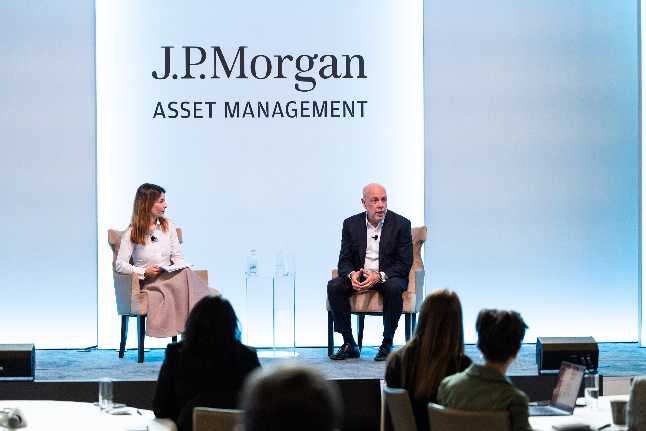
George Gatch speaking at the Media Summit 2026 in London. (Image: Courtesy of the Company)
«There is a tremendous amount of noise, uncertainty, and volatility right now — but very little clarity,»Gatch said. Investors, he noted, are searching for answers on inflation, geopolitical conflicts, and the future direction of the global economy. «This is probably one of the most uncertain market environments of my career.»
Growing Optimism Toward Europe
While roughly 60 percent of U.S. households invest in securities, a substantial share of European wealth still sits idle in low-yielding bank accounts.
«Europeans are savers, but they save inefficiently,» Gatch said. Around 40 to 45 percent of household wealth remains in cash, steadily losing purchasing power due to inflation.
At the same time, he sees growing optimism toward Europe. For the first time in a long while, European equities have begun to attract positive capital inflows again. Investors are betting on lighter regulation and stronger economic momentum across the continent.
Bonds are Making a Comeback
On fixed income, Gatch spoke of a «normalization» in yields. Rising long-term U.S. rates may be increasing uncertainty, but they are also making bonds attractive again.
«Emerging-market bonds are now yielding close to 8 percent,» he said. Diversified fixed-income strategies, meanwhile, are generating returns of six to seven percent, offering investors an attractive buffer against further rate increases.
«Europeans are savers, but they save inefficiently.»
One of the fastest-growing segments, according to Gatch, is fixed-income ETFs. J.P. Morgan Asset Management now manages more than $100 billion in active bond ETFs. He described it as “remarkable” that 96 percent of fixed-income ETF assets are still managed passively.
«In an environment characterized by inflation and credit risks, active management becomes increasingly important,» he said.
«No longer public or private — but public and private»
A major strategic focus for Gatch is the growing integration of public and private markets. Investors, he argued, increasingly need exposure to both worlds simultaneously.
«If you are only fishing in public markets, you may be missing the bigger catch,» he said.
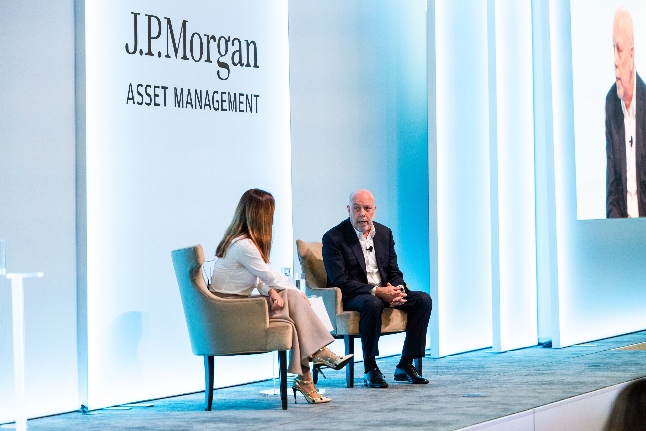
«An Analyst Will Be Able To Cover Two or Three Times As Many Companies In The Future As Today»: George Gatch. (Image: Courtesy of the Company)
The number of publicly listed companies in the U.S. has halved over recent decades, while private markets have expanded dramatically. Today, there are ten to twenty times more private companies than publicly traded ones.
According to Gatch, J.P. Morgan Asset Management manages roughly $300 billion in private-market assets, spanning infrastructure, real estate, private equity, and private credit. He sees particularly strong potential in hybrid strategies that integrate research and investment decisions across both public and private markets.
«There is no magical liquidity.»
«The real opportunity is not in multi-manager products, but in fully integrated investment decision-making across public and private markets,» he said.
Warning on Private-Credit Expectations
Despite the ongoing boom in private-credit strategies, Gatch warned against misconceptions surrounding the asset class. In his view, the biggest current risk is not credit quality, but liquidity.
«There is no magical liquidity,» he said. Many investors, he warned, have purchased products without fully understanding their liquidity profile.
While the market has not yet experienced systemic credit defaults, the industry has also never faced a major global recession. «This is a nearly $2 trillion market that has not yet gone through a significant downturn,» he said.
AI Should Make Analysts More Productive
Artificial intelligence was another major topic during the discussion. As part of JPMorgan Chase, the asset-management division has access to enormous technological resources, Gatch emphasized. The bank invests more than $20 billion annually in technology.
Within J.P. Morgan Asset Management, around 1,600 engineers are working on data and AI solutions aimed at making research processes more efficient and analysts more productive.
«Investors today need guidance based on facts — not emotions.»
«In the future, an analyst will be able to cover two or three times as many companies as today,» Gatch predicted. Machines will increasingly handle data processing — «but humans will continue to make the decisions.»
Even so, he does not expect massive job cuts. «I do not see significantly fewer employees in the future,» he said. The real objective, he argued, is to use technology to create more value.
«The most Dangerous World Since World War II»
Toward the end of the discussion, Gatch was asked why he considers the current environment particularly difficult. His answer was strikingly direct.
«This is probably the most dangerous geopolitical backdrop since World War II,» he said, pointing to conflicts in Europe and Asia, rising geopolitical tensions, and uncertainty surrounding U.S. policy.
Precisely because of this, long-term thinking has become more important than ever. Or, as Gatch put it: «Investors today need guidance based on facts — not emotions.»