
Lionel Aeschlimann: «We Are Not Important – Our Work Is»
Monsieur Aeschlimann, what fascinates you about Henri Matisse, to whom a major exhibition at the Grand Palais in Paris—supported by your institution—is dedicated until the end of July?
For me, Matisse is an artist of freedom and independence—and that resonates strongly both personally and with Mirabaud’s values. Matisse broke the codes of color. Before him, grass had to be green, the sky blue. Suddenly, he painted a red sky, yellow or blue faces. Color no longer represented reality but became an expression of emotion.
In doing so, he opened the door to the abstract world, to painting’s emancipation from reality. At the same time, there is this apparent simplicity: very clear lines, simple forms.
Could you elaborate on that?
Behind this simplicity lies enormous complexity. Creating something that looks so simple is extraordinary. Achieving maximum impact with minimal means is, to me, a very beautiful idea. Many artists after him said they would not have existed without Matisse. He opened up imagination—for forms, for minimalism, for abstraction. That is what makes him so fascinating.
«Supporting art and artists builds a bridge to our clients: they see that we reflect on values.»
What opportunities does such an engagement create for Mirabaud in terms of client relationships?
It allows us to talk with our clients about art and different perspectives, and to build new relationships. At the same time, it helps us reflect on the world—on what matters and what matters less.
We ask ourselves questions such as: what is the value of things? In our business, we have to assess the price of a security every day; art encourages us to question the difference between value and price and to reflect on what truly matters in life. Supporting art and artists builds a bridge to our clients: they see that we care about society, that we are rooted in culture and that we reflect on values. And it creates moments of shared passion.
Which target groups do you address in particular? More of an older audience, or does your cultural engagement also resonate with younger generations?
Both. For the Mirabaud art collection, we often acquire works by young, emerging artists. We are in close contact with them, invite them to the bank, and give them the opportunity to speak with our clients and present their work.
That is essential for a house that is over 200 years old: not only to look to the past, but also to the present and the future. The younger generation is our future. Engaging with young artists—who surprise us, sometimes even shock us or challenge us—helps us stay relevant.
How has the approach to art changed across generations, in your view?
Previous generations placed great importance on ownership: a house, a car, perhaps a yacht. Younger generations are less interested in ownership and more in experiences: visiting exhibitions, traveling, meeting artists, discovering new things. Artists also address topics such as climate change, conflicts, money, relationships or nature. Perhaps the older generation thinks more in terms of value and price, while the younger generation seeks meaning and experience. Both are important—and both are valuable.
«The younger generation is less interested in ownership and more in experiences.»
What does art mean to you personally? Is it also a counterbalance to the day-to-day banking business?
For me, art is first and foremost deeply human; it reflects our thoughts and emotions. It helps us reflect, remain humble and keep an open view of the world.
Many people in finance eventually start to believe they are important because they work with money and wealth. But we are not important—our work is. Our role is to protect and invest our clients’ money. It is not our money; it belongs to our clients. When we manage pension assets, we are dealing with the future of retirees. That is a social responsibility. I believe we must open up the world and build bridges. We should bring artists into banks—and bring bankers closer to art.
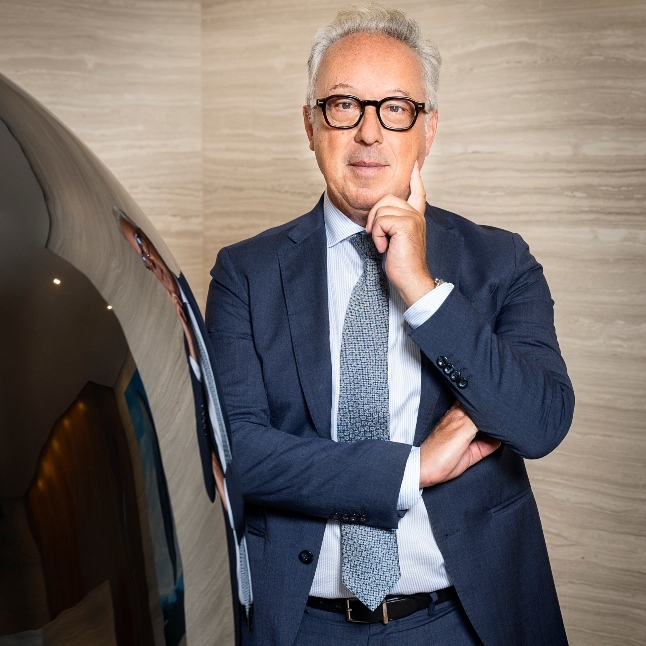
Lionel Aeschlimann: « There has always been a close connection between finance and art.» (Image: zVg)
- Page 1 of 2
- Next >>