
Swiss Private Banking: These Are the Branding Leaders
Swiss private banking has been undergoing a difficult structural transition for some time. Consolidation, rising regulatory costs, margin pressure and changing client expectations continue to reshape the industry. This reality is regularly documented by rankings and analytical reports that highlight different fault lines across the market.
Among the most established is KPMG’s annual study on Swiss private banking (see finews’ coverage of the 2025 report based on 2024 figures). It provides an anonymised but comprehensive overview of profitability, cost efficiency and key financial trends derived from banks’ published annual reports.
The Goldman Sachs Surprise
A similarly numbers-driven approach is taken by IFBC’s sector report, which analyses performance metrics, scale effects and strategic positioning across the market.
Particular attention was drawn more recently by yet another perspective. Fin21 and ZHAW researcher Chris Künzle, in cooperation with finews, published a study whose outcome surprised many observers. It concluded that Goldman Sachs currently operates the most powerful private banking unit in Switzerland – ahead of long-established domestic institutions. A finding that put widely held assumptions about size, efficiency and competitive positioning in Swiss wealth management to the test.
A More Qualitative Perspective
What all these analyses have in common is their reliance on hard financial metrics derived from annual reports. Largely left aside is a more elusive dimension: how Swiss private banks present themselves – and what strategic relevance this self-image actually has.
This is where the Swiss Private Banking Identity Index (SPBIx) comes into play. Published yesterday in its second edition, the index is authored by Jean-François Hirschel, founder of Geneva-based strategy firm H-Ideas, and Markus Kramer, managing partner at branding consultancy Brand Affairs. It deliberately shifts the analytical focus away from financial performance towards brand identity and its activation in the market.
Purpose, Values and Positioning
Rather than analysing balance sheets or income statements, the SPBIx assesses how clearly Swiss private banks articulate who they are – expressed through purpose, values and positioning – and how consistently they translate this identity into visible market behaviour.
The underlying assumption is intuitive: in an industry built on long-term relationships and reputation, identity should matter. The question is whether it actually does – and how meaningfully such a factor can be measured.
What the Index Measures
The SPBIx analyses 58 “pure” Swiss private banks, defined as institutions headquartered in Switzerland and not dominated by a foreign parent company. All assessments are based exclusively on publicly available information – websites, published statements, public management communication, cultural narratives and external platforms such as employee review sites.
Roughly 30 individual criteria are rated on a scale from 0 to 5 and aggregated into two dimensions:
- Identity (70 percent weighting): purpose articulation, value systems, clarity of positioning and internal coherence between purpose and values.
- Activation (30 percent weighting): visibility of senior management, storytelling, cultural transparency, consistency across channels and indicators of employee engagement.
Based on this framework, banks are grouped into four categories – Leaders, Introverts, Superficials and Laggards – depending on how effectively identity and activation reinforce one another.
Top 3 from Western Switzerland
At the top of the 2026 ranking, a clear geographical pattern emerges. The three highest-ranked banks are all headquartered in Western Switzerland. Pictet leads the table, followed by Piguet Galland and Banque Heritage. UBS ranks fourth, with the top ten completed by PKB Private Bank, Vontobel, Zürcher Kantonalbank, Graubündner Kantonalbank, Lienhardt & Partner and Mirabaud:
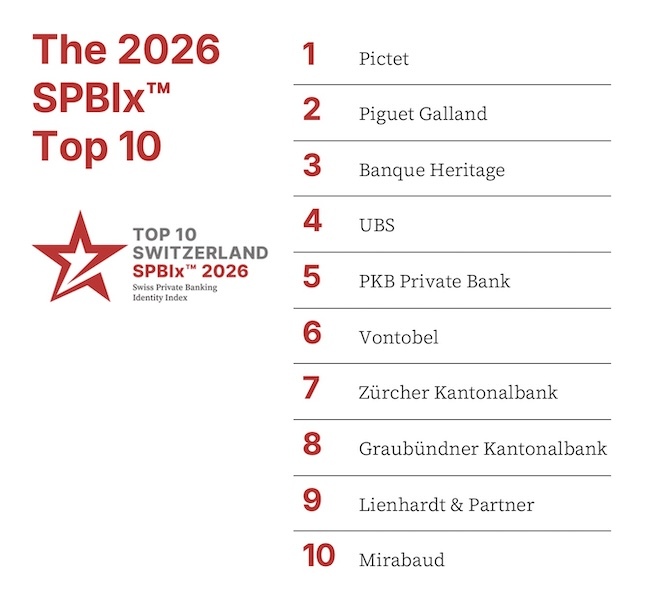
Top 10 ranking. (Image: Courtesy)
Asked by finews, the authors confirmed that neither methodology nor weighting had been changed compared with last year’s edition. The 2026 results are therefore directly comparable with those of 2025.
This methodological continuity also helps put this year’s findings into perspective. In the previous edition, Vontobel had unexpectedly claimed the top spot – a result that attracted attention precisely because it ran counter to conventional perceptions of brand leadership in Swiss private banking, as finews noted at the time.
A Compressed Field at the Top
The 2026 ranking now paints a picture of a highly compressed top tier, with several institutions clustered closely together. This suggests that last year’s surprise was less an outlier than an early signal of how narrow the gaps among leading brands have become – and how sensitively the ranking reacts to incremental improvements.
Accordingly, the authors caution against overinterpreting individual ranking movements. In a written statement to finews, they note: “The top ten in 2026 are extremely close. Pictet was already very strong last year and has now confirmed its leading position. Vontobel remains among the strongest brands in Swiss private banking, but has slipped back because other banks have made significant efforts to improve their identity and activation. In a field as tight as Formula 1, even the smallest differences can have a major impact.”
Moderate Progress
This also exposes a structural weakness of such rankings: when differences are marginal, symbolic shifts risk overshadowing more substantive developments. More telling than individual positions is the repeated presence – or absence – of certain institutions at the top over time.
Overall, the index points to moderate improvement. The average SPBIx score rose from 1.84 to 2.11. The share of banks classified as “Laggards” declined from 59 to 53 percent, while 16 percent now qualify as “Leaders”.
Bridging to Financial Performance
Against this backdrop, the authors explicitly seek to link their identity-focused findings with the traditional financial metrics that dominate most private banking studies. While the SPBIx does not analyse balance sheets or profitability ratios, it positions brand identity as a complementary perspective – a possible explanatory factor for why certain institutions consistently outperform others over time.
Indeed, the authors identify a correlation between strong SPBIx scores and growth metrics. Banks in the top ten achieve a growth score of 153, compared with 140 for the industry average. This score is based on growth in assets under management, net new money relative to AuM, and net new money per employee. The finding is instructive – but should be treated with caution. Correlation does not imply causality. Strong brands may grow faster; equally, strong banks may simply have more resources to invest in communication, digital presence and coherent narratives.
A Diagnostic Mirror
The SPBIx does not claim to replace established financial analyses of Swiss private banking. Its value lies elsewhere: as a diagnostic mirror that reveals how unevenly Swiss private banks communicate purpose, values and culture.
Equally important is what the index does not measure: client satisfaction, the quality of internal decision-making, governance, or actual investment in brand-building. The SPBIx captures the visible imprint of brand communication – not its underlying intent.