
Study: Family Offices Face Transformation
Family offices, and the families behind them, now hold a significant place in global financial markets, overseeing more than 3 trillion dollars in assets. With a projected 124 trillion dollar wealth transfer by 2048, the sector is set for further expansion and change, the U.S. bank notes. The priorities of the next generation are already reshaping demand.
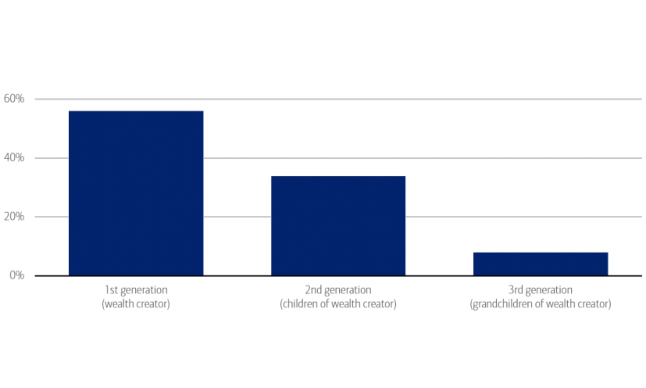
More than half of the family offices (56 percent) in the study were founded by first-generation entrepreneurs, who in many cases aimed for centralized oversight of their wealth. When family offices are set up for multiple generations, they are usually founded by heirs of the second (32 percent) or third generation (8 percent) who inherited the wealth.
(Graphic: BofA)
Family members are particularly active in the day-to-day business in those family offices where the original founder no longer exercises excessive control, the study continues. In more than three-quarters of the offices, the family head is moderately to very strongly involved in management, usually at the executive level or on the board, where they contribute to strategy, asset allocation, investment decisions and governance.
According to the study, Family members with formal functions are particularly common in offices with assets under management (AuM) between 500 million and 1 billion dollars, as well as in offices founded by next-generation family members. In addition, CEOs who are fully committed to the family office are generally found in offices that have existed longer and include more family members.
Growing and Preserving Wealth
The main task is viewed as growing and preserving the wealth. Other tasks mentioned include paying bills, capital calls, or handling tax matters.
Many family offices face a generational transition. Seventy percent have existed for a decade or longer, and one in three expects a change of control within the next five years. Six out of ten expect a transition in the next ten years.
Highly involved CEOs tend to take a more active, deliberate role in succession planning. More than 40 percent begin preparing the next generation as soon as they express interest or reach a certain age, compared with less than one-third of less involved CEOs.
Strategy, Investments and Future Planning
Regarding the question of where the greatest challenges are seen, the answers were very diverse, writes Bank of America. These depend on the family office’s age, the size of assets managed, or the number of employees. The generation in charge also plays a role.
Common themes among the challenges included questions on investment alignment, wealth growth and preservation, the strategic use of loans, or the role of technology and future planning.
Of those surveyed, only 34 percent currently use loans strategically, while 42 percent report that they take on new loans only when absolutely necessary. Maintaining investments, direct participations or large acquisitions, as well as minimizing the tax burden, are frequently cited reasons for using loans.
Technology Expected to Improve Returns
In terms of technology, both opportunities and risks are seen. On average, family offices use two different wealth platforms. Around three-quarters stated that automation is important for analyzing alternative investments, portfolio modelling and cash-flow forecasting.
A transformation is expected through increased use of technologies, including artificial intelligence (AI). Almost nine out of ten respondents believe that AI could improve investment returns, and more than half have already begun experimenting with it.
Security Concerns due to Cyberattacks
Security concerns are mounting as well: almost a third have already faced a cyberattack, with 40 percent of those citing moderate to severe damage to the family's wealth.
The study is based on a survey and interviews with decision-makers and senior managers at 335 U.S. family offices. These managed at least 25 million dollars in assets, and 60 percent managed more than 500 million dollars.