Crypto Treasury Model: New Strategy Reaches Switzerland
This column features opinions and analyses on economic and financial topics.
Following the success of MicroStrategy’s Bitcoin strategy, an increasing number of publicly listed firms have begun holding digital assets as balance-sheet reserves. Now, for the first time, a Swiss company is entering the market.
The newly established Zurich-based Future Holdings AG recently raised CHF 28 million to advance the Bitcoin-treasury model pioneered by MicroStrategy (now «Strategy») in Europe.
U.S. Sets the Pace
Among the co-founders are well-known Bitcoin figures from Switzerland and across Europe. The business model is built around a Bitcoin-dominated balance sheet complemented by additional services. With this setup, Future joins the growing cohort of firms taking inspiration from Strategy, ranking 75th globally in balance-sheet size among these treasury companies.
Michael Saylors Strategy pivot five years ago marked a turning point for institutional Bitcoin adoption. It became the first listed company to fully reorient its business model around accumulating «digital gold.»
Objective: Accumulating Bitcoin
Since then, Strategy’s market capitalization has surged twenty-fold to roughly USD 54 billion. The company tapped capital markets extensively to grow its Bitcoin position—initially through equity offerings, later via convertible bonds and preferred shares. The entire financing cycle pursued one clear mission: continuously expanding balance-sheet reserves in Bitcoin.
The model attracted attention. More than 200 listed companies now hold Bitcoin on their balance sheet. Among the 15 largest players, all but one are based in the United States. In total, corporate entities hold over 1 million Bitcoin—around 5 percent of circulating supply, or more than USD 90 billion.
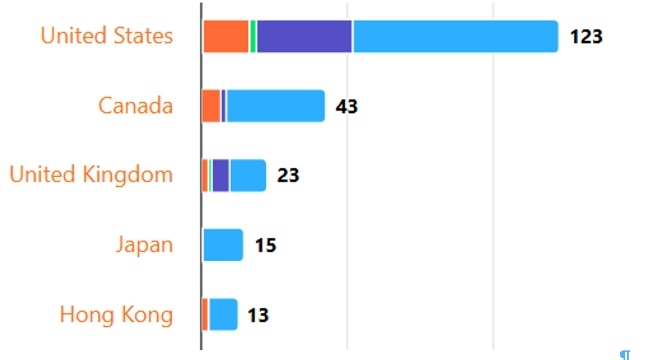
Anzahl Gesellschaften mit Bitcoin in der Bilanz (Grafik: Digital Asset Solutions/Bitcoin Treasuries.net)
Some of these holdings stem from companies whose entire model revolves around treasury strategies. Others—including miners or trading platforms such as Coinbase—hold Bitcoin as strategic operating reserves. Firms like Tesla primarily use digital assets as a store of value.
Treasury Companies Gain Momentum
The fast-growing segment of Digital Asset Treasury Companies (DATs, shown under «Public Companies» in the chart) is becoming increasingly influential. These balance-sheet-driven vehicles actively integrate cryptocurrencies—primarily Bitcoin, but increasingly also other digital assets—into their capital structure.
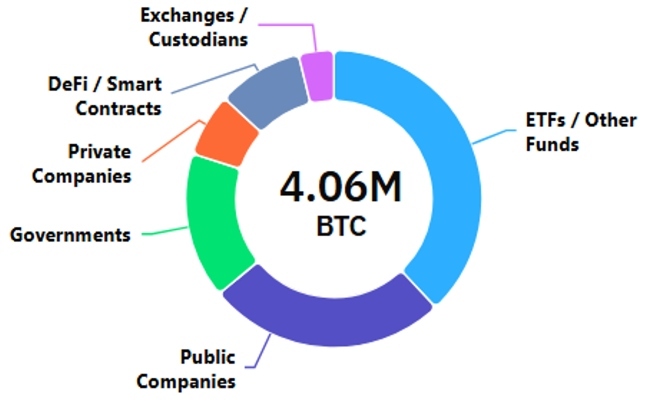
Verteilung der Bitcoin über ausgewählte Marktsegmente (Grafik: Digital Asset Solutions/Bitcoin Treasuries.net)
Their business model rests on three pillars. First, they invest their balance sheet into a core position of digital assets, typically Bitcoin or Ethereum. Second, they actively employ equity and debt financing to adjust leverage, manage liquidity, or refinance. Third, DATs respond to their market capitalization relative to their balance-sheet Net Asset Value (NAV), which reflects investors’ expectations around management quality, leverage, and future price movements. Accounting treatment varies significantly across jurisdictions, often creating divergences between reported values and fair-market pricing.
A premium to market NAV (mNAV) suggests confidence in capital discipline and future appreciation; a discount signals refinancing risks or potential dilution. DATs are neither traditional funds nor operating businesses. Instead, they are hybrid, publicly traded holding structures with actively managed balance sheets and market-driven valuations.
Can Switzerland Compete?
A DAT’s stability is primarily determined by two factors: the price of the underlying digital asset and the degree of leverage. The ratio of equity to debt defines the performance multiplier. High leverage can amplify gains but also increases mNAV volatility and the risk of market discounts. Prices reflect these dynamics immediately.
Switzerland’s first Bitcoin-treasury company highlights what it sees as a strategic advantage: a macro environment characterized by a 0 percent base rate and negatively yielding government bonds. However, leverage is heavily influenced by the firm’s base currency. Borrowing cheaply in Swiss francs means exposure to one of the world’s strongest currencies—while the vast majority of Bitcoin liquidity is USD-denominated. That mismatch can become a disadvantage quickly. For this reason, the momentum remains largely in the United States.
Playing with Fire – and the Recent Correction
For most investors, regulated products such as ETFs and ETPs remain the most efficient access route—free of corporate risks and valuation premiums.
Over the long term, digital assets such as Bitcoin, Ethereum, and Solana benefit from DAT-driven accumulation strategies. Companies with high leverage or pronounced mNAV premiums, however, should be viewed as speculative vehicles whose valuations depend heavily on sentiment and balance-sheet discipline.
Even the pioneer Strategy (MSTR) was hit hard by the current correction. Since its recent all-time high, the share price has fallen by 59 per cent, while Bitcoin lost only 27 per cent over the same period. The development was even more painful for the numerous imitators, whose less mature strategies and higher entry prices further exacerbated the losses.
Leon Curti is Head of Research at Digital Asset Solutions, which advises financial institutions on education, research, and asset-management strategies in digital assets.
- Read all previous articles on finews.com.