
Wellington’s Investor Playbook for a Messier World
After interviewing the firm’s leadership team in Zurich, Jenö Szabo and Luca Michienzi, earlier this year, finews.com's editorial journey continued straight into the London «kitchen», where Wellington Management’s investment strategies are actually crafted.
The timing could hardly have been more symbolic to underscore a core theme of the day – the increasingly politicised investment environment: on the very morning of the firm’s Media Day, France’s prime minister Sébastien Lecornu announced his resignation (he's since returned to office).
Intellectual Diversity as Feature
The setting: two stories of glass and steel on Victoria Street, just behind Westminster Cathedral. Inside, the atmosphere was collegial and analytical. At Wellington, there is no single «house view.»
Wellington’s employee-owned structure doesn’t just allow, but actively encourages, debate and dissent between teams – a built-in feature of how investment insight is forged.
The People Crafting Portfolios
Across five sessions, strategists and portfolio managers dissected the fault lines of a changing world. From Natasha Brook Walters and Will Lockhart on portfolio design to macro strategist John Butler on fiscal dominance, and from fixed-income expert Martin Harvey to global equity strategist Andy Heiskell (to mention just a few of the speakers), the day spanned many layers of global capital markets. The intellectual diversity was striking: a mosaic of perspectives competing and complementing one another.
The day opened with Natasha Brook Walters, head of Solutions at Wellington, who described the current investment environment as an «evolution, not yet a revolution» — but one that requires investors to abandon the assumptions of the past decade. The era of cheap money and low inflation, she said, is «behind us,» replaced by higher macro volatility, diverging policy cycles, and far more activist governments.
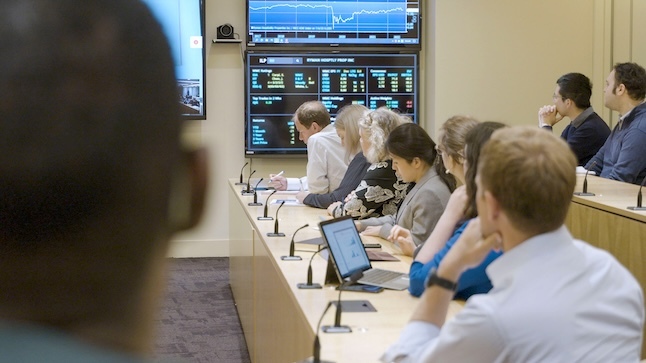
Inside the kitchen: Wellington Management's London office. (Image: Courtesy)
Adaptability as Key Investment Skill
Her prescription: rethink diversification, seek new sources of income, and embrace the «public-private shift» as companies stay private longer. «Adaptability,» she added, «has become the most important survival skill in investing.» The remark set the tone for a day that was less about forecasting and more about re-engineering how portfolios are built for a world in motion.
John Butler’s macro presentation cut through the optimism that still colours parts of the market. His diagnosis was blunt: «The world has changed.» Inflation, he said, is proving «sticky» at around 3 percent, while governments and central banks display «zero pain tolerance.» Fiscal expansion has replaced monetary discipline.
Markets Have Become Political
«Every recent election we’ve seen has led to more fiscal loosening, not less,» Butler argued. What he called «fiscal dominance» and «political dominance» are now setting the tone for markets once ruled by central banks.
The result, he warned, is a world where the old 2-percent inflation anchor is dissolving. «Once you start indicating that three percent is acceptable – then why not four, why not five? That’s the journey we’re on.» Stocks, he said, are «priced for Goldilocks,» hoping AI-driven productivity will deliver painless growth. His own take was cooler: the next phase could well be an «inflationary boom» that bond markets are not priced for.
The AI Dilemma
Butler’s scepticism found its counterpoint in the session «Investing in AI: A Public and Private Perspective,» where U.S.-based portfolio managers Matt Witheiler and Brian Barbetta joined virtually. Both described a constructive, research-driven engagement with the technology. «Private companies are driving public outcomes,» Barbetta said, outlining Wellington’s network across semiconductors, data-centre construction, and software infrastructure.
Witheiler added that AI is already embedded in the firm’s internal research processes through its proprietary tool «Welly,» which helps analysts synthesise global information flows.

«Stocks are priced for Goldilocks»: John Butler, Macro Strategist. (Image: Courtesy)
Confident Exploration of the Field
At Wellington, AI is seen less as a bubble and more as an operating reality – a tool that transforms both markets and the way investors work. Butler’s warning that AI «will have to deliver very quickly» in order to justify current valuations thus met its counterpart in the firm’s quietly confident, evidence-based exploration of the field.
When Tom Levering took the stage with analyst Megan Galligan, the focus shifted from algorithms to electricity. Their question – «Do we have a power problem?» – quickly turned into a secular growth story.
The Utility Saga
Levering, who leads Wellington’s infrastructure and energy platform, joked that he had «put all [his] own money» into his strategy fifteen years ago, long before electrification and data-centre demand became the narrative of the day. It was the embodiment of Wellington’s entrepreneurial partnership model: conviction backed by personal capital.
Levering and Galligan described a world of regulated, predictable business models that now face explosive new demand from AI and digital infrastructure. «We don’t need to make heroic assumptions,» she said. «Growth is visible and broadly based – not just in renewables, but across a pragmatic mix of energy solutions..»
Valuations, Quality, and the Broadening Market
The final plenary session, «Behind the Headlines: Finding Value in Global Equity Markets,» brought the discussion full circle. Andy Heiskell observed that markets had become «data-dependent» – reactive rather than predictive.
His view: the global economy has been in a «sideways malaise» since 2022, dominated by a handful of cash-rich companies that obscured the underlying bifurcation between winners and losers. Yet he also sees early signs of broadening: «You need fundamental growth to broaden equity markets – and we’re starting to see that.»

Macro Strategist Nicolas Wylenzek argues that the sentiment on Europe is turning. (Image: Courtesy)
A German «Wunder» Round the Corner?
Tim Manning noted that U.S. valuations «aren’t really crazy» once quality and cash flow are considered, while Nick Wylenzek pointed to a cautiously renewed confidence in Europe – and especially in Germany. «After years of stagnation and political drift, Germany’s mix of fiscal pragmatism, industrial policy and domestic demand is beginning to look more coherent,» he said.
«It’s still fragile, but sentiment is turning.» For Wylenzek, the continent’s biggest economy could once again become the pivot of a more self-sustaining European cycle: «The Europe of the next ten years will look very different from the one of the last decade.»
Framework for Debate
One doesn’t have to agree with every conclusion drawn that day. But the discussions offered a rare window into the level of sophistication with which Wellington approaches markets – and with which it speaks to its institutional clients. In a business often reduced to slogans and benchmarks, the London Media Day was a reminder that depth of thought can still be a competitive advantage.
By the time the discussions moved to the rooftop terrace, it was clear that Wellington’s most distinctive asset isn’t its over a trillion dollars under management, but its intellectual, decentralized architecture. No single doctrine – just a playing field of debate, curiosity, and ownership.