
Summer Greetings From The City Of The Gods
Written by Michael Barakos, Portfolio Manager at J.P. Morgan Asset Management
Although I was born in Norway, grew up in the English countryside and have lived in London for the last three decades, Greece has been my second home since childhood. Every summer, I find myself returning – especially to the Cyclades, whose barren landscape and cultural depth have always fascinated me. We have a house on Tinos, one of the quieter islands, and I got married on Amorgos – both places hold a special place in my heart.
When I’m in Athens, my first stop is almost always the Museum of Cycladic Art. The marble statuettes from the Bronze Age on display impress me anew every time. Their minimalist design language looks surprisingly modern: simple, clear and yet full of expression. Nearby is the Benaki Museum with its diverse collection of Greek art and history. I particularly enjoy taking a break in the café there – with a view over the National Garden, it’s the perfect place to pause and watch Athens unfold below.
But even beyond the museums, Athens pulsates with remarkable energy: culturally, culinarily, economically. It is this mixture of old and new, of history and the present, that makes Athens (and Europe as a whole) so exciting. And this dynamic is also reflected at the strategic level.
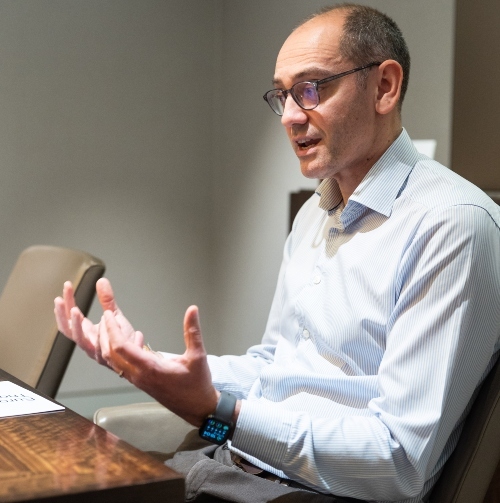
Michael Barakos from J.P. Morgan Asset Management (Image: provided)
Europe’s hour has come
From an investor’s perspective, European equities have long been laggards on the global stage. However, we are currently seeing a situation we haven’t seen in over a decade: the stars are aligned for a comeback.
Firstly, monetary policy in the eurozone is moving faster than elsewhere. The European Central Bank was the first major central bank to start cutting interest rates – a remarkable step. Key interest rates in Europe were lowered from 4 percent to 2 percent within a year and are now even below the US level. The full positive effects of this monetary easing will only be felt after a delay. This leaves room for optimism.
On the other hand, the fiscal policy debate is gaining momentum, especially in Germany. At the beginning of the year, it would have been unthinkable that Berlin would plan to invest around 1 percent of gross domestic product in defence and an additional 1 percent in infrastructure over the next ten years. For an economy that has hardly grown in recent years, this is a real paradigm shift – and it is possible because, unlike many other industrialised countries, Germany has significantly reduced its public debt in recent years.
Other eurozone countries could follow suit: we expect a broader wave of investment across Europe, particularly in the defence sector. Official announcements could come before the end of the year.
New opportunities through more flexible strategies
In such an environment, there are interesting investment opportunities – especially for strategies that not only rely on the classic «long-only» principle, but are more flexible. For many years, our team has been using an extended approach that can react to both rising and falling prices. These active «extension» strategies offer the advantage that a significantly higher market exposure is created for every euro invested – in other words, more capital works in the market without the risk increasing proportionally.
A further driver of returns is the targeted use of short positions: In Europe, there are not only undervalued companies with great potential – there are also stocks that appear attractive at first glance but reveal fundamental weaknesses upon closer inspection. Identifying and avoiding these so-called «Fool’s Gold» stocks – or even profiting from them – is an essential part of our active management approach.
What gives these flexible strategies their particular appeal is the ability to achieve higher returns and control risk at the same time. This can be a decisive advantage, especially in a market environment in transition.
Rethinking Europe
Just as the figurines of the Cyclades fascinate with their simplicity and timelessness, European equities also reveal a depth that is often overlooked upon closer inspection. Those who are prepared to take a closer look and think flexibly can discover new opportunities in this market – not despite, but precisely because of the challenges that Europe is currently facing.
And sometimes it’s like looking out from the Benaki Café: the horizon is wider than you think. You just have to take the right perspective.