
Costa Navarino: Greece’s Quiet Revolution in Luxury
For nearly four decades, the author managed to avoid Greece. Not out of intention, but because the country never seemed to settle into a coherent image. Was it the cradle of Western philosophy or the backdrop for noisy summer holidays? The land of Aristotle and Homer or of party islands, crumbling debt, and capital controls?
Even cinema made things worse. From sword-swinging Spartans in slow motion to digitally oiled warriors, Greece’s image in the cultural imagination was anything but serene. Add to that the endless stream of postcards from friends posing in Santorini’s blue-domed haze, or Mykonos’ nightclub chaos, and the country began to feel like a beautiful overexposure: too many myths, too many meanings, all individually fighting for attention.
Boldest and Most Audacious Tourism Project
In this dazzling confusion, the author never found an entry point. Until learning about Costa Navarino — the boldest and most audacious tourism project in modern Greece. Conceived on the unspoiled shores of the Peloponnese, it promised something radically different: a version of Greece that didn’t have to shout, fight, or dance for recognition, but could simply breathe — sophisticated and profoundly anchored in its landscape.
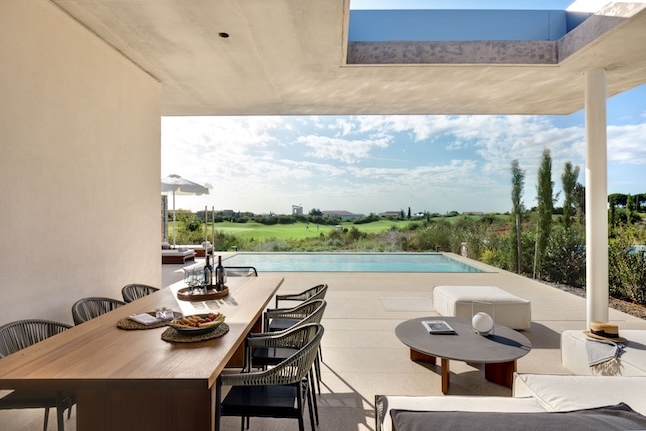
Some of the villas developed in Costa Navarino’s real estate division are also available for rent. (Image: Courtesy)
Costa Navarino justifies its superlatives. From the outset, it was never meant to polish Greece’s tourism offering, but to rewrite it. The developer, TEMES, remains 75 percent owned by the founding Constantakopoulos family and 25 percent by Saudi Arabia’s Olayan Group, a name that may still resonate with those who followed the Credit Suisse saga. Together, they have committed to an investment volume exceeding 1.2 billion euros, with total project spending expected to approach 2.5 billion over time – a scale unmatched in the country’s modern tourism history. In terms of geography, this translates to a development project spread across more than 1,000 hectares of restored coastal landscape.
Greece's Golf Capital
On the sporting front, Costa Navarino has become Greece’s undisputed golf capital. The destination now comprises four signature 18-hole courses – The Dunes, The Bay, The Hills, and the International Olympic Academy – each carved into the landscape with its own rhythm and views over sea and olive groves.
In hospitality, the resort recently welcomed the Mandarin Oriental, Costa Navarino, the group’s first hotel in Greece. It features 99 suites and villas – including 48 cave villas with private pools – and five restaurants and bars that span olive-oil-driven Greek cuisine, Italian fine dining, and contemporary Levantine fare. Across the wider estate, guests can choose from several dozen restaurants and bars, from barefoot tavernas by the sea to sophisticated dining rooms built into the earth itself.
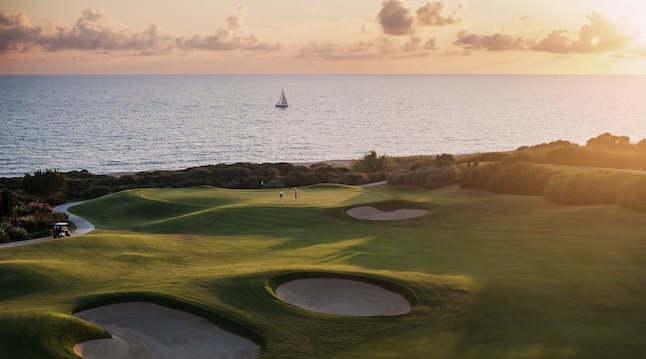
No filters needed: Sunset over the Dunes, the first of four golf courses. (Image: Courtesy)
Sustainable Luxury on European Soil
Beyond leisure and luxury, the developers have invested heavily in long-term infrastructure: roads, water networks, wetlands conservation, and integration with nearby communities.
All of this – the sheer dimensions, the fusion of sport, hospitality, and ecology, the sense of design discipline – substantiates the claim that Costa Navarino is Greece’s most audacious answer to the question of what sustainable luxury can look like on European soil.
Visit to Costa Navarino
So much for the theory. It all sounds perfectly orchestrated on paper — but what does it actually feel like? For an extended weekend, the author traveled to Costa Navarino to find out.
There are two practical ways to reach the Peloponnesian resort by air: via Kalamata International Airport, which lies just over half an hour away but has limited seasonal flights — or through Athens International Airport, offering a wider choice of connections at the cost of a long drive of more than two hours each way. The latter was chosen, a route that begins with Attica’s expressways and ends in the soft curves of Messinia’s olive hills, where the Ionian light first appears on the horizon.
Sweeping Panorama of the Ionian Sea
The arrival at The Romanos, a Luxury Collection Resort — the first of Costa Navarino’s flagship hotels, inaugurated in 2010 — carries a distinct cinematic quality. The reception sits at the heart of a terraced complex surrounded by discreetly detached villas and pavilions. From here, vast glass panes open onto a sweeping panorama of the Ionian Sea. It’s easy to imagine the scene as the courtyard of an Ancient Greek king’s palace, complete with attendants, marbled stillness, and salt-laden air drifting in from the coast.
The symbolism runs deeper than aesthetics. The resort’s logo, a stylized letter from the ancient Linear B alphabet, alludes to the Mycenaean scripts discovered in nearby Pylos — the palace of King Nestor, one of Homer’s wise counselors. It’s an early clue to Costa Navarino’s ambition: to merge classical heritage and contemporary design into one seamless experience of place.
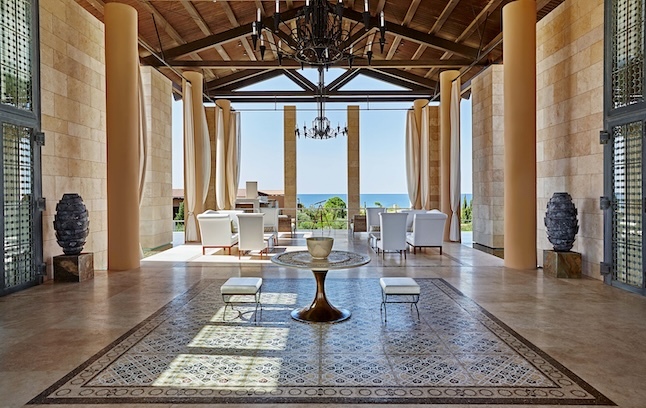
A hint of King Nestor: Reception at The Romanos. (Image: Courtesy)
The Romanos: A Hotel that Echoes the Landscape
The guest rooms at The Romanos follow the same principle of restrained refinement. Natural stone and wood are present throughout — in flooring, wall cladding, or wood detailing — creating a warm, tactile ambience. Sliding doors lead to terraces with infinity pools that seem to merge with the Ionian horizon. Inside, soft light washes over marble touches, linen curtains, and neutral hues that echo the landscape.
Everything is composed to make one feel instantly at ease. There is no grand gesture, no overload of design statements — only a balanced sense of calm, as if the architecture had already anticipated the traveler’s pulse and adjusted it to the slower rhythm of the Peloponnese.
From The Westin to The Mandarin Oriental
Next door, The Westin Resort Costa Navarino shares much of the same infrastructure — from the Anazoe Spa to the sports facilities, shops and many of the restaurants — yet it projects a different tone. While The Romanos leans toward discreet elegance and seclusion, The Westin carries a livelier, family-oriented spirit, with children’s programs and a touch more movement in its courtyards. Together they form a symbiotic pair: two worlds connected by design, catering to different rhythms of leisure.
Dining at Costa Navarino is not an afterthought but a world of its own. Across the resort’s vast grounds, more than twenty restaurants and bars trace a culinary map that stretches from traditional Messinian kitchens to the international stage. During the stay, only a fraction could be explored — enough, however, to reveal the resort’s philosophy carefully curated by the French Culinary Director Joris Larigaldie.
A World-Class Steakhouse
The first evening led to Flame, the steakhouse overlooking the Dunes Golf Course. With its dark wood interiors and open kitchen, it could easily hold its own in New York, Dubai, or Zurich. The meat selection is world-class, yet the dish that stood out was unmistakably Greek: Braised Lamb Leg «Trahanoto» with Metsovone cheese, smoked black eggplant purée, sheep’s yogurt and lamb jus — the restaurant’s signature plate and a true discovery. Deep, earthy, and balanced, it embodies what Costa Navarino does best: translating local tradition into fine dining without losing its roots.
Lunches gravitated toward Barbouni, the resort’s laid-back beach restaurant set directly on the sand. Built from wooden slats and open to the sea breeze, it serves the kind of generous Greek food that invites conversation — platters of fresh fish, grilled vegetables, and bright salads meant to be shared across the table, as is custom in Greece. The mood is barefoot, the flavors precise, the soundscape pure Ionian rhythm.
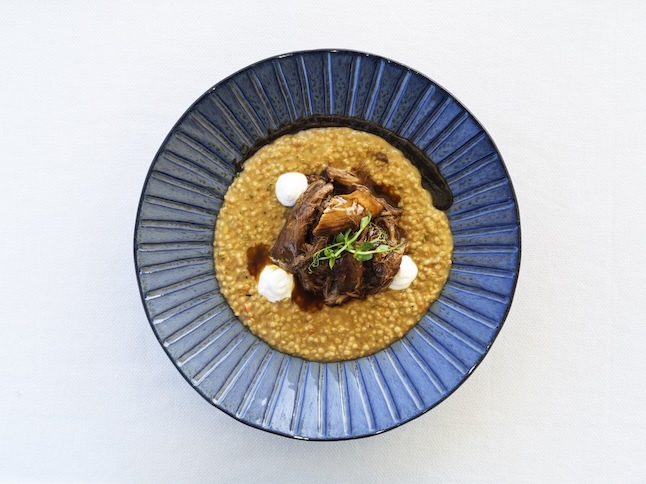
Braised Lamb Leg «Trahanoto» at Flame Restaurant. (Image: Courtesy)
Mediterranean Polish at The Mandarin Oriental
One lunch at the Brasserie de la Bay in the Mandarin Oriental, Costa Navarino added another register to the culinary spectrum. Here, Mediterranean sensibility meets Italian polish: handmade pizza and seafood dishes that mirror the horizon outside. The atmosphere is slightly more formal yet still infused with the relaxed confidence that defines the entire destination.
And then there are the mornings. The breakfast at Costa Navarino is an opulent tableau of freshly baked pastries, local fruits, honey and yogurt, cold cuts, warm dishes...
The Captain's Vision
It is intellectually impossible to be at Costa Navarino without wondering who made all this happen. The scale, precision, and serenity of the project suggest someone with the vision, the skills, and the capital to turn an improbable idea into reality. That person was Captain Vassilis Constantakopoulos (1935-2011), a man whose story could easily have been written by a Greek novelist: seafarer, shipping entrepreneur, nature lover, and patriot in equal measure.
Born in Messinia, Constantakopoulos spent decades at sea before founding Costamare Shipping in the 1970s and building it into one of the world’s largest container-ship companies, listed today on the New York Stock Exchange. Wealth, for him, was never an end in itself but a means to bring prosperity back to his home region — a corner of Greece then known more for its olive oil than for tourism. His idea was audacious: to create a destination of global caliber without violating the landscape that had shaped him.
A Plethora of New Projects
In the late 1990s, when Greece’s tourism was still synonymous with mass-market islands, he began buying parcels of land around Pylos — over 1,000 hectares in total — with a vision that seemed almost utopian. He wanted to prove that luxury could thrive in a socially and ecologically embedded way, and that a large-scale development could protect nature rather than exploit it. During construction, every single olive tree that had to be removed was replanted — some of them thousands of years old.
Out of that conviction grew TEMES, the development company that still carries his imprint today, now run by his sons Achilles, Konstantinos, and Christos. And, according to our hosts, there are plenty of fresh ideas and projects either on the drawing board or already being realized.
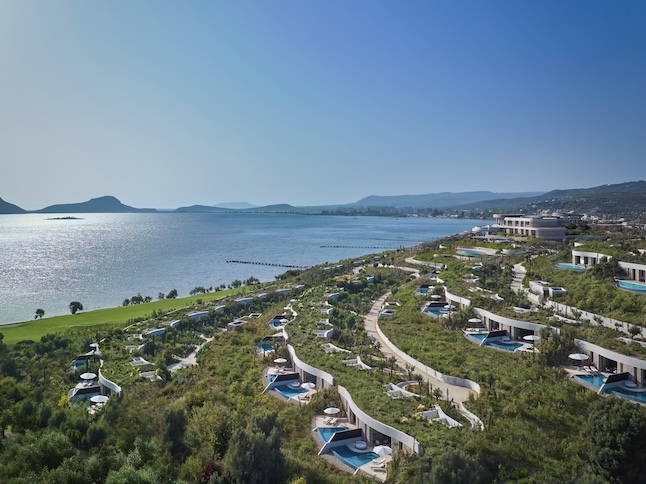
Anchored in Messinia’s landscape: the new Mandarin Oriental at Costa Navarino. (Image: Courtesy)
Energizing Real Estate Developments
The family's philosophy has also resonated in the real estate developments that accompanied the resort’s expansion and helped finance it. New villas and greenfield parcels within the Navarino Dunes and Navarino Bay zones have consistently sold out within months, appealing to international buyers seeking both lifestyle and legacy.
Among them are several Swiss clients from the worlds of business and sports, drawn by the region’s discretion, its year-round climate, the abundance in golfing and tennis offerings, and the rare combination of Mediterranean ease and— as finews.com's visit easily confirms — Swiss-level reliability.
Patience, Vision, Restraint
Leaving Costa Navarino by car toward Athens Airport, one thought becomes hard to ignore. If the great resorts along the French, Italian, and Spanish Rivieras had waited just a few decades — and followed the Costa Navarino approach instead of building wall to wall — Mediterranean tourism might look very different today. Here, Greece has shown what coastal development can be when guided by patience, vision, and restraint.
Costa Navarino is not only a rapidly evolving touristic gem — though it truly is — but also an outstanding case study in real estate entrepreneurship.
The fact that the resort opened its doors at the height of the Euro crisis, when Greece was struggling for its economic survival, makes its success all the more remarkable. Against that backdrop, the project’s quiet prosperity feels almost subversive: proof that long-term thinking can prevail even in short-term times.
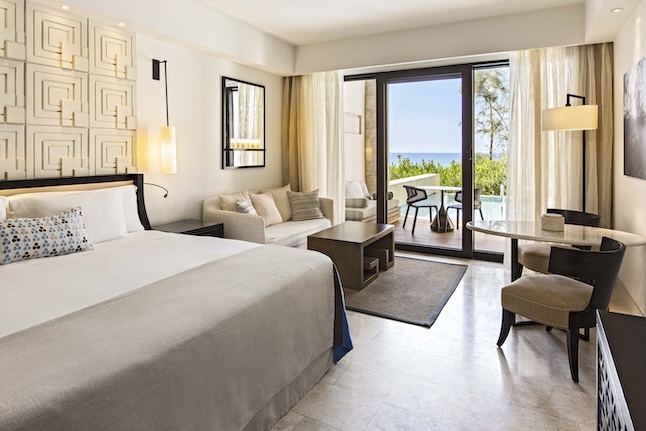
Private infinity pool at The Romanos. (Image: Courtesy)
Greece, Newly Understood
For the author’s part, the visit to Costa Navarino — one he would gladly repeat — has reconciled and corrected his image of Greece. What once seemed a chaotic blend of myths, crises, and clichés now appears as something far more coherent: a country capable of reinterpreting its heritage with precision, beauty, and confidence.
On the road back to Athens, olive groves and sea alternate in the rearview mirror, and the idea of Greece — old, new, and newly understood — travels along.