
Summer Greetings From Greece’s Best-Kept Secret
Written by Jeroen Van Oerle, Portfolio Manager, Social Systems Change & Global Fintech at Lombard Odier
I went to Greece for the summer holidays. After taking the plane from Amsterdam to Athens, I took an overnight boat to get to the beautiful island of Amorgos. Not many tourists visit the island – compared to some other islands. There is no airport and no cruise ships, as the locals don’t like mass tourism, but on the other hand are very dependent on this income source since the only other resource is goat.

Jeroen Van Oerle from Lombard Odier. (Image: provided)
It is a fine balance to strike. Some islands, like Santorini and Mykonos, have clearly chosen economics over tranquility, but others are trying to find a better balance.
Connected – Far From Mass Tourism
When I arrived at the island, I felt the much-needed piece and quiet almost immediately. Usually, that means going off grid. But that was not the case here, as connectivity was still good and it became a deliberate choice to leave the phone at the holiday home.
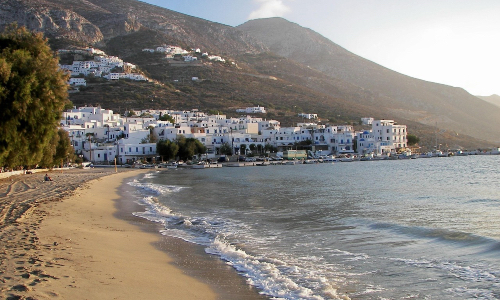
Eine Insel, die zum Baden einlädt: Amorgos. (Bild: Pixabay)
But connectivity is not just phones, it is also payments. Despite visiting a reasonably remote island, I had no problem paying by card. Greece has undergone a massive transformation in financial inclusion over the last decade. After the 2009 debt crisis, Greece underwent extensive economic reforms. As part of those reforms, digital payment initiatives were stimulated. Card usage surged from under 10% of transactions in 2014 to over 60% by 2024, especially after the 2015 capital controls.
The interesting thing about financial inclusion in a digital format is: once the first connection is made, a lot of innovation can happen on the back of that infrastructure. This implies that, besides card payments, it is also possible to make mobile and instant payments. Even buy-now-pay-later (BNPL) is more widely adopted by merchants.
Point-of-sale terminals – the devices customers use to pay in shops – also function as a bridge to cross-sales, as payment data leads to better underwriting when merchants are in need of (short term) credit. Point-of-sale terminals are no longer just cash register systems.
They also collect important payment data – information about how much a business earns, how often customers shop, whether there are regular sales, and so on. Whereas in the past, it used to be difficult to get credit – and it is still not optimal today as about 1/3rd of SMEs in Europe don’t find the access they need – digital payment data allows for better and faster credit applications because the credit providers can see and verify that data better and underwrite the risk more precisely. Greece merchants are now above average users of digital payments, coming from a position in the bottom quartile a decade ago.
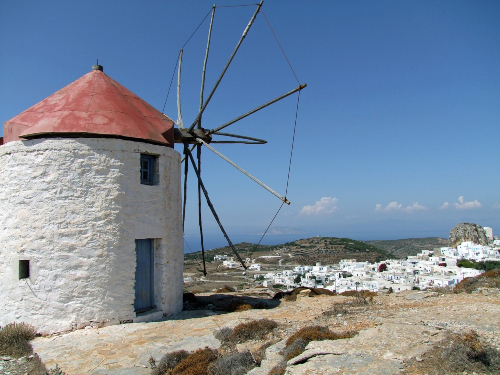
They define the landscape: the traditional windmills. (Image: Pixabay)
At the same time, there is also a big plus from a consumer perspective, as it becomes easier to pay, tourists tend to spend more. I would like to be classified as a rationale investor, but I was accompanied on my trip by my lovely girlfriend and, as we all know, some decisions can be irrational at times. The fact that a hand-crafted piece of jewelry could be paid for by credit card, instead of cash – which I don’t carry around in such amounts –, might have been the final push to give in to the need to show my affection through a long-lasting purchase that went around the arm of my girlfriend. Tourists are not the only ones who like the new payment methodology though. Surveys indicate that over 70% of Greek consumers now trust and prefer digital payments over cash.
Technology as a Driver of Inclusion and Growth
Accessibility will play a vital role in the social transition. We at Lombard Odier Investment Managers have been investing in FinTech for many years – in companies that offer cost-efficient solutions, which is key for more financial inclusion. It is also part of our broader social thesis, which includes accessibility as a major driver. My visit to Amorgos was, once again, a confirmation that the digital finance revolution is in full swing and that even a remote island can now reap the benefits.