
Investment Properties Regain Popularity
According to the real estate consulting firm IAZI, current geopolitical uncertainty is driving demand in the Swiss property market. Prices for investment properties rose again in the second quarter of 2025.
Willingness to pay for residential property also increased during the second quarter of 2025, the firm reports in its latest market study based on transaction prices.
According to the IAZI Investment Real Estate Price Index, prices for multi-family houses rose by 0,7 percent over the course of Q2 2025. The previous two quarters had shown slight price corrections, resulting in a moderate year-on-year price increase of 1,5 percent.
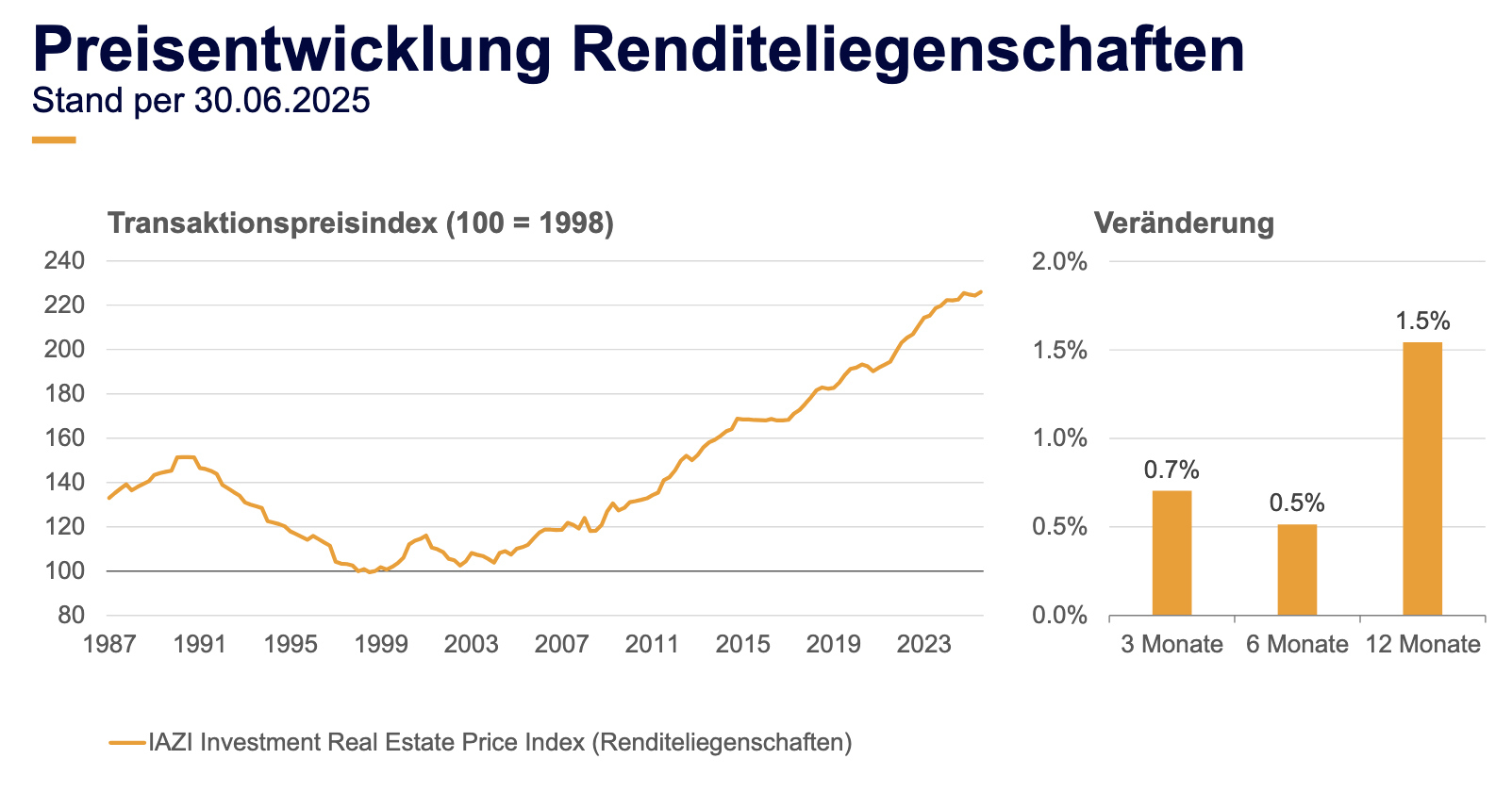
The index measures price developments of residential and mixed-use properties acquired for investment purposes. It considers real estate transfers financed through bank mortgages.
Market sentiment appears to have shifted again with the recent uptick.
Owner-Occupied Property More Expensive Year Over Year
Prices for owner-occupied residential properties — including condominiums and single-family homes — rose by ,.9 percent in Q2 and by 2,5 percent compared to the previous year. This is close to the long-term average growth rate of around 3 percent.
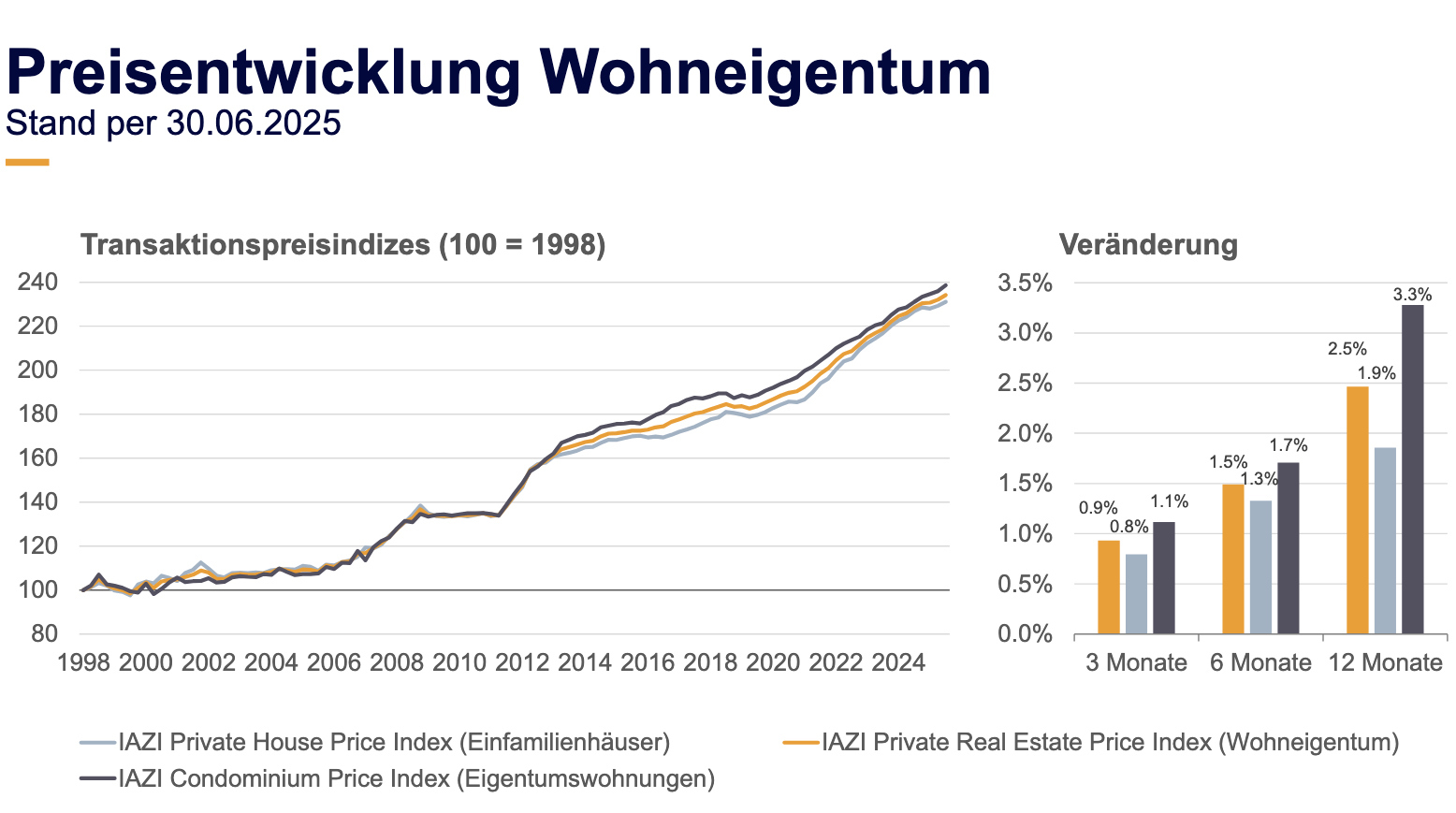
Condominiums saw a stronger quarterly increase of +1,1 percent, while prices for single-family homes rose by 0,8 percent. Year-on-year, the increases were 3,3 percent and 1,9 percent, respectively.
Whether for personal use or investment, heightened geopolitical and economic uncertainty is impacting all segments of the real estate market by fueling demand, according to the IAZI experts. This is likely to further drive up prices in the coming months.
Due to its stable economic and political environment, Switzerland is once again viewed as a safe haven by investors — prompting many to hold francs, which in turn strengthens the currency against the euro and the dollar.
How This Differs from the Previous Low-Interest Phase
The Swiss National Bank’s (SNB) recent rate cut to zero percent has also caused mortgage rates to fall. «Money is now almost free again,» commented Donato Scognamiglio, Chairman of IAZI’s Board. However, unlike the previous low- or negative-interest-rate phase, less capital is available overall — evident in the SNB’s significantly reduced balance sheet.
Banks and mortgage lenders must now raise funds through deposits or refinancing. Institutional investors such as pension funds and insurance companies — those with sufficient capital — are resuming large-scale investments. In contrast, private households are facing greater challenges in financing purchases or construction projects. Stricter requirements, such as those from Basel III, are also having an impact.
With each step toward monetary easing, the relative attractiveness of real estate increases from an investor’s perspective. Unlike other asset classes, real estate yields remain stable over the long term, as they are primarily driven by rental income. At the same time, yields on 10-year government bonds have fallen significantly in recent months, while financing conditions are becoming more favorable due to lower interest rates.
Risk of Overheating Could Rise
Additional supporting factors include Switzerland’s robust economy, a positive employment trend, and continued high net immigration. These not only fuel demand for rental housing and owner-occupied homes, but also generate positive knock-on effects for office and commercial real estate.
IAZI concludes that the combination of uncertainty, low interest rates, high immigration, and sluggish construction activity is likely to shape the Swiss property market for the foreseeable future.
«The risk of price overheating is increasing, and government or regulatory intervention is becoming more likely.»