A Swiss Private Bank Fights Its Way Back
These days, Lionel Aeschlimann is in his element. The trained lawyer, who switched to private banking over 15 years ago, is, at heart, a man obsessed with art. That is his true passion – a fact that becomes apparent time and again when one encounters him in the art world. Such a moment presented itself last Friday: the major retrospective of the German artist Wolfgang Tillmans opened at the Centre Pompidou in Paris.
The exhibition is unique in several respects. It not only offers an overview of 15 years of Tillmans’ artistic output but is also the last major show before the Centre Pompidou – the world’s second-largest art museum after New York’s MoMA – closes for five years in September. The iconic building from the 1970s is set to undergo a comprehensive renovation.
Art in a State of Emergency
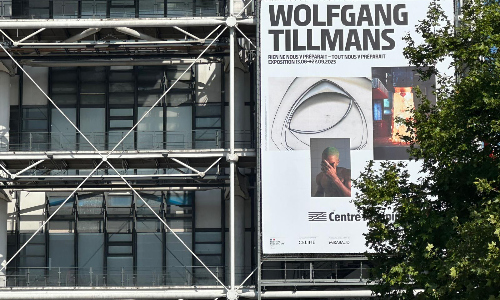
Last exhibition before the closure. (Image: finews.ch)
The nighttime transport of thousands of artworks to undisclosed locations has already begun – for security reasons. Some pieces will be shown in the Louvre or the Grand Palais in the future. The Tillmans retrospective, however, takes place in a space not typically used for exhibitions: the Centre Pompidou’s Bibliothèque d’information. This unusual setting lends the exhibition a distinctive flair. Here, the 56-year-old artist’s photographs, photocopies, and prints are particularly striking. But what does all of this have to do with Lionel Aeschlimann and a traditional Geneva-based private bank?
The answer: Since 2022, the Mirabaud private banking group has been one of the Centre Pompidou’s most significant partners. Despite the upcoming closure, it extended its partnership for another three years just last week. Behind this commitment is none other than Aeschlimann himself – the driving force behind the bank’s impressive contemporary art collection. For him, this engagement is both a statement and an obligation: «Contemporary art plays an essential role in our society,» he explains. «It challenges us to reassess the world and to question ourselves.»
Change with Symbolic Power
These words hit the mark, especially when they come from Aeschlimann. Since the beginning of the year, he has been «Senior Partner» at Mirabaud – the primus inter pares of a house founded in 1819, now in its seventh generation. Ironically, the bank is perhaps facing the greatest challenge in its history during this phase.
In September 2024, it became public knowledge what the Swiss Financial Market Supervisory Authority Finma had already determined: that for years, Mirabaud had neither an adequate organizational structure nor sufficient risk management – especially with regard to sensitive client relationships, as reported by finews.com. Finma identified violations of key regulations regarding governance, risk management, and anti-money laundering measures.
Far-Reaching Consequences
The bank’s undoing was a long-standing business relationship with an American family – specifically with a now-deceased member. Proceedings against Mirabaud were opened in 2021 and concluded as early as June 2023. Due to legal wrangling, the public only found out more than a year later.
The result: Finma imposed a range of measures, most of which have now been implemented. Nevertheless, the public disclosure caused significant reputational damage. Since then, the bank has been under special supervision. Observers expect Finma to decide in the third quarter of 2025 whether all conditions have been met.
Strategic Renewal at the Top
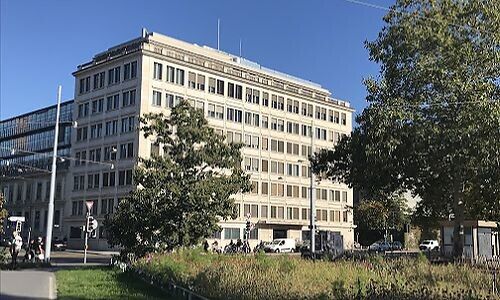
Headquarters of the Mirabaud Group in Geneva. (Image: finews.ch)
One of the central directives: Mirabaud’s corporate governance had to be fundamentally overhauled, both organizationally and in terms of personnel. According to a company statement from late 2024, this has been completed. Whether the leadership change at the group’s top – with Aeschlimann succeeding Yves Mirabaud – was part of this restructuring is something the institution does not clarify. Instead, it emphasizes that the leadership transition was long-term and strategically planned. Yet, the timing of the change in relation to the Finma announcement remains noteworthy.
In Aeschlimann, the bank certainly has a strong personality at its helm. The Biel native embodies a modern, approachable banquier – far removed from the often elitist aura of Geneva’s financial aristocracy. As a lawyer, he has a knack for filtering out the essentials amid the noise of the present – and doing so with refreshing directness. His passion for the intersection of money, intellect, and art never feels forced or preachy. One believes him when he says: «Our goal is to guide our clients through an increasingly complex world – and to help ensure that the financial sector enables a fairer society.»
Asset Management and Entrepreneurship
Before taking overall responsibility, Aeschlimann led the Asset Management division. Under his leadership, the bank built a diversified product portfolio and established a strong presence in private market investments – a segment highly popular with wealthy investors. Now, that success is to be extended to other areas as well.
One focus is on the French market, one of Mirabaud’s most important international locations. There, under the name Mirabaud Advisors, the bank aims to expand its business with entrepreneurs. Marc Sabaté, an experienced entrepreneur and consultant, has been brought on board to contribute his network in the French SME scene.
Cautious Approach
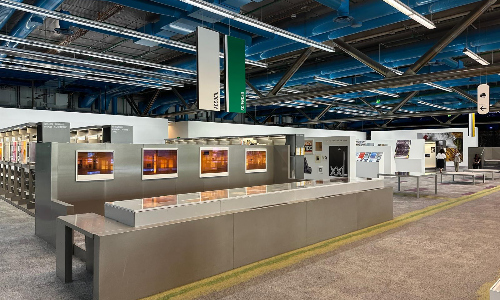
Wolfgang Tillmans retrospective in Paris. (Image: finews.ch)
The digitalization of wealth management is also moving to the forefront – artificial intelligence is currently being integrated into the bank’s IT tools, according to Aeschlimann. However, Mirabaud remains faithful to its cautious approach: it has never been among those who blindly follow every trend. Instead, it follows a strategy of small, deliberate steps, focusing on Europe, Dubai, and select countries in Latin America.
Mirabaud’s engagement with art can be interpreted as a key expression of these ambitions – or, as Aeschlimann puts it: «Art forces us to look beyond the obvious and explore new perspectives.»