
One Last Trace of the Faded Credit Suisse on the Capital Market
On Tuesday, Zürcher Kantonalbank (ZKB) published the «2025 repayment calendar» for Swiss franc bonds. Admittedly, the title of the publication does not sound particularly exciting, and yet it is almost a must-read for anyone who wants to have their say on issues relating to the Swiss capital market and the financing of Swiss companies.
The study, which is available to ZKB clients, contains an overview of new issues in 2024, highlights the longer-term development of the outstanding nominal value of all bonds and includes a list of all bonds due for repayment in 2025, broken down by month. A distinction is made between the domestic and foreign debtor segments.
A High-Issue Year
In terms of issue volume, 2024 is a strong year. The two previous years, which were already pleasing, were surpassed. Bonds with a nominal value of 74.6 billion Swiss francs had been issued by the end of November. It is striking that the domestic segment has developed particularly dynamically. In the first eleven months, bonds with a nominal value of 54 billion francs were issued.
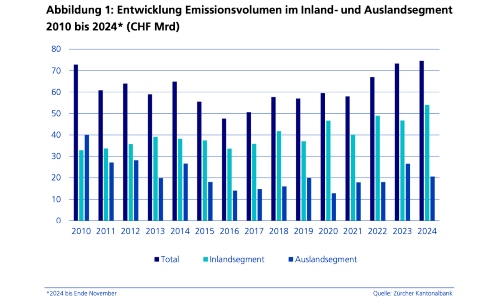
According to the ZKB, the increase is mainly due to the corporate sector. Swiss companies raised 16.5 billion francs via the bond market, 40 percent more than in the previous year.
Swiss Companies Are Increasingly Using the Market
Does this indicate a trend where larger Swiss corporates are increasingly turning to the bond market for refinancing, following the loss of Credit Suisse (CS) in the corporate client business? The «repayment calendar» offers no clear answer to this intriguing question.
Instead, it highlights that a different dynamic is at play in the foreign segment. After a strong 26.6 billion francs was issued in 2023, only 20.6 billion francs was registered by the end of November 2024. This means that only 28 percent of the issue volume was attributable to foreign borrowers, compared to 55 percent in 2010, which was more than half.
Dwindling Importance of the Foreign Segment
ZKB attributes the declining importance of the foreign segment in recent years to the fact that a number of foreign banks gave up business areas in Switzerland after the financial crisis, which is not a good sign for the financial center, and other financial service providers significantly reduced their involvement in the local mortgage market. In addition, the Swiss franc has appreciated and the cost of currency hedging (swaps) has risen, making the market less attractive for foreign borrowers who use the Swiss franc market opportunistically.
The dampener in 2024 is attributed to the fact that credit spreads on the Swiss capital market have widened «also due to the high issue volume in the corporate sector», in contrast to developments on the international markets.
Is CS Exerting a «posthumous» Influence on the Market?
It would be a historical irony if the departure of CS, traditionally the leading manager in both the domestic and international segments, resulted in more Swiss companies entering th bond market while simultaneously deterring foreign investors.
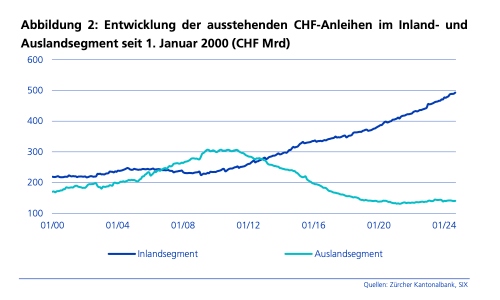
The total outstanding bond stock - the change corresponds to the difference between new issues and repayments - has risen by 3.2 percent in the last twelve months to 633 billion francs at the end of November. Here, too, there is a gap between the domestic and foreign segments. The former increased by 5.2 percent and reached 495 billion francs, while the latter shrank by 3.4 percent to 138 billion francs.
Domestic Top 3 Borrowers with a Lot of Weight
The Pfandbriefbank, Pfandbriefzentrale and the Swiss Confederation continue to dominate the domestic segment. They all account for over 80 billion francs each. The concentration of foreign borrowers is lower. The top 3 only account for between 3 billion francs and 4.5 billion francs each.
In 2025, 38.1 billion francs will fall due in the domestic segment, 200 million francs more than in 2024. At 21.7 billion francs, foreign borrowers will also repay slightly more (100 million francs) than in the previous year.
Refinancing of Repayments – Good Prospects fo 2025
ZKB assumes that Swiss borrowers will refinance a large proportion of their 132 maturing bonds on the Swiss capital market.
This is a promising forecast for 2025 for the banks that are active in the Swiss franc bond issuing business as syndicate members or even as leaders - and which include the Zurich State Bank itself.