
Switzerland’s Lead in Wealth Management Now Slim
On a positive note, Switzerland remains—and will continue to be—the leading destination for wealth management. According to the new study by Deloitte, which was presented on Wednesday, no other country is still attracting more money from international private customers. On closer inspection, however, dark clouds can be seen.
For the fifth time, Deloitte has analysed and ranked the world's leading wealth management centres, focusing on competitiveness and size, exclusively in the offshore sector. The study was last conducted in 2021.
Only a Razor-Thin Lead
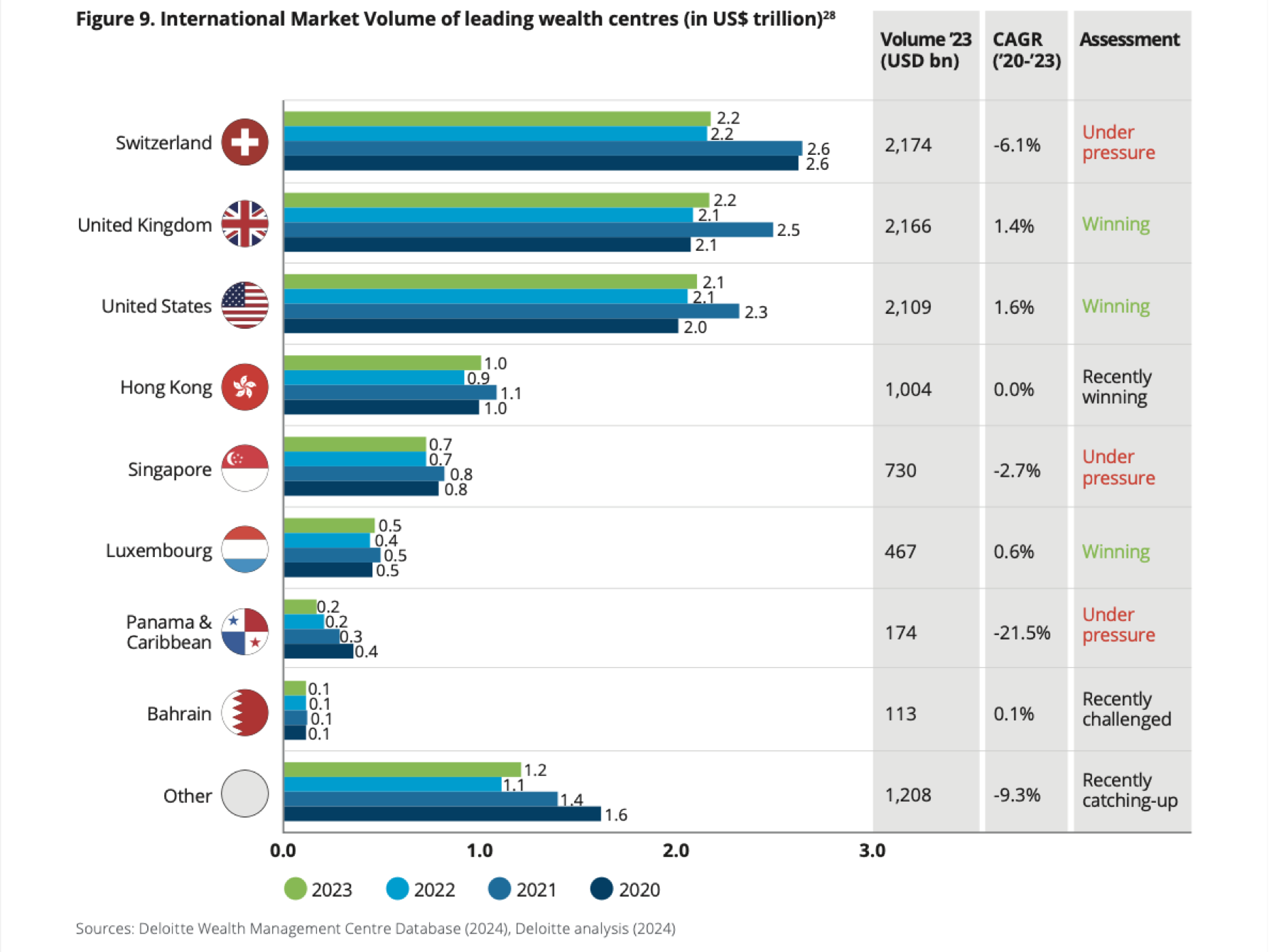
Switzerland ranks highest in both categories, maintaining its position as the global leader. With foreign assets amounting to $2.2 trillion, Switzerland remains the largest booking center.
However, Switzerland can only just hold its own in first place: the United Kingdom follows in second place with a gap of only 8 billion dollars. The USA is in third place.
Click to zoom in
Global assets under management totaled $10.1 trillion in 2023 – 2.9 percent more than in the previous year. However, the international market volume has been relatively stable since 2018. What has changed, however, is the distribution: while just under 24 percent of these assets were managed in Switzerland four years ago, it was around 21 percent in 2023. Panama and the Caribbean have lost the most market share during that period, while the United Kingdom and the USA have gained the most. Both now also manage around 21 percent each.
There are various reasons for this development. These are the main ones:
1. Growth is mainly taking place in Asia
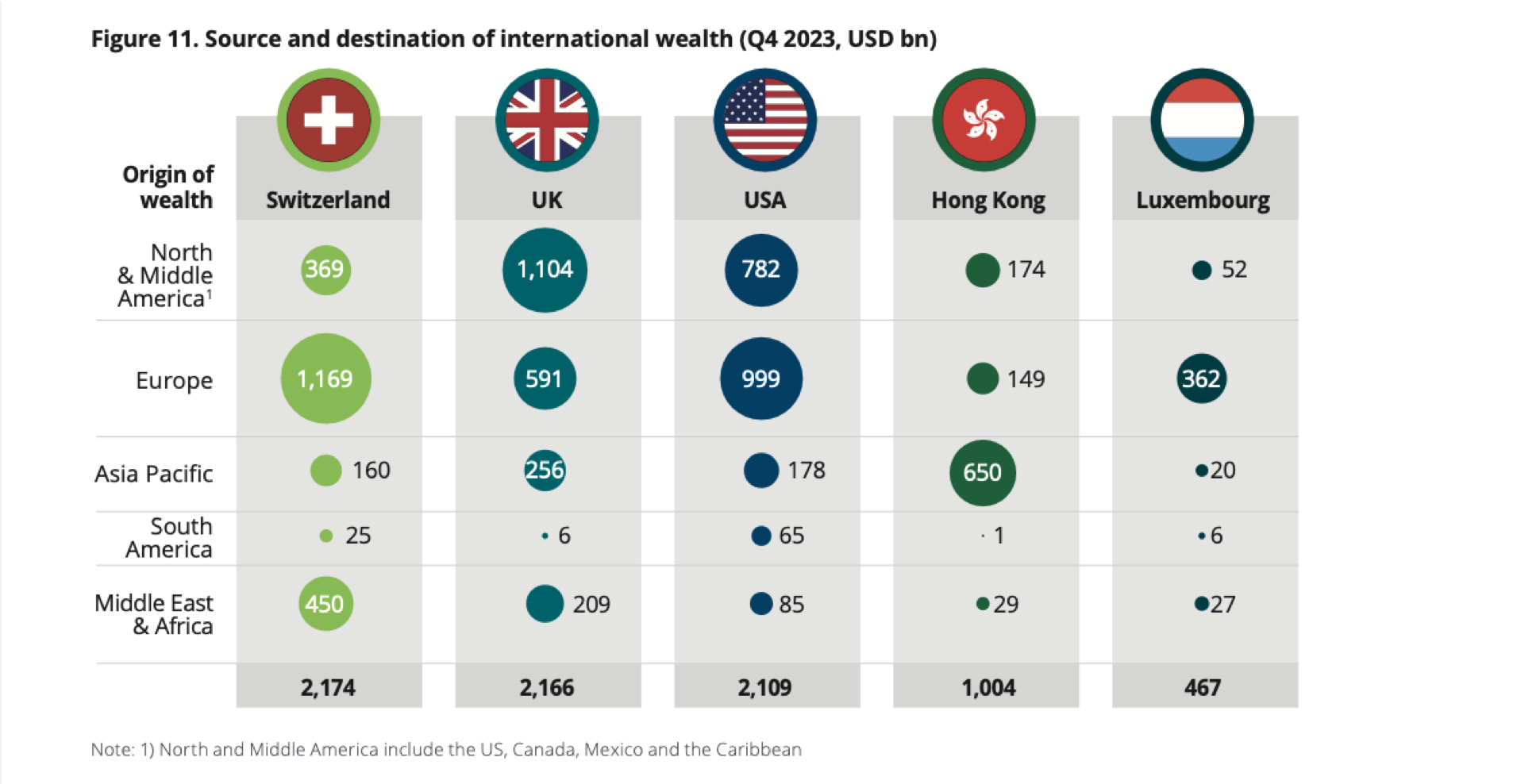
When it comes to asset investment, Switzerland is the leading and preferred place to invest, especially for clients from Europe and the Middle East. The greatest international growth, however, is currently being recorded in Asia.
Click to zoom in
2. Competition has caught up
The competition does not sleep: Hong Kong has recovered after the political turmoil of recent years, and Singapore is also making further progress. But most of the time, Great Britain and the USA are breathing down Switzerland's neck. Despite Brexit, the UK has remained an important banking centre, benefiting from its cluster. However, competitiveness is likely to be a challenge for the UK in the future.
The US, on the other hand, has been able to make up so much ground mainly thanks to the high quality of its asset managers, its leading position in artificial intelligence and its strong capital market.
3. Switzerland is feeling the consequences of the CS crisis
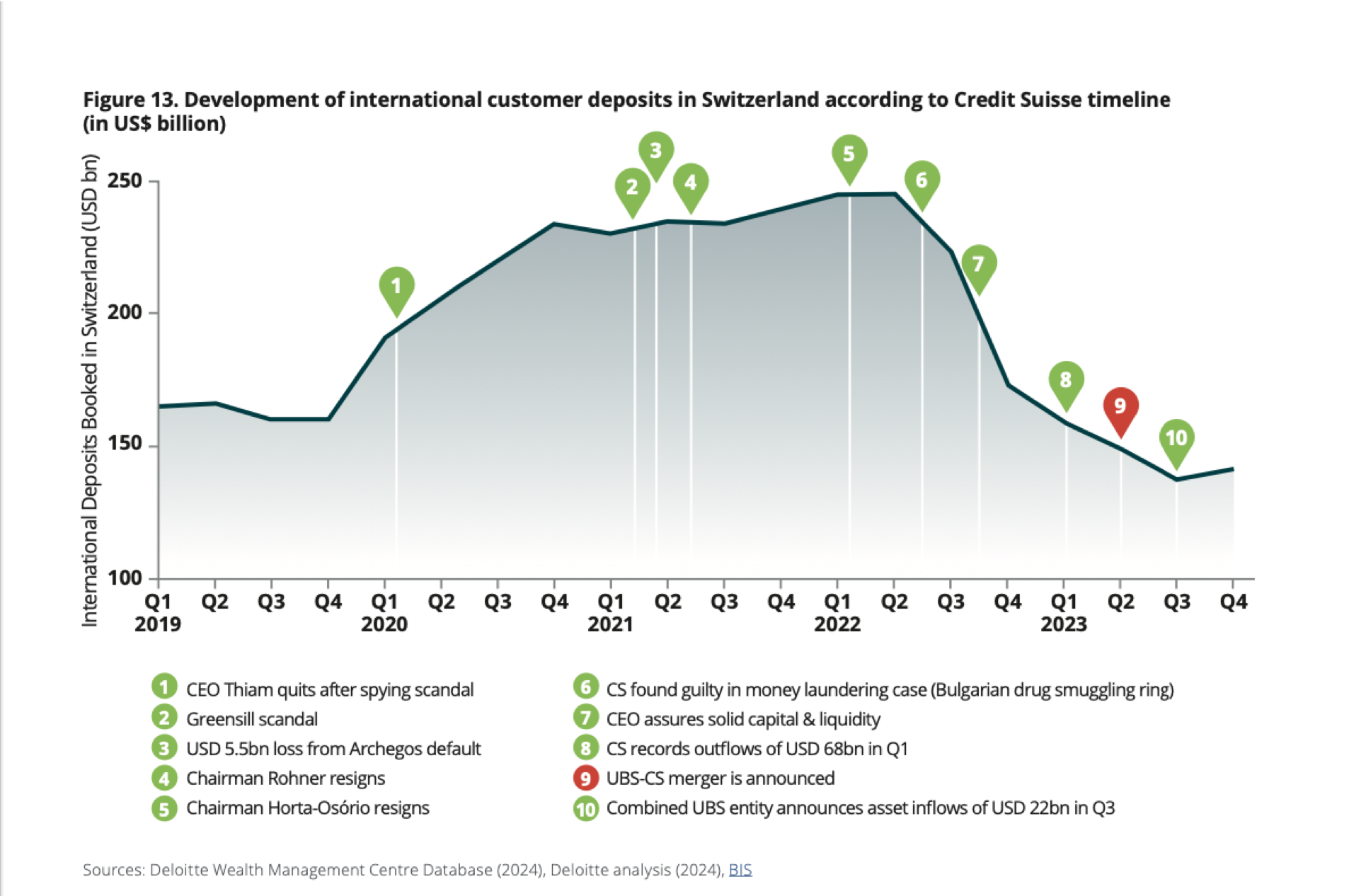
The impact of the decline of Credit Suisse (CS) on the financial center is the subject of intense debate. In its study, Deloitte concludes that the stability of Switzerland's economic and banking markets has suffered greatly as a result. In cash deposits alone, the outflow was around $100 billion. The financial centre has not yet recovered from this shock.
Click to zoom in
At the same time, Switzerland's reputation has suffered – not only due to CS crisis. The study's authors note that key advantages such as low taxes, political and economic stability, legal certainty, and neutrality have diminished in importance over recent years.
Notably, Switzerland’s neutrality has taken a hit after supporting international sanctions against Russia. In the past, Switzerland has taken a more pragmatic approach to the adoption of sanctions.
4. Overregulation restricts competitiveness
«To maintain its competitive advantage, Switzerland must adapt its international strategies and work towards further regulatory improvements, a reduction in administrative burdens and an acceleration of the pace of innovation,» says Patrik Spiller from Deloitte.
According to Jean-François Lagassé from Deloitte, it is particularly important to keep a sense of proportion when it comes to regulation: «Switzerland must focus on developing its regulatory framework in such a way that financial stability is guaranteed, but growth remains possible in order to restore confidence after the end of Credit Suisse,» he says. «Swiss asset managers need to invest in digital transformation and optimize their operational efficiency in order to defend their leading position in the global market in the long term,» he adds.