
Banking Showdown: Globalance and Helvetische Bank, 13 Years On
Among the family of companies dotting Zurich’s banking landscape, Globalance and Helvetische Bank stand out as the «teenagers.» These two were the first Swiss private banks to be established in Zurich after the 2007–2009 financial crisis.
Both bank launches were spearheaded by notable figures.
Globalance was driven by CEO Reto Ringger, who founded sustainable asset manager SAM in 1995, later selling it to Robeco in 2008. The board of directors is chaired by Swiss corporate lawyer Felix R. Ehrat who previously served on to boards of directors at Julius Bär and Banca del Gottardo (today: EFG).
Helvetische Bank, meanwhile, emerged under the initiative of the bank's president Thomas Matter, a Swiss People’s Party (SVP) parliamentarian and former CEO of Swissfirst, and Daniel Hefti who has been serving as CEO ever since.
Notably, Marcel Rohner, former CEO of UBS and current president of the Swiss Bankers Association, has been involved since the outset. He sits on Helvetische Bank’s board of directors and holds a 5 percent equity stake via his investment firm, Löwenfeld Beteiligungen.
How Have The Newcomers Fared?
To assess their trajectories, finews.com analyzed the 2023 annual reports of both banks (on a consolidated level). Helvetische Bank’s report is publicly available on its website, while Globalance provided their financials upon request.
- Assets under Management: As of December 31, 2023, Globalance managed 1.974 billion francs in assets, while Helvetische Bank oversaw 2.484 billion francs.
- Equity: Equity at Globalance amounted to 47.1 million francs, accumulated through several capital increases. At Helvetische Bank, it stood at 67.8 million francs, though without any capital increases since its founding. The CET-1 ratio at Helvetische Bank was 26.7 percent; at Globalance, this figure is not reported separately.
- Balance Sheet: At year-end, Globalance’s total assets stood at 78.7 million francs, whereas Helvetische Bank’s balance sheet was nearly ten times larger, with 803.9 million francs in assets.
- Profitability: In 2023, Globalance generated operating profits of 1.1 million francs. Helvetische Bank, on the other hand, recorded 20.2 million francs in operating profits. After accounting for extraordinary income and taxes, Globalance netted 891,781 francs, while Helvetische Bank reported a significantly higher net income of 15.3 million francs.
- Revenue Breakdown: Both banks derive income from interest, commission and service fees, as well as trading activities. The breakdown is as follows:
Globalance Helvetische Bank Interest Income 655,481 16,133,397 Commission and service fees 6,879,808 12,226,866 Trading activities 5,289,334 3,896,835 Other operating income 3,190,079 -528,862 Total operating income 16,014,702 31,728,236
- Workforce: By the end of 2023, Globalance employed the equivalent of 38.8 full-time staff, with personnel expenses totaling 7.6 million francs. Helvetische Bank, with 35.1 full-time positions, recorded personnel costs of 8.7 million francs.
- Loss Carryforwards: Globalance ended 2023 with a loss carryforward of CHF 26.4 million. Helvetische Bank last reported a loss carryforward in 2016.
While Globalance and Helvetische Bank are similar in terms of assets under management and headcount, they diverge sharply in nearly every other aspect.
Distinct Business Models
These differences stem largely from their respective business models. Globalance positions itself as a niche player, catering primarily to clients seeking sustainable investment opportunities. Given this focus, it’s notable that nearly one-third of its revenue originates from trading activities, likely tied to foreign exchange commissions.
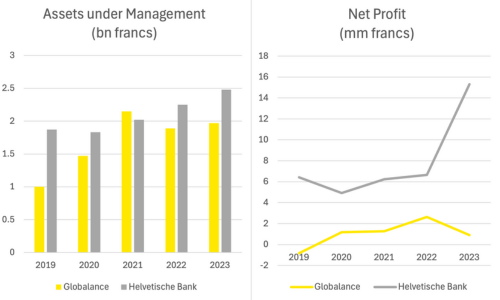
Assets under Management and net profit. (Source: Globalance, Helvetische Bank. Computation: finews.com)
By contrast, Helvetische Bank operates as a more diversified institution, offering a broad array of services—including corporate banking—to a target clientele of entrepreneurs and high-net-worth individuals. This is reflected in its substantially larger balance sheet and wider scope of activities.