
Banks Stuck in a Real Estate Dilemma
When it comes to analyzing market developments in Swiss real estate, there is no more competent authority than Wüest Partner.
It was therefore fitting that Patrick Schnorf, Partner at Wüest Partner, was tasked with setting the stage for the subsequent panel discussion on «Home Ownership in Switzerland—Current Situation and Outlook» at yesterday's Banking Industry Talk.
Great Audience Interest
The topic sparked considerable interest among an audience of representatives from retail and regional banks, whose lending activities are inherently centered around real estate.
Schnorf explained that prices for home ownership have doubled over the past twenty years. This development was driven by low interest rates and significant population growth.
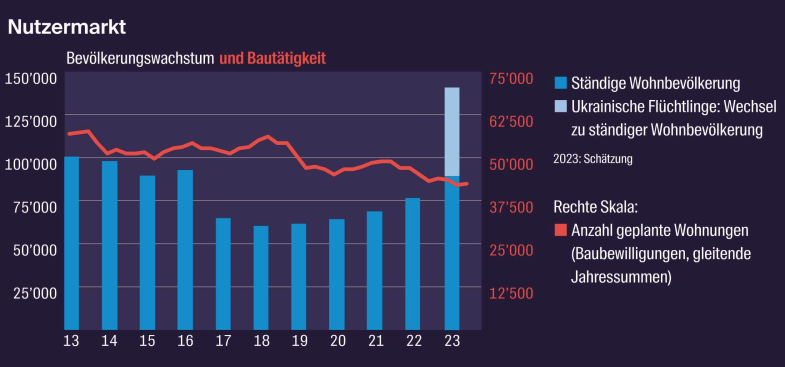
Growing Population, Declining Construction Activity
In the past ten years, Switzerland's population has grown annually by between 50,000 and 140,000 people. At the same time, however, construction activity has been on a downward trend.
(Image: Wüest Partner, zVg)
What does this mean for the mortgage market from the perspective of regional banks? This question was explored in the subsequent panel discussion, moderated by finews.ch founder Claude Baumann, featuring Schnorf along with Riku Aro, Deputy CEO of Clientis BS Bank Schaffhausen and Lukas Vogt, CEO of the mortgage platform Moneypark.
Largely Stable Overall
The panelists painted a picture of a predominantly stable macroeconomic environment over the last ten years, characterized by low interest rates and increasing demand for home ownership.
This stable environment was only disrupted twice: first by the COVID-19 crisis, which drove demand to unprecedented heights, and then by the interest rate turnaround in 2022 and 2023, which impacted market sentiment.
«The Supply Is Too Low»
«That has changed again now,» said Schaffhauser banker Aru. «We are seeing prices rise again; however, the supply of real estate is too low.» There is also an increasing number of bidding processes for sought-after properties.
According to the representative from MoneyPark, the real estate and mortgage market is on a «path to normalization», returning to conditions before the exceptional COVID boom. He also confirmed an «incredibly high demand»; on its own platform, MoneyPark is generating about twice as many leads this year compared a year ago.
Saturation Effect
Vogt observes that many banks are experiencing a certain saturation effect; they are not eager to issue new mortgages.
This point was illustrated by the representative of Clientis BS Bank Schaffhausen: the sharp increase in real estate prices puts many banks in a position where customer deposits are growing significantly slower than the mortgage volume.
The Impact of Credit Suisse's Exit
Combined with tightened equity capital regulations, this could lead to bottlenecks in lending. He is aware of larger development projects that are hardly being financed for this reason.
Baumann asked the panelists whether the disappearance of Credit Suisse has accentuated this problem. Yes, said Riku Aro. Patrick Schnorf of Wüest Partner agreed. Overall, however, the market is still well supplied.

Panel from left to right: Moderator Claude Baumann, Riku Aro (Clientis BS Bank Schaffhausen), Lukas Vogt (Moneypark) and Thomas Schnorf (Wüest Partner). (Image: Sandra Blaser/schweizeraktien.net, zVg)
Mortgages Remain a Banking Matter
The question then arose as to why non-banks in the mortgage business, particularly pension funds, are unable to secure a larger piece of the pie.
The prevailing opinion on the panel was that, especially among retail and regional banks, the long-standing personal customer relationships result in a low propensity for customers to switch providers. «I would have expected this to be quite different ten years ago,» said Patrick Schnorf.
Trend away from Single-Family Homes
However, MoneyPark CEO Lukas Vogt emphasized that the willingness to switch in the renewal business is significantly higher than when taking out a mortgage for the first time. Out of a total loan volume of 3 billion francs in the first half of the year, half of the transactions involved pension funds.
Another trend discussed was the move away from single-family homes toward condominiums. The experts primarily attribute this to the investment backlog for energy-efficient renovations associated with many single-family homes.
However, this was just a side note to the general conclusion: as long as the framework conditions in Switzerland—driven by immigration and low interest rates—remain largely unchanged, the mortgage market will continue to move at its usual pace.
The Banking Industry Talk was organized by «schweizeraktien.net». finews.ch was on-site as a media partner.