«I see art as a form of complementary medicine»
Mrs. Schmid, how did you get this role at the hospital?
About six years ago a job came up for a project head related to art and construction projects because a large new building for the cantonal hospital was nearing completion at the time. In Switzerland, it is customary for art to be integrated into construction projects of that scale.
To that end, regular competitions are held to find the best artists for such projects. I found it an exciting challenge as I saw the opportunity to raise art to the level of architecture and not have it there only as a form of decoration.
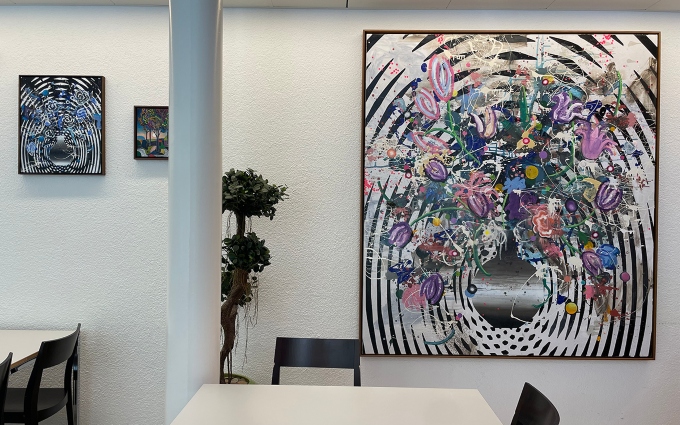
Work by Christian Achenbach (Image: KSGR)
What role do professional artists play in your projects?
When I started, I was asked if I would be prepared to run the art commission as well. I agreed but only under the condition that we would work with professional artists. In many hospitals, art is organized as a sideshow, and amateur works are often on display.
I wanted to avoid that at all costs as those kinds of projects don't have the desired impact on patients and employees. We did make one exception to that rule after COVID-19 when we put the works of our employees on display as a way of appreciating their artistic endeavors during the difficult pandemic period.
My objective was to structure professional exhibitions by which we would occasionally purchase certain works for the hospital to display in important places such as patient wards and waiting rooms.
Can you tell us more about your current exhibition «Flower Power – Healing Plants»?
It is our annual exhibition and it shows the close link between art and medicine. There are over 100 floral works in the public areas of our four hospital locations in Chur and Walenstadt. The exhibition is about more than just aesthetics and it should portray the healing power of nature by way of the beauty of the works on display - in a fashion that integrates them with hospital daily life.
We also organize monthly events such as the medicinal plant walk with an ethnobotanist and Professor em. Dr. med. Reinhard Saller, the founder of the Institute of Complementary Medicine at the University Hospital of Zurich and overall patron of our annual exhibition. Internally, our patron is Monica von Toggenburg, the departmental head of nursing staff and specialist care who is also a member of management.
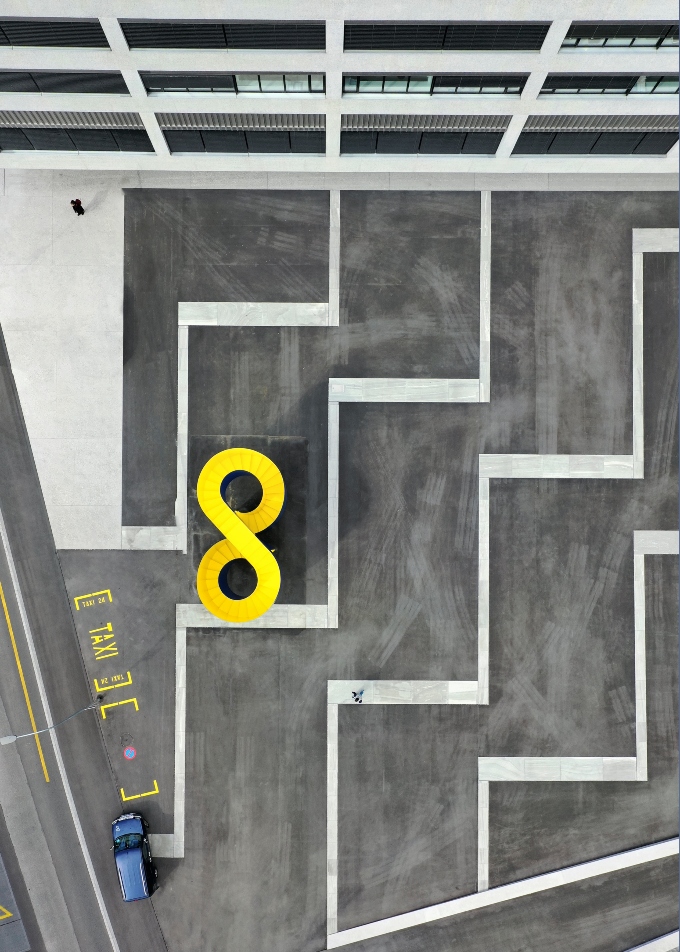
Landmark hospital entrance: Accessible sculpture «SCARCH» by Not Vital (Image: Ralph Feiner)
There are also several fixed installations at the different hospital locations. Which are particularly noteworthy?
The Graubunden Cantonal Hospital has always had a great emphasis on art and construction work and there are some important works in the different locations. I would particularly note the works by Not Vital, Zilla Leutenegger, and Christian Herdeg. Not Vital created an accessible sculpture in the form of the number eight that is supposed to reflect both philosophical and health qualities.
«For me, it is important for art in a hospital to have a long-term impact while being firmly anchored in the everyday»
Leutenegger painted a wall in the restaurant of the hospital with a traditional Engadiner Sgraffito technique that draws a connection between contemporary and traditional art. The Zurich light artist framed the inner courtyard with a calming light ellipse. All the artwork on display reflects the rooms and their use.
How are the hospital's art projects financed?
I work with a small budget that the art commission makes available. For me, it is important for art in a hospital to have a long-term impact while being firmly anchored in the everyday.
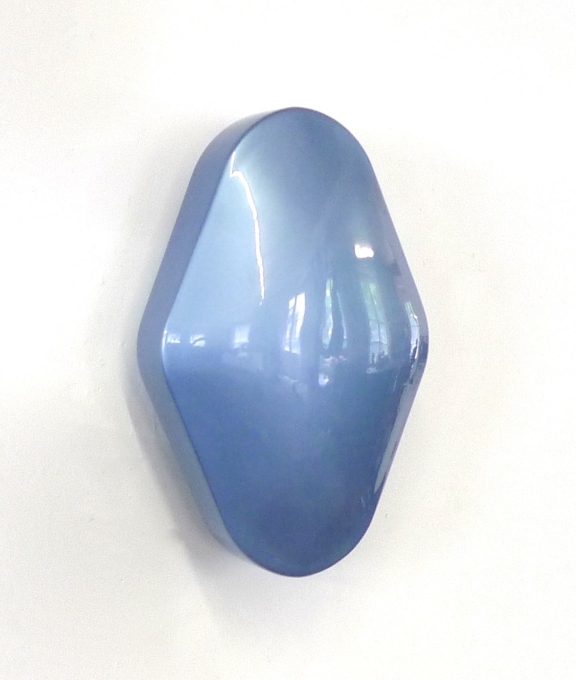
Art in «Viagraform», «ViaVia» by Hans Thomann (Image: KSGR)
Are there any notable works in the current exhibition?
Yes. Besides the floral art, there are several noteworthy, humorous, and original works. An example is the giant Viagra pill in a Porsche-related metallic hue hanging in the Urology department - a work by St. Gallen artist Hans Thomann, and something that certainly prompts a wink here or there.
«A 2019 WHO study shows that a pleasant environment promotes healing»
Just as fascinating are the potato images by Renate Bodmer in the X-ray department that show a subtle connection to medical practice. I find the forest painting by the young Graubunden artist Emanuel Heim in the cardiology department particularly touching and it should serve as a reminder to patients with heart problems how important movement is for their recovery.
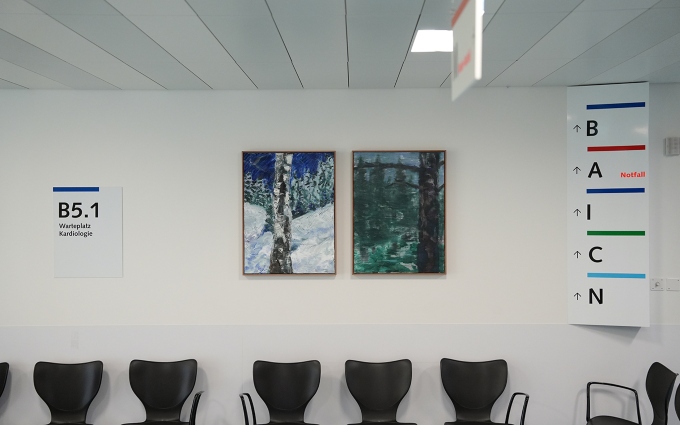
Paintings by Emanuel Heim (Image: KSGR)
How do patients react?
The reactions are very positive. Art can improve well-being and support the healing process. A 2019 WHO metastudy encompassing 3,000 studies showed that a pleasant environment promotes healing by shortening hospital stays, cutting relapse rates, and lowering the need for painkillers. Art can also play an important role by making stays more pleasant and improving the atmosphere.
What makes the current exhibition so special?
An important aspect of the «Flower Power» is that much of it is a result of loans. We have artwork on loan from several renowned collections, including the art collection of the Canton of Zurich, the Graubunden Cantonal Bank, and the museum franz gertsch in Burgdorf.
«Art doesn't only help physical healing but it also helps with emotional and psychic recovery»
The loans as well as several artists we were friendly with allowed us to present a diverse and valuable exhibition.

St. Petersburg hanging mural: floral mix of artworks (Image: KSGR)
What role does art play in the healing process of patients?
I see art as a form of complementary medicine. Art doesn't only help physical healing but it also helps with emotional and psychic recovery. Our «Flower Power» shows exactly how the healing powers of plants and art are brought together in a way that has a positive impact on patients.
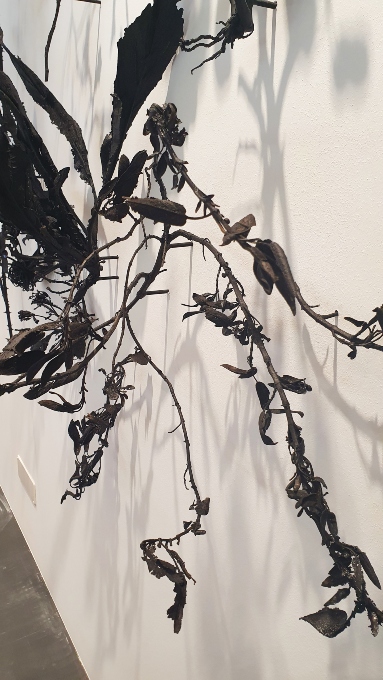
Installation by Ursula Palla, «Botanical Notes - Hortus Medicus» (Image: KSGR)
Can visitors go and see the exhibition?
Yes, the exhibition is open to everyone and not just to patients and employees. We want external visitors to have the opportunity to experience the links between medicine and art. Some of the works can even be bought - not at the hospital but from the artists directly. Those who want to visit the exhibition have the time to do so until 16 March 2025.
Friederike Schmid has been responsible for art projects at the Graubunden Cantonal Hospital since 2018. Since 2019, she has headed the hospital's art commission. She has a business background and extensive experience in art and architecture. Since 2022, she has also been the curator and member of the Fondation WhiteSpaceBlackBox in Neuchatel, where she organizes exhibitions and artist-in-residence programs. Before that, she was responsible for art and construction projects at the building department for the Canton of Zurich, as well as being active in cities like Lenzburg and Zurich.