Lionel Aeschlimann: «I Am the Committee»
Lionel Aeschlimann is far from the classic private banker. He is approachable, kind, and attentive. Even as a lawyer, he comes across as atypical, despite having started his career with a law degree and many years in the profession. In retrospect, 2010 was a pivotal year in his professional life.
That year, the now 58-year-old from Biel joined the Geneva private bank Mirabaud, where he began in asset management, became a managing partner a year later, and in 2012 took over responsibility for asset management, the division developing and distributing financial products and investment solutions. However, Aeschlimann found his true calling within the firm when he was entrusted with managing the bank's art collection.
Unleashing Passion
When his enthusiasm breaks out, he delves into descriptions, memories, and inevitably into a fervent plea for art. In these moments, he is in his element, wandering through the corridors of Mirabaud’s Geneva headquarters, where the impressive array of art on display sometimes makes one forget it is a bank.
As Aeschlimann reveals in his conversation with finews.art, Mirabaud, unlike most other financial institutions with large collections, has no formal concept for selecting or acquiring new works. It is solely Aeschlimann who makes these decisions, and he notes with a playful twinkle in his eye: «I am the committee.»
Significant Investment
And that means something, considering the collection encompasses around 450 works of various kinds. Each year, 10 to 20 new pieces are added, selected by Aeschlimann in consultation with trusted advisors, galleries, artists, and museums. He won't disclose how much the bank spends on this, but it’s evident he has full support from his partners within the bank, some of whom place far less importance on all these paintings and sculptures.
This makes it all the more crucial for mastermind Aeschlimann to substantiate this significant engagement with the bank. «Art is a process,» he explains, adding, «Artists help us think. And with their creations, they give us a glimpse of the future.»
Winston Churchill as a Role Model
That an institution like Mirabaud spends money to possess highly subjective, very expensive items needs some explaining. In this regard, Aeschlimann likes to quote British politician and wartime Prime Minister Winston Churchill, who was also a passionate painter and writer. During World War II, Churchill refused to cut cultural spending in favor of the war chest, believing that without such expenditures, cultural life – and ultimately our existence – would wither.
Aeschlimann gladly takes this mindset as his role model, ensuring the public can also enjoy Mirabaud's art commitment. When the bank celebrated its 200th anniversary in 2019, it made admission to the Museum of Modern and Contemporary Art (Mamco) in Geneva free for everyone for a year.
A few years ago, the venerable financial institution also gifted the city of Geneva the artwork «Moon» (pictured below) by Swiss artist Not Vital, which is publicly accessible in a small park near the bank's headquarters at Plaine de Plainpalais. The bank maintains a long-term partnership with the Centre Pompidou in Paris and recently entered into a collaboration with the Zurich-based Bechtler Foundation.
Beyond Switzerland
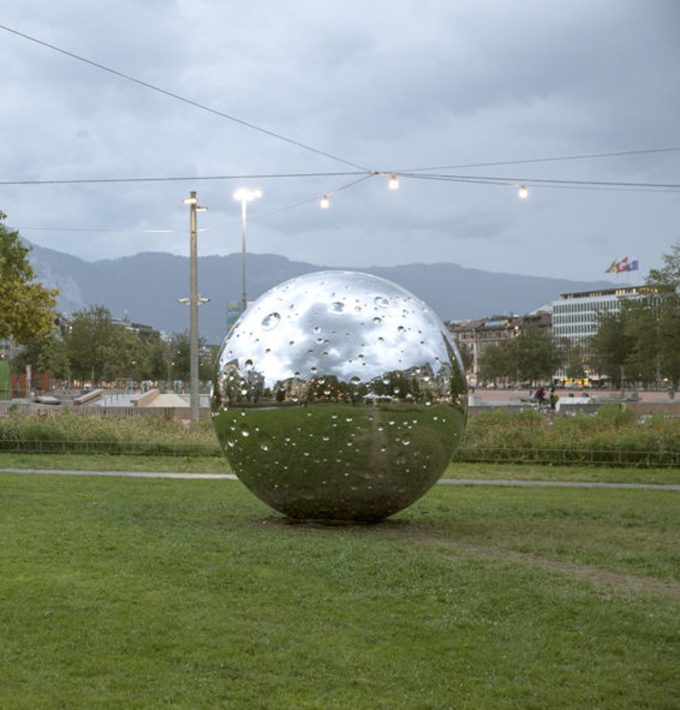
«Moon» by Swiss artist Not Vital, a gift from Mirabaud to the city of Geneva (Image: courtesy)
Mirabaud owns an impressive collection of modern art, including works by Bruce Nauman, Christian Marclay, and Marina Abramovic, as well as younger artists like Omar Ba and Antoine Roegiers. Aeschlimann focuses not only on local artists but also on works from around the world. «Switzerland has always been international; we were a country of emigrants, and many foreigners have settled here. The collection should particularly express this,» he says.
The symbiosis of near and far, familiar and foreign, is central to Aeschlimann: «Contemporary art forces us to open our eyes and see things differently. It provokes a different view of the world we live in,» he says, referring to works by Thomas Ruff, Ann Veronica Janssens, Emily Ding, Daniel Canogar, or Allan McCollum, the latter of whom embodies an ethos similar to that of the financial world.
Between Mass Production and Uniqueness
Until the 15th/16th century, art was considered interchangeable; only later did it acquire the claim of uniqueness. McCollum explores this transformation in his work, blurring the lines between single pieces and mass production with his images, vases, and other art objects.
A venture that can also be applied to banking, where the boundless universe of financial products and investment strategies ultimately must be tailored to each individual client, resulting in a unique solution.