Hublot CEO: «More Own Movements, More Own Materials»
It's one of the smaller injustices in the watch world that much revolves around Rolex and Patek Philippe. Among the other brands, Hublot, part of the LVMH group, is one of the most important challengers. Founded only in 1980, the brand has always been surrounded by an aura of avant-garde nonconformity.
This spirit was palpable when the brand presented a limited edition of 20 pieces, the «Big Bang Unico All Black Schloss Schauenstein,» earlier this week. For this occasion, Hublot CEO Ricardo Guadalupe, who has been leading the company for over ten years, came to Zurich.
On this occasion, experts from the watch industry and top gastronomy gathered at «The Nest» of the Hotel Storchen. Gratian Anda, founder of The Living Circle group, which also includes the Storchen, was among the guests.
Mr. Guadalupe, you came to Zurich in order to launch an ultra-limited special edition dedicated to star chef Andreas Caminada. In which sense is this collaboration a representation of Hublot’s «Art of Fusion?»
The Hublot «Art of Fusion» concept blends traditional craftsmanship with avant-garde materials, mirrors Andreas Caminada's culinary approach, and combines traditional ingredients with innovative techniques. Both Hublot and Caminada strive for perfection and innovation in their respective fields, and this collaboration showcases their shared dedication to creating something unique with a Swiss touch.
It also represents the fusion of haute horlogerie and culinary mastery. Just as precise timing is crucial in watchmaking, it is fundamental in gourmet cuisine, from ordering ingredients to plating dishes. This shared mentality has brought Hublot into the world of gastronomy, where it admires chefs like Caminada who skillfully fuse ingredients to create unique experiences.
Wherein lies the connection?
Andreas Caminada respects tradition, but at the same time, he tries to reinvent it. His cooking symbolizes the way we make our watches: always trying to be innovative, creative, sometimes disruptive – this is what makes us different.
What's the target market?
It is appealing to the Swiss market first and foremost. We are commemorating the 20 years of Caminada’s «Schloss Schauenstein» with exactly 20 pieces. He asked us if we can make a watch for this purpose, and I said yes. We're part of a family and Hublot is capable to create even a special limited edition of 20 watches.
Those ultra limited special editions have increased considerably at Hublot in the last few years. Is that the general strategy of yours?
Yes, but normally we have international limited editions with our big partnerships like the artists Murakami and Daniel Arsham. Since we sell watches to customers that have everything, we also do some special editions that are linked to a place like Mykonos, Capri or Madrid: it gives a high degree of exclusivity – something that almost nobody can have.
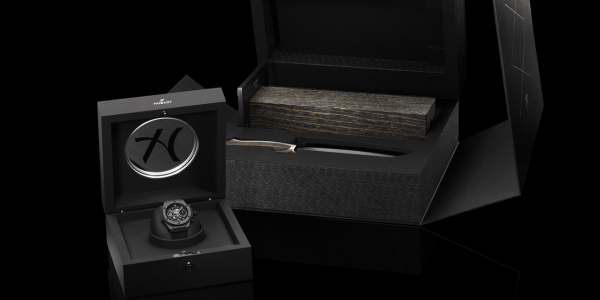
Accompanied by a custom-engraved knife: «Big Bang Unico All Black Schloss Schauenstein» by Hublot. (Image: Courtesy)
There is demand for those products by customers that have a personal relationship with that particular place. We can see that even some fashion brands have done the same, having Saint-Tropez editions, and the like. Our stand-alone boutiques are very convenient for this – we even did a Las Vegas edition, some years ago.
The overall sentiment tells us that the watch industry is going through a challenging year. We’ve seen export records in 22 and 23. Now it's getting a bit more difficult. How does this play out at Hublot?
At Hublot, we are not shielded from general trends in the watch industry. 2022 and 2023 have been years that were not normal. After COVID, we had some years of what I call revenge buying. Now we are back to normality, back to 2019 numbers, which was a very good year. So maybe it's not 2022, but still with numbers that are, I would say, acceptable.
Given that new situation: Are you still confident that enlargement of your production facilities in Nyon was the right decision, in the long-term?
It’s more about elevating the brand by verticalization: doing our own movements and materials. If you want to be compared to a very big brand of our industry, we must be at that level also in terms of production.
Let’s turn to the financial sector: The watch industry and financial services are the main Swiss export products after pharmaceuticals; they cater to the same international customers. Do you see synergies between the watch industry and the Swiss banking sector?
That's a good question. For the time being we haven’t had a meaningful partnership in that industry. Our partnership and cross-marketing is oriented towards other luxury brands. We are part of the LVMH group, so we do more with their champagne brands or leather goods brands, and with gastronomy. There are some overlaps maybe at the Polo in Gstaad, but we have never done something more ambitious in the field. Perhaps it could be a good idea.
How happy are you with the performance of your own boutique that operates in Bahnhofstrasse?
We opened half of it a few years ago. Now we doubled the space because we have been able to buy the other side. In terms of size, we now are exactly where we want to be, at around 120 square meters. That’s the right size to give an experience to our consumers. So we're happy with the location, with the size and also with the sales.
How do the figures compare to your boutique in Geneva, the capital of watchmaking?
Zurich and Geneva are comparing more or less at the same level, which is great for Zurich. I didn't think they could do better than Geneva. But they are competing right there.
What are you going to do over the summer?
Obviously, the UEFA Cup in Germany will be our main activity. We will invite around 500 guests. So, it's a big activity. I will be there at the opening and Friday and I also will be attending from the quarter-final onwards.
And privately, where are you going to spend your summer holidays?
We will go to Mykonos and to Sicily this year. But, in part, it’s always about business, too.
Ricardo Guadalupe joined Hublot twenty years ago alongside then CEO Jean-Claude Biver. He is credited as main engineer of Hublot's «Art of Fusion» concept. When Biver became Chairman of the Board in 2012, Guadalupe took over as CEO. He was born in Neuchâtel to parents from Spanish origin and began his career in the watch industry directly after completing his studies, when he worked for Bulgari as Product Manager.