
Cantonal Banks Were The Winners of The Interest Rate Turnaround
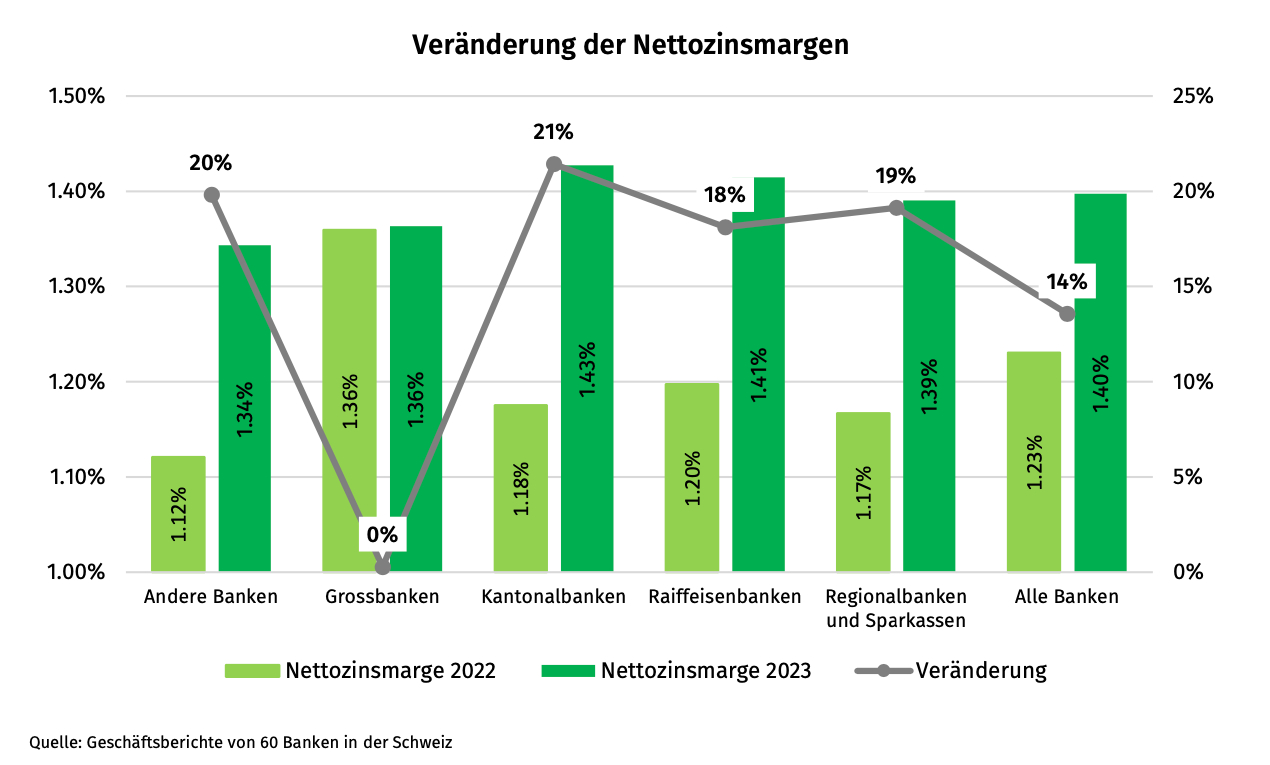
Thanks to the interest rate turnaround in 2022 and 2023, banks were able to significantly increase their net interest margins. On average, banks' net interest margins rose from 1,23 percent to 1,40 percent, an increase of 14 percent, according to an analysis by the comparison portal Moneypark and the insurance company Helvetia.
Leading the way were the cantonal banks. They were able to increase their margin by 25 basis points to the current 1,43 percent, an increase of 21 percent.
Gap between savings and mortgage interest rates
The net interest margin is the difference between the interest that savers receive and the interest that credit or mortgage borrowers pay to the bank.
A decisive factor in how high the margin rises with interest rate hikes is the maturity structure of the mortgage portfolios. This success of the cantonal banks is largely due to strategic positioning and the skillful management of their mortgage portfolios.
«The clear winners of the interest rate turnaround are the cantonal banks, which have massively benefited from the changed interest rate environment and are in an unchallenged leading position,» comments Lukas Vogt, CEO of Moneypark.
Big banks already had higher margins
In contrast, the margin at the big banks hardly increased. On one hand, they had already realized the highest interest margin in the market. In addition, there was the crisis at Credit Suisse (CS). «Credit Suisse had to endure a drastic drop in its net interest margin by over 40 percent, as savers withdrew their funds on an unprecedented scale, forcing the bank to refinance expensively,» the analysis states.
Moreover, the big banks have a higher proportion of short-term mortgages in their portfolios. Currently, this proportion is around 45 percent. Looking ahead to the expected lower interest rates, this could be an advantage. «This could allow them to significantly increase their margins in 2024, as short-term interest rates can be adjusted more quickly.»
Maturity structure is crucial
Due to the maturity structure of their portfolio, Raiffeisen banks are considered the most vulnerable to changes in interest rates. Almost 85 percent of their mortgages have a term of more than one year, making them less flexible for short-term interest rate adjustments. Cantonal banks (71 percent) and regional banks and savings banks (72 percent) also have a high proportion of long-term mortgages.

«While these long-term mortgages ensure stable earnings, they also make the affected banks sluggish and vulnerable to unexpected interest rate changes,» Vogt adds.
Alternative providers often cheaper
Insurance companies and pension funds are not dependent on the interest differential business like banks and can often offer better terms than traditional banks. The interest rates agreed on for ten-year fixed-rate mortgages in the past six months show that they were significantly cheaper on average than banks.
Moneypark acts as an intermediary in the mortgage business and is a subsidiary of Helvetia.