Major Global Banks See Opportunity – But Not Everywhere
Global financial institutions had a lot of questions at the start of 2025 – would Donald Trump’s campaign trail promises become US government policy? Will we see regional divergence in the direction of fiscal and monetary policy? Would investors finally tire of ever-expanding government debt levels?
Fast forward twelve months and while some of those questions have been resoundingly answered, the answers have raised new questions and even more uncertainty.
To better understand investors' concerns and thus be better equipped to anticipate their needs, Natixis Investment Managers has been aggregating the public outlooks of many of the world’s global financial institutions (GFIs) for several years. It provides insight into how they are thinking about the year ahead and, importantly, how that thinking changes over time. And what is clear is that GFIs have started the year even more bullishly than they did last year.
Despite worries about the likelihood of an Artificial Intelligence-driven bubble, despite the expensiveness of risk assets, despite concerns about the trajectory of public debt, especially in developed markets, GFIs have started the year in a risk on position. But it is a reluctant risk on position. This is because, while the ascent of asset prices can’t continue forever, no one yet wants to run the risk of leaving too early.
And, if one looks at the data, it becomes clear why. Starting points matter in investing, because they are a significant factor in the likelihood of long-term success. Intuitively this makes sense – the lower the starting price, the wider the range of potential outcomes in which the conditions are met for the price to go up over the long term and vice versa.
Over the short term, however, there is always the chance that markets could eke out one last gain.
The Good and the Bad of 2025
Many of the calls GFIs made in 2025 proved good ones, they expected the US equity rally to continue, and for the dollar to peak in value, opening up opportunities within emerging markets. At the same time, they expected global bonds to provide opportunities and were bullish on investment grade credit and high yield bonds, even though the latter were already expensive.
On the other side, the strong preference for US equities over European equities proved less prescient, as was the view that the US equity market would broaden out.
2026 Positioning
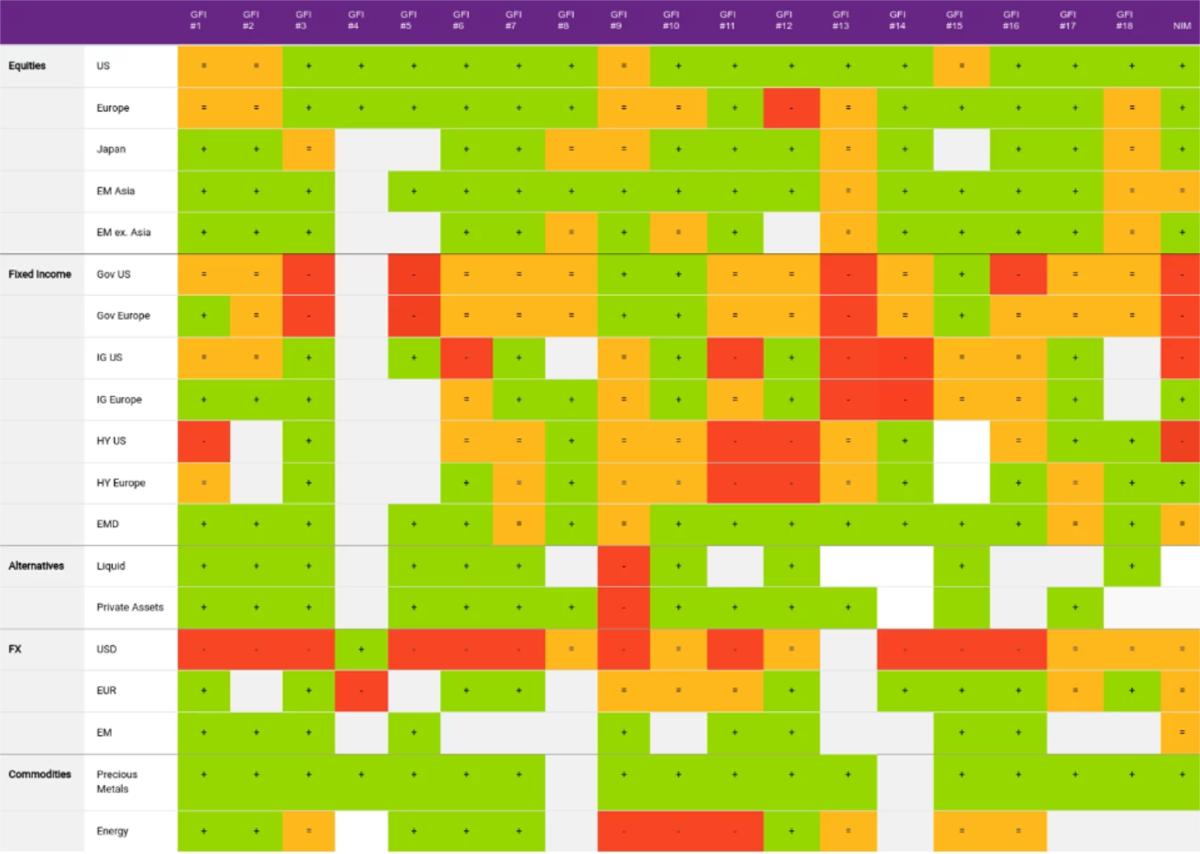
Source: Natixis IM Solutions, Amundi, BNP, CAI, Citibank PB, Julius Baer, JPM PB, UBS, AXA IM, Barclays, DWS, GS, HSBC, Morgan Stanley, ABN, Lombard Odier, Pictet, Santander, UBP – January 2026
Macro Backdrop
The prospect of state-led capitalism is well and truly back on the agenda, as events in Venezuela would seem to demonstrate and the continued rise of economic nationalism is one of the key long-term themes GFIs expect to shape markets over the long term. But, while each geopolitical bloc is aiming to reach self-sufficiency, each one appears to be taking a different approach.
The US ist focused on reshoring and securing supply chains, Asia is focused on AI – with China seemingly focused on the end product, while countries like Korea and Taiwan are focused on the broader AI supply chain and Europe is focused on fiscal policy and infrastructure.
As such, GFIs consistently highlighted the opportunities within investments linked to strategic autonomy – such as infrastructure and defence – as areas of opportunity. On the other side of the equation, the sustainability of public debt continues to be a key area of concern, especially as the expected retreat from globalisation is likely to be accompanied by protectionist policies, higher trade friction and even tighter immigration controls, all of which could dampen economic efficiency and constrain, and domestic counter-responses such as fiscal stimulus and government investment programmes.
The other major throughline at a macroeconomic level is the inexorable rise of artificial intelligence. The term was inescapable in 2025, and expectations are that it will continue to dominate conversation. While there remain concerns at all levels, most GFIs are bullish on the technology, expecting it to be a powerful driver of near-term profitability and long-term productivity, which should help to offset some of the labour supply constraints expected as a result of ageing populations in developed markets and slowing migration.
However, there was agreement that investors are likely past the «buy the dream» phase and will expect to see tangible results in 2026.
If these results materialise and meet or exceed expectations, GFIs expect a further tech boom. But, if not, predictions are gloomier. However, it is also important not to discount the geopolitical dimension to AI, which could well put a floor under the market. In both scenarios, however, what was clear was that the need for active management will be crucial as the tide will no longer lift all boats.
Monetary Policy
Most GFIs expect the rate cut cycle within developed markets (outside of Japan) to continue in 2026 outside and, as a result, moving investors out of cash is likely to be a key challenge for GFIs in 2026.
Equities
When it comes to the outlook for equities, the biggest shift in GFI attitudes at the start of 2026, compared to 2025 is the view on Europe. In 2025, GFIs were either neutral or negative on the prospects for European equities. This year, however, that has flipped. The overwhelming majority are positive on the asset class, with a handful still neutral. This positivity is largely down to expected impacts from fiscal easing as well as growth from sectors such as defence and those companies involved in the green transition.
When it comes to US equities, the consensus expectation is still that we will see strong earnings growth from the technology sector, especially from those firms involved in AI infrastructure. However, whereas all the GFI outlooks we reviewed in 2025 were bullish on the prospects for US equities, a few have moderated that view to neutral for 2026.
One of the other key consensus views was a high conviction about the potential opportunity to be found within Asian emerging markets, because of the weakness in the US dollar and as they will likely be beneficiaries of the build out of AI infrastructure.
Fixed Income
US investment grade credit was the sub-asset class that saw the biggest shift in GFI views over the past 12 months. Of the 18 GFI outlooks reviewed in 2025 that had a view on US IG credit 17 were positive and one was neutral. In 2026, 17 had a view, of which 5 were negative, 6 were neutral, and 6 were positive. But while US credit saw the most extreme negative shift, attitudes toward fixed income were less positive almost across the board. The only exception was emerging market debt, where consensus expectations were for a strong performance because of a combination of a weaker dollar backdrop, lower inflation and higher real yields.
There was also some excitement about the opportunities to be found in European investment grade bonds, which were favoured because of an expectation that those instruments would continue to display lower volatility than their US counterparts and offer better yield carry.
Overall, GFIs expect rate sensitive asset classes to benefit from monetary easing and yield curve steepening (short term Treasuries, Small Cap, IG Credit, Real Estate)
Alternatives
Given how strong its performance was in 2025, it was unsurprising that gold, and precious metals more broadly featured strongly in GFI outlooks of 2026. And the expectation remains that the metal will continue to act as a good hedge amid monetary easing and ongoing geopolitical uncertainty this year. In fact, precious metals topped the list as the strongest overweight within the GFI outlooks we reviewed.
Likewise, commodities, infrastructure and real estate instruments linked to the energy transition, such as copper and lithium are also expected to benefit from ongoing macroeconomic trends.
How to Play 2026
Two of the key refrains, running through the GFI outlooks was the need for diversification and the importance of being selective. While the overall view across asset classes was positive, there is a growing recollection that not everything can be a winner all the time, especially given the sheer number of known unknowns facing markets. As such, investors are increasingly adopting a balanced approach, avoiding concentration and diversifying their portfolios.
- More on Natixis Investment Managers here.
Written in January 2026
Additional Notes
Marketing Communication. Capital at Risk. This material has been provided for information purposes only to investment service providers or other Professional Clients or Qualified Investors and, when required by local regulation, only at their written request. This material must not be used with Retail Investors. It is the responsibility of each investment service provider to ensure that the offering or sale of fund shares or third party investment services to its clients complies with the relevant national law.
Please read the Prospectus and Key Information Document carefully before investing. If the fund is registered in your jurisdiction, these documents are also available free of charge and in the official language of the country of registration at the Natixis Investment Managers website (im.natixis.com/intl/intl-fund-documents).
To obtain a summary of investor rights in the official language of your jurisdiction, please consult the legal documentation section of the website (im.natixis.com/intl/intl-fund-documents).
In Switzerland: This material is provided by Natixis Investment Managers, Switzerland Sàrl (Registration Number: CHE-114.271.882), Rue du Vieux Collège 10, 1204 Geneva, Switzerland or its representative office in Zurich, Schweizergasse 6, 8001 Zürich.
The above referenced entities are business development units of Natixis Investment Managers, the holding company of a diverse line-up of specialised investment management and distribution entities worldwide. The investment management and distribution subsidiaries of Natixis Investment Managers conduct any regulated activities only in and from the jurisdictions in which they are licensed or authorized. Their services and the products they manage are not available to all investors in all jurisdictions.
Although Natixis Investment Managers believes the information provided in this material to be reliable, including that from third party sources, it does not guarantee the accuracy, adequacy, or completeness of such information.
The provision of this material and/or reference to specific securities, sectors, or markets within this material does not constitute investment advice, or a recommendation or an offer to buy or to sell any security, or an offer of services. Investors should consider the investment objectives, risks and expenses of any investment carefully before investing. The analyses, opinions, and certain of the investment themes and processes referenced herein represent the views of the individual(s) as of the date indicated. These, as well as the portfolio holdings and characteristics shown, are subject to change and cannot be construed as having any contractual value. There can be no assurance that developments will transpire as may be forecasted in this material. The analyses and opinions expressed by external third parties are independent and does not necessarily reflect those of Natixis Investment Managers. Any past performance information presented is not indicative of future performance.
This material may not be distributed, published, or reproduced, in whole or in part.
All amounts shown are expressed in USD unless otherwise indicated.
Natixis Investment Managers may decide to terminate its marketing arrangements for this fund in accordance with the relevant legislation.
NATIXIS INVESTMENT MANAGERS Paris 453 952 681 Capital : 178 251 690 € 43, avenue Pierre Mendès-France, 75013 Paris www.im.natixis.com