
Bar Tip: Urban, Hip, Unique – The Bambusnest Brings New Energy to Basel
Anyone entering the Bambusnest encounters deliberate surprise: a sliding door, an escalator – and suddenly beach, palm trees, a waterfall. «You can stand at the entrance and literally see the moment people think: Where did I just land?», says operator Urs Poživil.
This moment of astonishment, he says, is the starting point for experiences «that stick». Light and sound set the scene – indoors and outdoors – «so the space can be used in an extremely multifunctional way».
Business Logic: Two Seasons, One Cashflow
The concept is dual: summer with beach flair and street-food ease; winter as a winter market with fondue, hot drinks, and more classic cocktails. The split allows for differentiated target groups, pricing models, and demand patterns – and mitigates weather risks, since the indoor area secures corporate events even on rainy days.
«A company event with 200 people? Then we simply move indoors. That gives flexibility and planning security», says Poživil. The exhibition district instead of the city center. The goal: activate the neighborhood outside of major trade-fair peaks and create synergies with fairs and exhibitors – public programming plus exclusive corporate events. «Our main focus is to energize the exhibition area with public events – complemented by corporate functions», he says.
Programming & Formats: From «Back in Time» to Tastings
Every two months, the Bambusnest sets a clear highlight with its «Back in Time» parties: curated playlists, matching décor and a defined dress code create nostalgia at Snapchat speed – ideal for bringing crowd and community together.
Between these anchors, cooperative formats add rhythm and depth: tastings with regional producers, small food pairings, and after-work sessions with brand partners translate festival atmosphere into a compact urban setting.
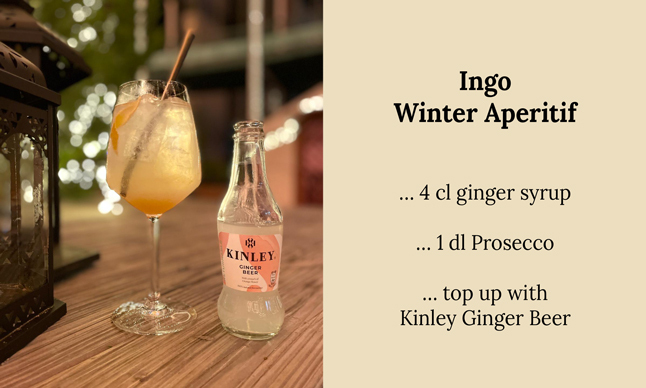
A Bambusnest cocktail creation. (Image: Courtesy)
Greater Experience Density
Next season will focus more strongly on guest proximity: tailored corporate events, closed brand pop-ups, and community nights aim to increase experience density, boost repeat visits, and bridge the quieter intervals between major events.
The result is a programming calendar that combines attention-grabbing highlights with smart in-between formats – turning a single location into a continuously active experience platform.
Menu & Consumer Trends: The Spritz Economy and No/Low
The drink menu is lean – but curated to match the zeitgeist. Spritz styles (Aperol, Limoncello, Sarti & co.) drive aperitif sales; Prosecco – including the alcohol-free version – is booming. «We’ve never used as much Prosecco as we do now», says Poživil. «Spritz» stands for variety; Aperol’s marketing has anchored the style across demographics.
Parallel to this, No/Low keeps growing. Guests expect equivalent alternatives – visually and in taste. «It’s not enough to put a glass of water on the table when everyone else gets a decorated drink», says Poživil. Virgin classics work; in winter, hot non-alcoholic options join the menu. Partnerships enable scale: with Kinley fillers from The Coca-Cola Company universe, the team can reliably organize welcome drinks and large-scale events (New Year’s Eve, music sessions) – a lever for growth.
Food & Sharing: Dwell Time as a KPI
The menu follows a simple logic: sharing over single portions. In summer, wings and pinsa/pizza variations deliver speed from the kitchen and lightness at the table; in winter, fondue takes over as the social connector.
The sharing principle impacts the unit economics on three levels: it increases dwell time, boosts order frequency (extra sides, dips, a second pinsa for the group) and encourages conversation at the table – a soft factor that reliably translates into higher revenue.
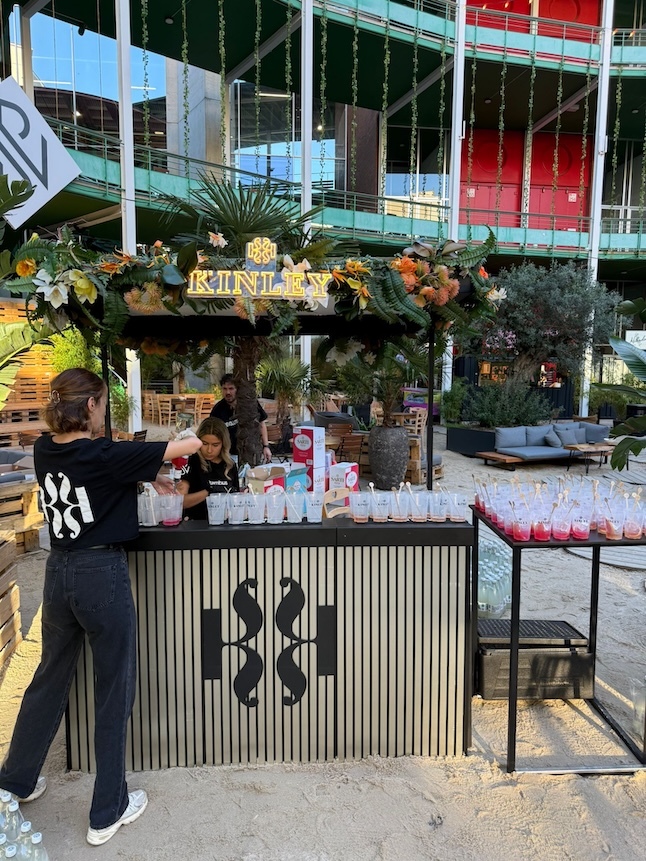
Partnerships enable scale: cocktails with Kinley. (Image: Courtesy)
Guest Favorites: Pinsa, Fondue
Pinsa has become a crowd favorite – not only thanks to its digestible dough, but also because it works modularly: seasonal toppings, vegetarian options, limited editions for event nights. For the operation, that means predictability: high reproducibility, efficient mise-en-place, and cross-utilization in preparation.
In winter, fondue delivers the same strengths – ritualized, group-friendly, and cost-stable. Paired with hot companions (from alcohol-free punch to classic tea), the menu creates atmosphere while keeping throughput high.
Operationally, the Bambusnest relies on smooth service flows: large sharing platters, clear communication on the menu, add-on upsells (extra dips, side salads, dessert to share). Fewer individual courses, better table choreography – and a culinary frame that supports the brand experience: approachable, shareable, memorable.
Sustainability: From Label to Practice
At the Bambusnest, sustainability means consistent action rather than collecting certifications. Purchases are regional and seasonal where it makes ecological and operational sense: short supply routes, stable quality, predictable availability.
The biggest lever lies in food-waste reduction. Instead of «always full buffets», the kitchen works with portioned serving, replenishment in waves, and clear guest communication: whatever comes next is fresh – and prevents overproduction. This reduces disposal and energy costs, protects margins, and keeps operations lean.
Reusable systems (where practical), deposit models for to-go containers, and bundled logistics with suppliers complement the approach. Mise-en-place plans and standard portions minimize deviations. Sustainability becomes an operational discipline – measurable in less waste, more stable food costs, and more satisfied guests.
Operations: Weather, Staffing, Demand Curves
Even with an indoor backup, the business remains weather-driven: sunny days extend stays and increase spontaneous visits; rain at the wrong time suppresses traffic – even in months that look «dry» on paper.
The Bambusnest responds with flexible staffing: a pool of around 40 team members – mostly on hourly contracts – scheduled based on forecasts, bookings, and day-to-day developments; a small core team leads and ensures quality.
A Demand-Responsive Platform
Operational SOPs stabilize peak-time load: simplified menus during peak hours, pre-batched signature drinks, defined runner routes, and structured upsell moments (second pinsa, hot non-alcoholic options in winter).
The calendar uses flagship events (e.g., «Back in Time») as pacing elements and fills quieter periods with cooperative formats. The result is a demand-responsive platform that adapts to weather and weekday – without tipping into idle time or overload.
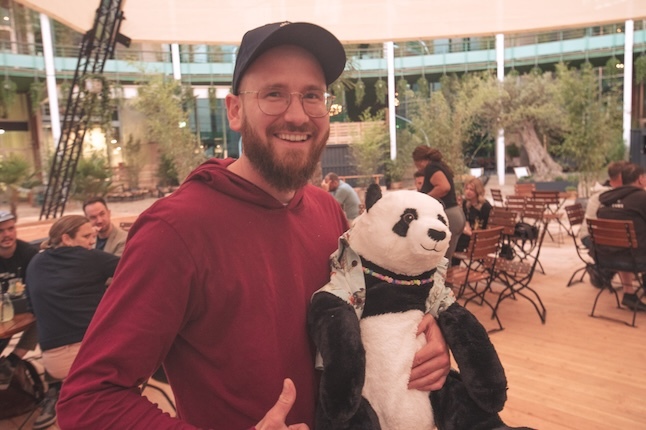
Urs Poživil, host at Bambusnest. (Image: Courtesy)
Basel as Stage – and Benchmark
Basel’s gastronomic topography is diverse: the harbor district, Kleinbasel, the city center – three milieus, one market. The Bambusnest positions itself with broad accessibility: families and neighborhood visitors during the day, corporate guests and younger nightlife audiences in the evening.
The location in the exhibition district acts as a magnet beyond the city – including cross-border traffic from Weil am Rhein and Lörrach. For the city, this means added liveliness between fair peaks; for the operators, diversified demand beyond a purely premium segment.
Brand, Naming & Experience Architecture
Bambusnest is programmatic: «nest» for coziness and community, «bamboo» for scalability and quick availability – exactly what a temporary concept needs.
The experience is curated through light and sound scenes that seamlessly shift the space from daytime operation into events and parties: warm, soft lighting for families; focused accents and bass foundation for night sessions; reduced volume for tastings. Zoning and clear wayfinding keep the space modular, service-friendly, and brand-coherent despite constant change.
Lean Leadership Structure
Operationally, the brand relies on a lean leadership structure: a core team secures quality and narrative, while the hourly pool in summer provides elasticity for weather, season, and bookings. The result is a robust experience architecture that aligns atmosphere, throughput, and cost control.
For the winter season, the team is planning additional covered outdoor zones, enabling spontaneous visits even in cold weather – complete with wind-protected seating and hot No/Low options. Programming-wise, cooperation formats (tastings, sessions, brand pop-ups) will grow to fill frequency gaps and boost repeat visits.
Between Experience and Efficiency
Complementary initiatives include testing digital ticketing journeys, reservation windows for corporate time slots, and limited-edition menus for event nights. This turns the seasonal space into a learning platform that performs measurably better every quarter.
In the exhibition-center ecosystem, this generates additional footfall outside classic peaks – and a platform that captures corporate budgets without drifting into rigid fixed-cost structures. For Basel, it means more life in the district; for the operators, more resilient unit economics between experience and efficiency.
Data & Milestones
- Opening: July 5, 2024
- Start of Winter Season 2025/2026: November 3
- Model: Public + Corporate (up to approx. 200 guests), summer/winter seasons
- Team: ~40 in the pool, mostly hourly
- Weather hedge: indoor areas as backup, outdoor experience as frequency driver.
This bar recommendation is presented to you by The Coca-Cola Company.