Investing For The Low-Carbon Transition
Governments globally are moving decisively to accelerate the transition to a low carbon economy. This will be necessary if we are to limit temperature increases to 1.5 C or less above pre-industrialized levels and therefore mitigate some of the worst risks of global warming. With this significant global energy shift underway, there are some clear ways for investors to incorporate carbon transition investment implications into their portfolios.
Temperature Anomalies Increasing Steadily Over Five Decades
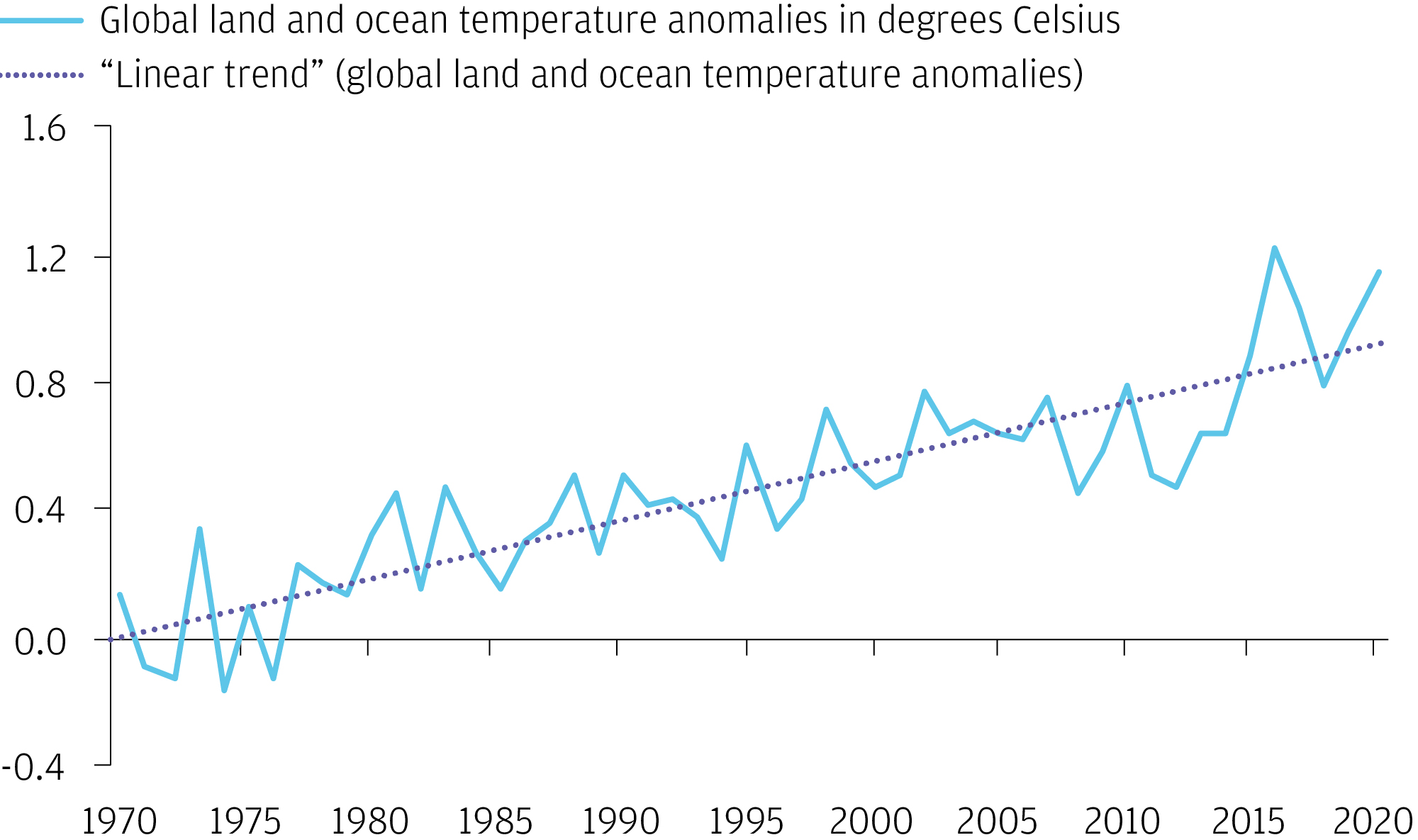
Global temperatures, 1970-2020; source: NOAA National Centers for Environmental Information, Climate at a Glance: Global Time Series, published April 2020, J.P. Morgan Asset Management. Note: The simple linear trend is likely to underestimate future increases in temperatures in a «business as usual» scenario. That is because of important non-linearities and tipping points in the climate system. Temperature anomalies are defined as deviations of temperatures from their long-term mean.
Climate Policy And Economy
There are two distinct potential low carbon transition models to bear in mind. On the one hand, governments could be mandating and enforcing sustainable behavior and private businesses bearing the bulk of the cost of the transition. If governments impose carbon taxes or regulations, that could reduce 2030 GDP by around 1 percent. On the other hand, governments could be incentivizing green behavior through subsidies and other forms of fiscal stimulus.
If governments decide to provide debt-financed green stimulus to build low carbon infrastructure or increase public expenditure on green R&D, there would be enough fiscal tailwinds to offset any medium-term costs of the transition. An expansionary transition such as this could increase the level of global GDP by 2030 by around 1 percent.
Of course, it will likely be some combination of these two approaches. Whichever form the low carbon transition takes, what is certainly clear at the moment is that simply reducing the energy intensity of GDP – the «fewer fossils» approach – will not be enough to avoid significant increases in temperatures. It will be essential to also generate energy in less carbon-intensive, and therefore «more green», ways.
The Pain of Transition Varies Greatly by Country
Investors need to start looking now at the carbon transition readiness of their portfolios in order to capture investment opportunities as well as manage risks. Importantly we see three dimensions of assessing carbon transition readiness in terms of portfolio exposure: geography, inflation/interest rate implications and company-level impact.
Countries with highly carbon-intensive domestic economies will find the transition more painful than those with less carbon intensity. Countries that are currently large net exporters of fossil fuels, or countries that are home to large energy companies, will also experience a more difficult transition.
In our view, Russia, India, South Africa, Australia and Canada will likely be the hardest hit. Conversely, the euro area, Sweden, Switzerland and Japan look much more transition-ready. They are less reliant on fossil fuels, have the willingness to embrace the transition to a low carbon economy and are in many cases already leaders in green technologies.
Modest Moves Up Or Down
A second dimension of assessing carbon transition readiness involves forecasting the equilibrium interest rate implications. In our view, if the private sector bore the bulk of the cost of the transition, this would result in a small drag on medium-term economic growth and a correspondingly modest reduction in equilibrium real interest rates.
On the other hand, if governments launched substantial green stimulus, taking on the cost of transition, it would provide a tailwind to growth that would boost rates at the margin.
Countervailing Forces at Play
A third carbon transition aspect would be to look at companies. This of course will vary significantly by sector. Sectors that stand to gain include renewable energy and green infrastructure.
The sectors are likely to be hit the hardest include energy, consumer cyclicals, materials and some utilities. Companies in these sectors will suffer from a decline in demand as the goods they sell become less sought-after and carbon costs are become ongoing burden.
Different Shades of Green
That said, even for sectors squarely in focus for the carbon transition, like oil companies, there will be meaningful dispersion between companies that are embracing a decarbonization strategy and those that are lagging. This underscores the importance of security selective and of taking an active approach.
By acting early in assessing carbon transition readiness in their portfolios, investors can avoid or mitigate climate policy risks as well as capture investment opportunities across asset classes and markets – before they are fully priced in.
J.P. Morgan Asset Management and Sustainable Investing: You can find all insights in the full paper. Stay ahead of the game when it comes to sustainable investing: with our webconference on «Climate Change and Sustainable Investing Opportunities» as well as on our climate change page.