
Giving Is Better Than Receiving – But One Need Not Be Blind While Doing So
Fittingly for the Advent season – when mailboxes fill with donation appeals, especially in households identified as receptive to charitable missions – the consultancy PPCmetrics, known for its work in the Swiss pension fund landscape, together with the Center for Philanthropy Studies (CEPS) at the University of Basel, has released the latest Yearbook of Aid Organisations.
The yearbook is a treasure trove for donors who are interested in how non-profit organisations (NPOs) manage their finances. It contains all key financial indicators and is based on the publicly available 2024 financial statements of 532 analysed, mostly Zewo-certified NPOs, 80 percent of which are domiciled in German-speaking Switzerland.
Zewo Certification Raises Transparency
Almost all certified organisations (87 percent) published their full financial statements online, the authors note approvingly. Among NPOs without the Zewo quality label, the figure was just under half (47 percent).
Donation volumes developed differently depending on the area of activity. In the category «Domestic Social Causes,» donations in 2024 fell back to the level of 2015 (just under 150 million francs), due to the decline in Covid-related contributions. «International Humanitarian Aid,» by contrast, reached 394 million francs – practically matching the peak level of 2022, likely also due to the rising number of armed conflicts.
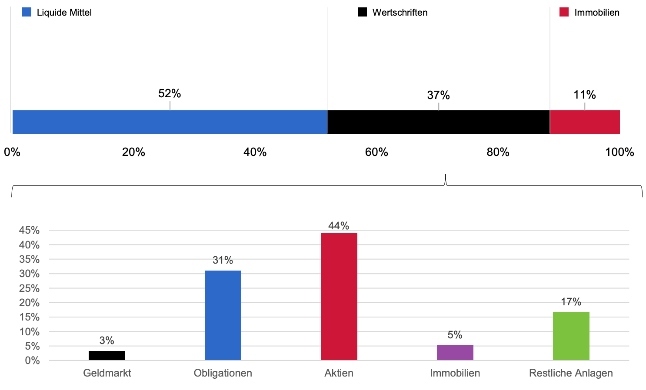
Graphic: Yearbook of Aid Organisations 2025
On the investment side, an average NPO holds roughly half of its financial assets in liquid funds, 37 percent in securities and 11 percent in real estate. Among the 70 institutions that disclose a detailed securities allocation, equities account for 44 percent and bonds for 31 percent.