
Julius Baer and Pictet: Two Paths Through the Technological Storm
Consulting firm Xebia convened leading digital practitioners for the Lead26 Conference. Senior executives from the banking world were also among the speakers. At the Executive Circle — held «off the record» the evening before — Pieter Brower, Group Operations & Technology Officer at UBS, provided his perspective.
In the public portion of the event, the opening impulse came from David Schlumpf, Head of Leadership Development at Julius Baer. His core message: «Technology alone will not future-proof banks. Those who want to master change need a new understanding of leadership.»
He describes today’s environment as a «flux world» — a state of permanent motion. In such conditions, rigid answers and classic best practices fail. What is needed is a style of leadership that relies less on control and fixed solutions and more on consciously navigating uncertainty.
Adaptive Leadership
The concept Julius Baer applies is Adaptive Leadership. The point is not for leaders to always have the right answer. Rather, they must create the space in which the right questions can be asked. Leadership, in this logic, means addressing realities openly rather than glossing them over; opening learning environments instead of reproducing old patterns; and returning responsibility to where it ultimately belongs — to the employees who carry the transformation.
A central insight: Every technological advance is simultaneously a human rupture. Identity, roles, and habits come under pressure. Only once this loss is named can real movement begin.
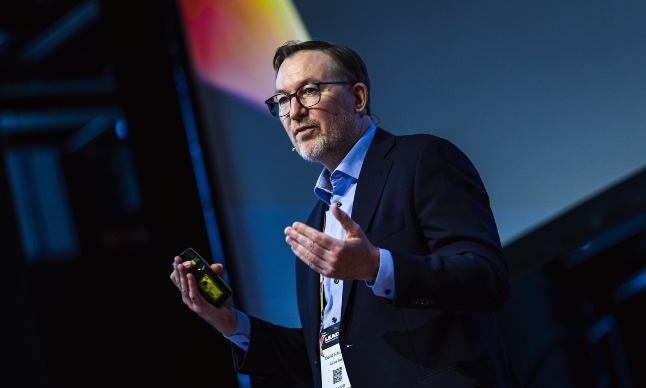
David Schlumpf of Julius Baer (Image: Courtesy)
Schlumpf likens the process to building a tree: values, guiding principles, and leadership philosophy form the roots. The trunk represents the common language that connects the global organization. The branches symbolize programs that bring together different perspectives. The leaves stand for learning through practice — because at Julius Baer, knowledge becomes impactful only when applied. The fruits, finally, are the tangible changes in day-to-day life.
For Schlumpf, the conclusion is clear: Without cultural maturity, technology is a blunt instrument.
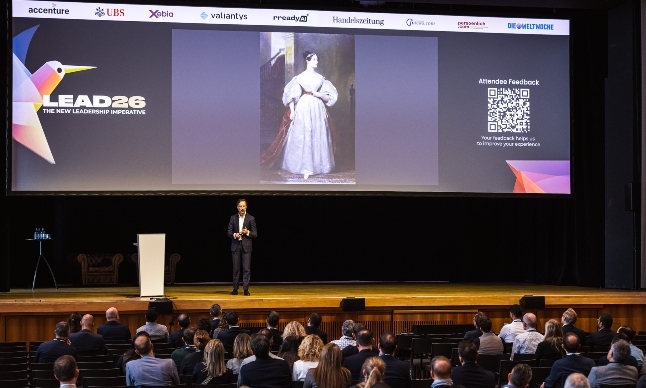
Laurent Gaye refers in his talk to Ada Lovelace, the visionary pioneer of computer science (Image: Courtesy)
Pictet’s AI Push: Little Patience for Pilot Projects
Laurent Gaye, Chief Technology and Operations Officer at Pictet Asset Management, took a different approach — more analytical, more technical, and notably more provocative. His guiding question: How can banks move beyond testing AI and start using it productively and at scale?
Ada Lovelace as a Guiding Figure — Vision Requires Courage and Patience
Gaye began by invoking Ada Lovelace, the visionary pioneer of computer science. Her story, he said, illustrates two principles essential in today’s AI adoption: first, the courage to think beyond the obvious use case; and second, the patience to accept that radical ideas take time to bear fruit.
He also outlined the technical architecture of generative AI: large foundation models enriched with company-specific context layers, coupled with capabilities such as code interpretation and API integration. The next stage, he argued, will be agentic AI — autonomous systems that no longer wait for prompts but execute entire process chains independently.
No Hesitation, No PoC Runs — Pictet Opts for Full Deployment
The surprising part, however, was not the technology but how Pictet implements it. While many banks introduce AI through small pilot projects, Pictet does the opposite: no proof-of-concepts — only full rollout. In 2023, the bank activated its own GenAI tool for all employees. The same applies to Microsoft Copilot.
The belief behind the move: only broad deployment creates the necessary momentum, accelerates learning curves, and avoids isolated solutions. As Gaye puts it, it requires «an act of faith».
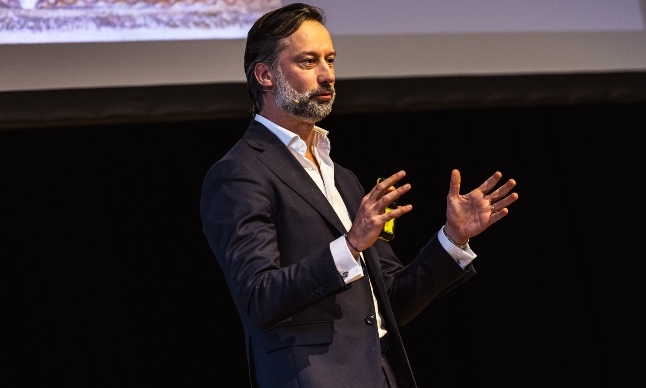
Laurent Gaye of Pictet (Image: Courtesy)
The Real Hurdle Is the Human Being
Despite all technological conviction, Gaye is clear that the biggest obstacle is not the tech — it is people. Uncertainty, lack of incentives, and insufficient trust can slow even the best AI. He illustrated this with examples from industry: the failed Amazon Go model, or the same GM factory that once struggled under General Motors but became the most productive plant in the U.S. under Toyota.
The lesson: transformation works only if employees are engaged, retain agency, and feel the personal benefit of change.
Seen together, the perspectives of David Schlumpf and Laurent Gaye point to a simple conclusion: technology is only the beginning — the real work starts with people.
Adaptive Leadership at Julius Baer, Radical Transparency at Pictet
But without the right culture, all of this remains theory. Julius Baer focuses on learning spaces, reflection, and adaptive leadership. Pictet emphasizes radical transparency, trust, and bold execution. Gaye sums it up succinctly: «It’s not about being right. It’s about building a system that survives any future.»