Beleaguered Government Bonds: Is Bitcoin the Solution?
By Bitcoin Suisse
As the effectiveness of government bonds slowly wanes, and their maintenance threatens the financial system, a thoughtful allocation of cryptocurrencies in investment portfolios may be worth consideration.
For decades, institutional investors have treated government bonds as unassailable «the foundation of prudent portfolio construction, the cornerstone of capital preservation.» Today, that foundation is cracking. Perpetual sovereign issuance, central bank interventions, and overreliance on state credibility have transformed the «risk-free rate» into a systemic vulnerability.
The 60/40 Portfolio Is Breaking
Like rust spreading through structural steel, the erosion is gradual and invisible until suddenly, the framework fails. As fiscal deficits expand and debt servicing consumes growing portions of public budgets, what was once considered baseline safety now threatens the entire edifice.
Performance data confirms what market natives already recognize: the traditional model is breaking. The 60/40 portfolio, long held as the standard of institutional asset allocation, is no longer fit for purpose. Over the past decade, long-duration U.S. government bonds — proxied by instruments like TLT and ZROZ — have delivered deeply negative real returns after adjusting for inflation, a fundamental failure of their core mandate to preserve purchasing power.
60 Months of Declines
This supposed bedrock of stability has experienced drawdowns extending roughly 60 months, the longest contraction in modern financial history. Even shorter-duration treasuries with maturities between 5 and 10 years — like the IEF and VGIT — have produced inflation-adjusted losses exceeding 17 percent over the same timeframe.
Meanwhile, introducing a Bitcoin allocation into a globally diversified portfolio materially improved both absolute and risk-adjusted returns between 2015 and 2025. A 5 percent BTC allocation more than doubled the Sharpe ratio compared to a traditional portfolio with zero crypto exposure. A 10 percent BTC allocation tripled traditional portfolio returns, pushing annualized returns from 6.5 percent to 16.5 percent.
Consider Crypto Allocations
This demonstrates the asymmetric upside potential of Bitcoin despite its volatility profile. Critically, the marginal increase in total portfolio volatility remains modest, as diversification dynamics offset most of Bitcoin’s raw volatility.
These performance improvements manifest even within conservative asset mixes that include gold and money market positions, underscoring Bitcoin’s diversification benefits and superior return characteristics. Contrary to prevailing assumptions, even a modest BTC allocation substantially enhanced portfolio efficiency, making it a compelling consideration for forward-thinking investors pursuing long-term outperformance and genuine diversification.
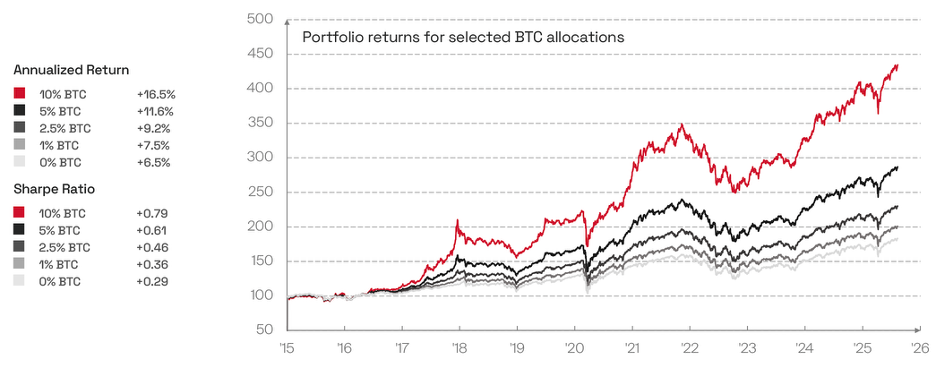
Data: TradingView, Data as of August 11, 2025. Click image to enlarge. (Source: Bitcoin Suisse)
The allocation source and rebalancing frequency warrant strategic consideration. In our framework, Bitcoin replaced a portion of the equity sleeve — the risk-asset segment of the portfolio. However, given fundamentally altered bond-market dynamics, there may be increasing merit in reallocating from the «risk-off» allocation as well.
In a monetary regime characterized by fiscal dominance, debt-spiral risk, and correlation breakdowns that undermine bonds’ traditional hedge function, the 40% fixed-income allocation has shifted from stabilizer to drag.
Hedge Against Eroding Fiscal Credibility
Consequently, there may be compelling rationale for redeploying a meaningful share of long-duration bonds into hard assets. This segment carries the highest sensitivity to interest-rate movements, offers negligible inflation protection, and depends entirely on issuer credibility. Strategic reallocation away from the 40 percent sleeve not only expands the portfolio’s opportunity set but could also function as insurance against accelerating fiscal-credibility erosion.
Given Bitcoin’s long-term upward trajectory, allowing allocations to drift unchecked can amplify both returns and risk, often resulting in significantly larger drawdowns. More frequent rebalancing tempers this dynamic, smoothing portfolio volatility. In both dimensions — allocation source and rebalancing frequency — Bitcoin’s low correlation to traditional assets enhances diversification while materially improving returns.
More Effective with BTC and ETH
Adding Ethereum alongside Bitcoin meaningfully strengthened the case for crypto as a portfolio component. A dynamic BTC and ETH allocation within a diversified global portfolio enhanced both absolute and risk-adjusted performance beyond what Bitcoin achieves alone. A 10 percent crypto sleeve weighted by market capitalization between BTC and ETH outperformed both a BTC-only allocation and the baseline portfolio with no crypto exposure.
The dynamic weighting methodology adjusts BTC and ETH exposure over time based on relative market size, eliminating hindsight bias and better reflecting systematic institutional allocation behavior. Despite higher volatility, the BTC and ETH combination produced a positively skewed return distribution, improving long-term return potential without proportionally increasing risk.
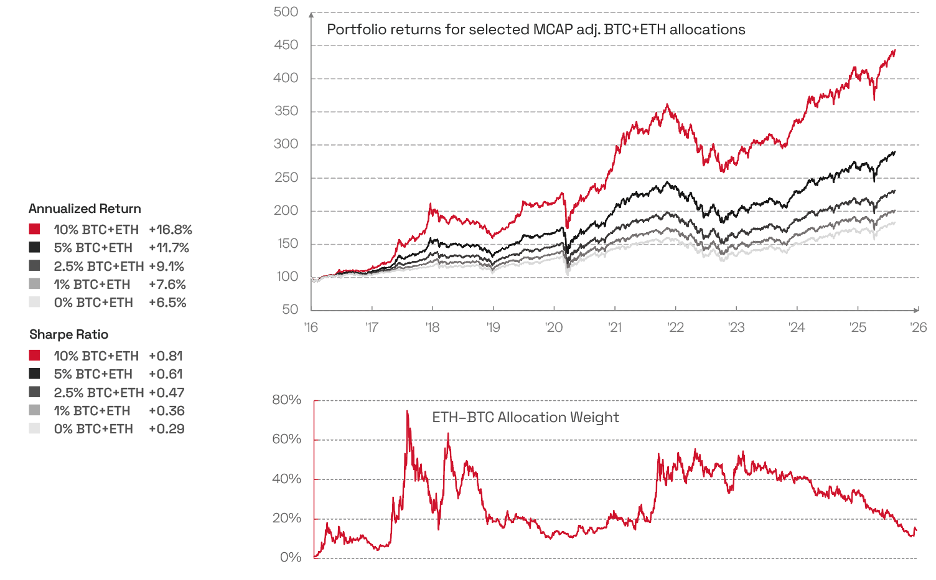
Data: TradingView, Data as of August 11, 2025. Click image to enlarge. (Source: Bitcoin Suisse)
Within a diversified crypto allocation, Ethereum may provide distinct exposure to the broader digital economy’s growth trajectory, complementing Bitcoin’s role as monetary anchor. This dual-core allocation framework redefines modern institutional portfolio construction — not merely as a return enhancer, but as a strategic diversifier in forward-looking asset-allocation models.
Intrigued by this article’s insights? Learn more by reading our full Wealth Management Report here.
finews.com publishes this article as part of the Crypto Corner, which is sponsored by Bitcoin Suisse. The aim of this section is to provide readers with insights and market assessments from Switzerland’s crypto pioneer.