
Alvarez & Marsal: U.S. Bank Deregulation to Spur Competitive Dynamics
The overview of banking regulation for globally active systemically important banks (G-SIBs), published by the U.S. consulting firm Alvarez & Marsal, highlights striking differences in direction between the U.S., the U.K., the EU, and Switzerland. In particular, the easing of rules in the U.S. and the planned tightening in Switzerland are expected to cause distortions.
«The aim of the study is to provide a comprehensible overview of the complex and non-transparent field of banking regulation,» said Giuseppe Di Riso, Managing Director and Head of the Financial Services Industry (FSI) practice in Zurich.
Creating Comparability and Providing Information
«This independent study was conducted on our own initiative and not commissioned by a client. We are not making any recommendations, but rather illustrating the potential impact of upcoming and planned regulatory changes,» emphasized Silvan Schriber, also a Partner in the FSI team at Alvarez & Marsal in Zurich. «We want to create comparability and provide information. The study serves as a reference for ourselves, our clients, and the entire industry.»
A total of 19 banks were examined: eight from the U.S., three from the U.K., seven from the EU, and UBS as the only remaining G-SIB (globally active systemically important bank) from Switzerland.
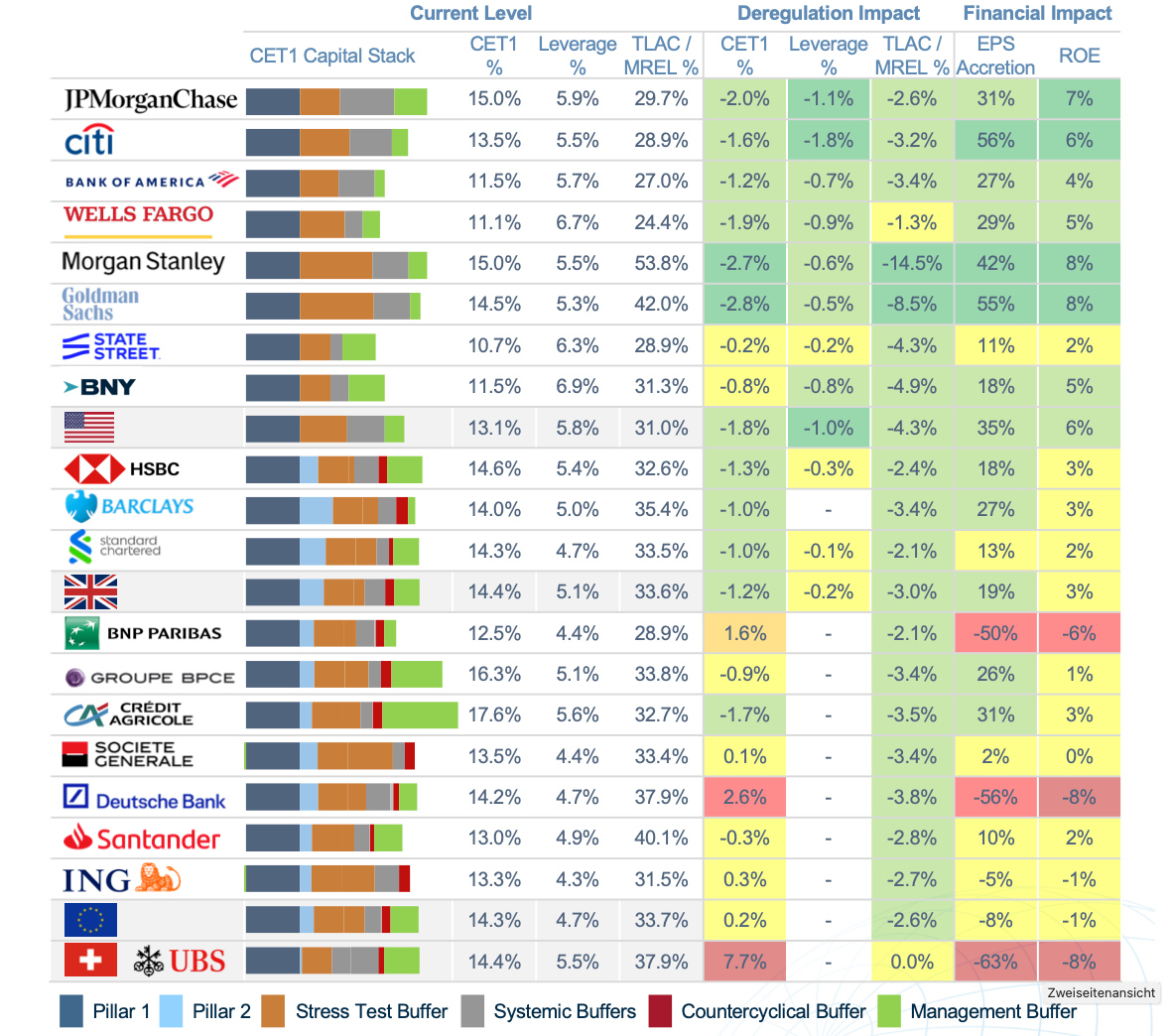
(Table: Alvarez & Marsal)
The study, titled «Bank Deregulation Primer», focused on three main aspects: how regulation is currently structured, how changes are implemented, and the overall direction of developments.
Reduction in Core Capital Requirements
The data show that U.S. banks, in particular, are expected to benefit from the release of capital resulting from the relaxation of regulatory rules. This could translate into an additional lending capacity of nearly $2,6 trillion. The rollback of post-financial crisis capital regulations could, according to calculations, free up $140 billion in previously tied-up capital.
For U.S. banks, a 14 percent reduction in core capital requirements could boost earnings per share by 35 reduction and return on tangible common equity by 6 percent. This would provide more funds for investments in AI, data centers, and energy infrastructure, while also enabling increased shareholder payouts.
At J.P. Morgan Chase, the largest U.S. bank, deregulation could free up an estimated $39 billion in capital, potentially increasing earnings per share by 31 percent and return on equity by 7 percent.
By contrast, the U.K. is expected to reduce capital requirements for banks by around 8 percent in an effort to maintain competitiveness with the U.S.
The EU regulators are taking a different path, preparing to raise requirements by about 1 percent. In particular, Deutsche Bank and BNP Paribas are expected to feel the impact of higher requirements.
Capital Rules for Foreign Subsidiaries
Switzerland, meanwhile, is planning a much more significant increase—up to 33 percent. The proposed measures could force UBS to hold considerably more capital. «The planned capital rules for foreign subsidiaries represent the most far-reaching changes,» said Di Riso.
«We refrain from making any judgment about whether the regulatory adjustments are good or bad. We merely describe their consequences,» said Schriber. However, he noted that it is time to reassess the capital requirements for G-SIBs globally.
He does not expect the differences and complexity of capital structures and regulations worldwide to diminish or become harmonized. The likelihood of international coordination to resolve the current inconsistencies, he said, remains low.
Alvarez & Marsal intends to update the study regularly to reflect changes. This will make it possible to evaluate developments and monitor strategies and their impact on the industry.