Iconic Timepiece: From Racetrack to Moon
By Swiss Watch Advisor
Anyone who recently took a closer look at the Swatch store window on Zurich’s Bahnhofstrasse may have noticed something interesting alongside the latest MoonSwatch release: Swatch and Omega took a more or less subtle jab at Rolex and the ever-popular (and recently discussed here) Cosmograph Daytona.
Displayed prominently was the fact that the Omega Speedmaster reference 105.003 was declared in 1965 as the only «flight-qualified watch for all manned space missions by NASA». Equally intriguing was the note that a certain brand with five letters ending in «X», namely its reference 6238, failed NASA’s testing back then.
Omega vs. «....X»
As if the written hint wasn't enough, Swatch also showcased a non-sellable Bioceramic prototype of the «....X» reference 6238 — essentially a plastic version of the highly coveted vintage Rolex Daytona.
Jab or not — it illustrates what has long been known and is fact: Omega's Speedmaster chronograph was technically superior to the Rolex Daytona of the 1960s space era. Even Rolex’s playful coining of the word «Cosmograph», merging «Cosmos» and «Chronograph» to suggest a space connection, didn’t help.
Aesthetics, craftsmanship, a unique story
Later, a new purpose was found in motorsport, and the model was renamed to the now iconic «Cosmograph Daytona».
Back to the Speedmaster: watches can be interesting or relevant for completely different reasons — simply because they are aesthetically appealing, made with incredible attention to detail, or because they tell a unique story.
In the case of the Omega Speedmaster 105.003, all these aspects come together.
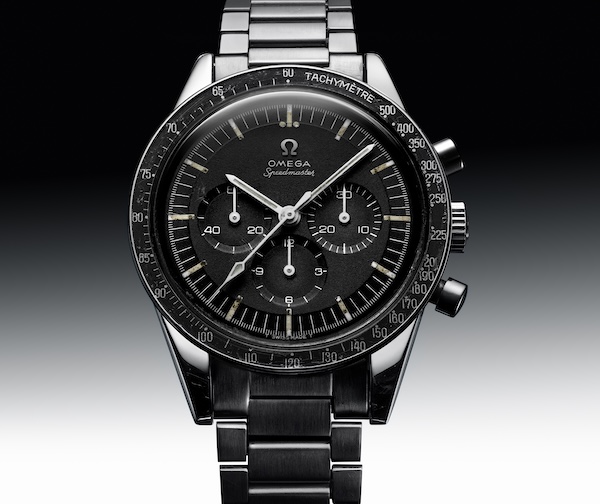
Omega Speedmaster 105.003 from the 1960s. (Image: Omega)
The only Omega movement to make it to the moon
First, the obvious: with its straight lugs and «Flat Link» bracelet, the watch appears aesthetically timeless and appealing to many collectors.
Less visible at first glance — but just as important — is the movement, originally developed by Lemania in 1941 as the «27 Chro C12». Equipped with a column wheel among other features, it is considered a high-end chronograph caliber.
NASA’s Silver Snoopy Award
In 1957, it entered Omega’s Speedmaster lineup as Caliber 321 and was slightly modified for use by «Haute Horlogerie» brands such as Patek Philippe and Vacheron Constantin — in some models and variations up to just about ten years ago.
It is also important to mention that all Omega Speedmasters worn on the moon were equipped with this caliber, and that it was crucial in helping save the Apollo 13 crew. For this extraordinary contribution, NASA awarded Omega the Silver Snoopy Award.
Galactic nickname
The reference 105.003 was also worn in 1965 by Edward White during the first extravehicular activity (EVA), or «spacewalk», by a U.S. astronaut, earning it the nickname «Ed White».
When Omega ramped up Speedmaster production in the late 1960s, Caliber 321 was replaced by a movement that was easier and more industrially feasible to produce. As a result, for a long time it was impossible to buy a Speedmaster at an official dealer with the same movement worn by Apollo astronauts on the moon.
That wait finally ended in 2020 when Omega launched the steel Speedmaster Calibre 321, a reissue that stays very true to the original 105.003.
Sparing no expense or effort
While the retail price of 14,600 Swiss francs — almost double that of the Speedmaster Moonwatch Professional — may initially seem daunting, it is fully justified. Omega spared no expense or effort on this «reissue».
Because the original blueprints lacked sufficient detail and the 105.003 worn on the moon by Apollo 17 astronaut Eugene Cernan could not be dismantled as it is now a museum piece, Omega performed a computed tomography scan to recreate the watch as faithfully as possible.
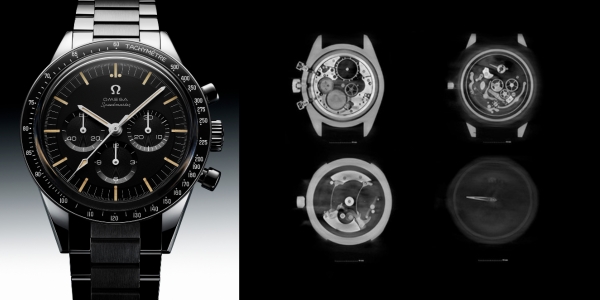
Left: 2020 Omega Speedmaster Calibre 321 reissue. Right: computed tomography scan of Eugene «Gene» Cernan’s original Omega reference 105.003. (Images: Omega)
Assembled individually by hand
Unlike regular Speedmaster models, the Speedmaster Calibre 321 is assembled individually in a dedicated workshop by a single watchmaker, with the movement hand-finished and hand-calibrated.
This manufacturing process is not merely «marketing talk», nor is this model one of the countless artificially scarce limited editions increasingly offered by brands. It is produced without a strict time or quantity limitation.
Six decades after the first U.S. spacewalk
However, due to this specialized production method, capacity is naturally limited and only around 1,500 Calibre 321 units leave Omega’s production facility each year.
In this sense, Omega also has the edge in 2025 — 60 years after the first U.S. spacewalk — as the Speedmaster 321 is likely to be rarer than the hyped steel Daytona.
New, secondary, or vintage?
Similar to the well-known Snoopy Speedmaster Anniversary Series, there is a long waiting list for the 321. The good news is that the current model can also be purchased on the secondary market without a major premium.
Alternatively, one can opt for the original: a 105.003 from the 1960s, which — depending on condition, configuration, and provenance — can even be more affordable.
Swiss Watch Advisor was founded by a Swiss private banker. He regularly shares his watch expertise on finews.com. As the first fully independent advisor, he supports both first-time buyers and experienced collectors in curating their collection or finding their first (and only) watch. Free of conflicts of interest, Swiss Watch Advisor offers a second opinion and tailored recommendations as a sparring partner. The author can be contacted directly via