
The Mood Among Financial Analysts Continues to Brighten
Following the sharp drop in sentiment in April, a recovery had already begun in May, writes UBS in its «CFA Society Switzerland Indikator» on Wednesday. This trend also continued in June.
The sentiment indicator currently shows a value of -2.1 points, remaining in slightly negative territory. In the two previous months, however, the sentiment barometer was significantly more pessimistic at -22.0 points (May) and -51.6 points (April).
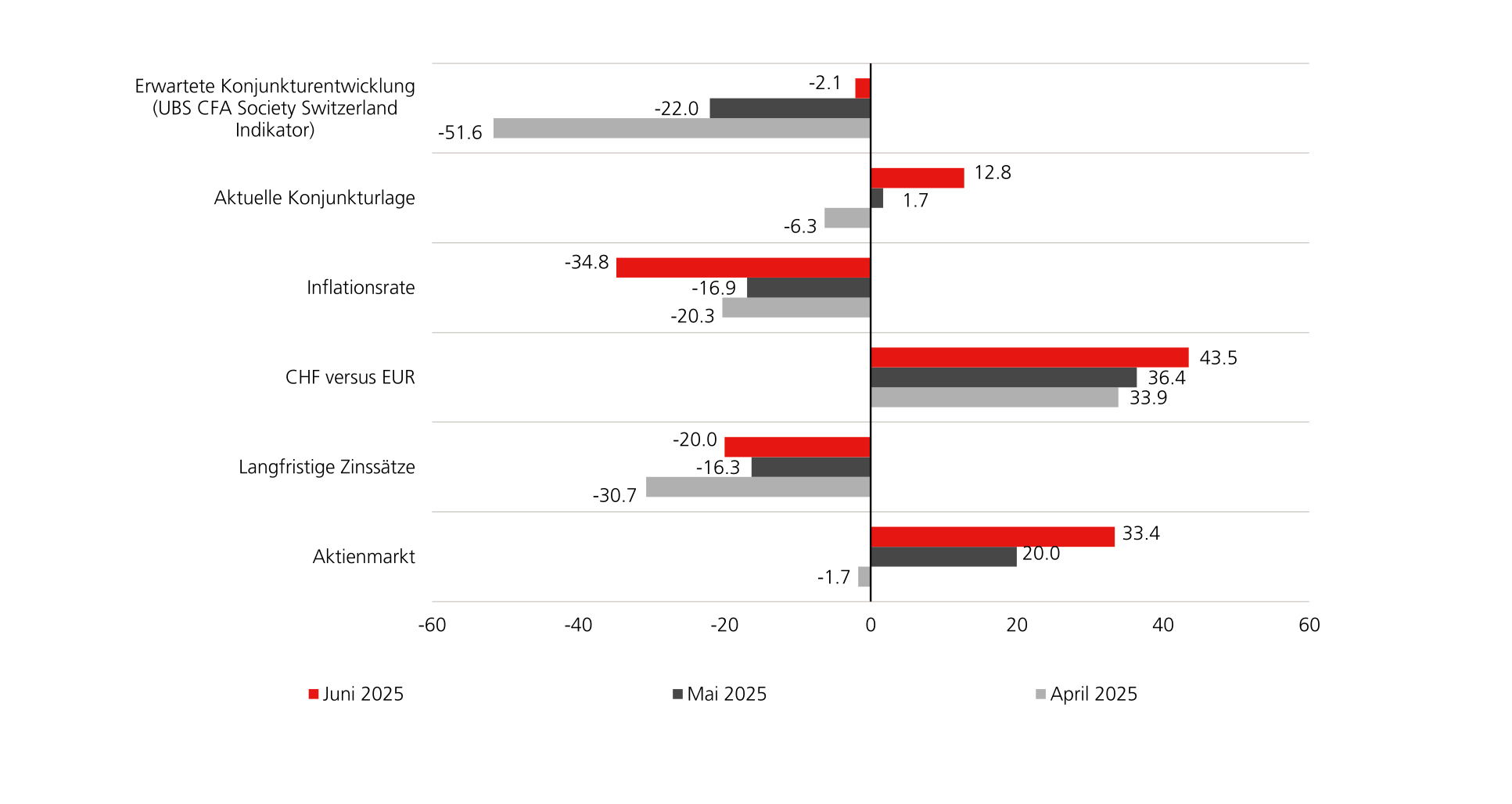
«Against the backdrop of easing trade tensions, expectations regarding economic development in Switzerland, the USA and China have improved significantly,» write the authors of the study.
Currently, 57 percent of survey participants still expect economic conditions in the USA to deteriorate over the next six months. Previously, this figure was two thirds.
Only 10 percent now expect an economic slowdown in China, down from around 30 percent previously. The current economic situation is also viewed less negatively than in May.
Inflationary Pressure Should Continue to Decrease
The tariff dispute also had an impact on inflation expectations. «In the USA, the majority of survey participants continue to expect consumer prices to rise in the next six months, although expectations have fallen significantly compared to the previous month.»
Only just over half now expect an increase, down from around 70 percent previously. Around 20 percent (14 percent) now expect a fall. «Both in the eurozone and in Switzerland, the analysts surveyed expect inflationary pressure to decrease further over the course of the year.»
Sentiment toward the stock markets has grown more optimistic, with 55 percent of respondents expecting the SMI to rise. In contrast, views on U.S. equities remain split, despite showing slight signs of improvement.
Growth and Inflation Outlook
The long-term growth and inflation outlook for Switzerland is stable. Despite the geopolitical and trade policy upheavals, the forecasts have remained largely unchanged in recent months. The financial analysts estimate the probability of economic growth for Switzerland of 1 to 2 percent over the next three to five years at around 50 percent. This value is stable compared to the results from March and last December.
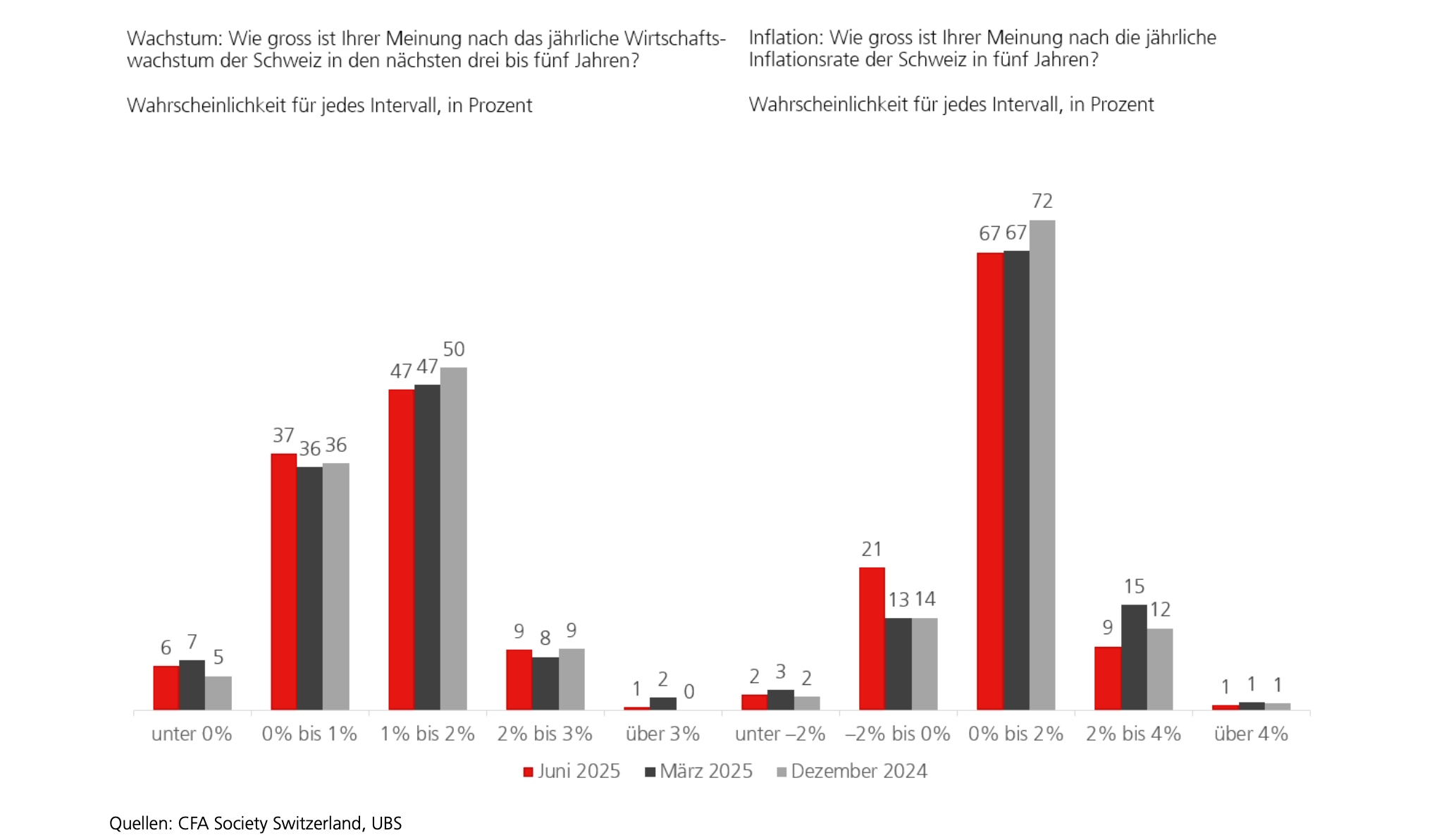
(Graphic: UBS)
However, 43 percent believe it is likely that growth will fall below this range, while only 10 percent believe it will rise. The point forecast for growth in five years is 1.3 percent (March: 1.4 percent).
Two out of three of the analysts surveyed expect inflation to be within SNB's target range of 0 to 2 in three to five years. Here, too, there has been a shift in risk. Falling consumer prices in the long term are now expected by over 20 percent, while only 10 percent expect inflation to rise to over 2 percent. Accordingly, the point forecast for inflation in five years has fallen from 1.2 percent in March to 1.0 percent in June.
What Effects Did the Negative Interest Rate Phase Have?
In retrospect, the UBS also asked questions about the effects of the negative interest rate phase in Switzerland between 2015 and 2022. A majority believe that negative interest rates led to an increase in real estate prices and tended to have a positive impact on credit growth. Two thirds also expect a positive impact on economic growth. 21 percent and 14 percent see no or a negative impact respectively. Government spending is likely to have increased.
Just under 50 percent of respondents rate the influence of negative interest rates on inflation as positive, around 16 percent as negative and around 40 percent see no significant effect. A negative impact on the performance of pension funds and the net interest income of households is seen by 44 percent and 53 percent of respondents respectively.
The majority of analysts believe that negative interest rates have reduced the upward pressure on the Swiss franc. Just one in five respondents, however, believe that negative interest rates have contributed to additional upward pressure.