
Digitalization Score: UBS Tops the Ranking Once Again
Investments in digitalization have long played a key role in the private customer business of Swiss banks. Now, the Institute of Financial Services Zug (IFZ), in collaboration with Swisscom’s think tank e.foresight, has once again analyzed the digital maturity of retail and neobanks. A total of 47 institutions were assessed based on 138 criteria. Both unweighted and weighted rankings were created, with greater importance assigned to certain topics in the weighted version.
In the annual evaluation conducted since 2020, UBS has once again claimed the top spot, having only been overtaken once by Migros Bank in 2023. Migros Bank now ranks second again
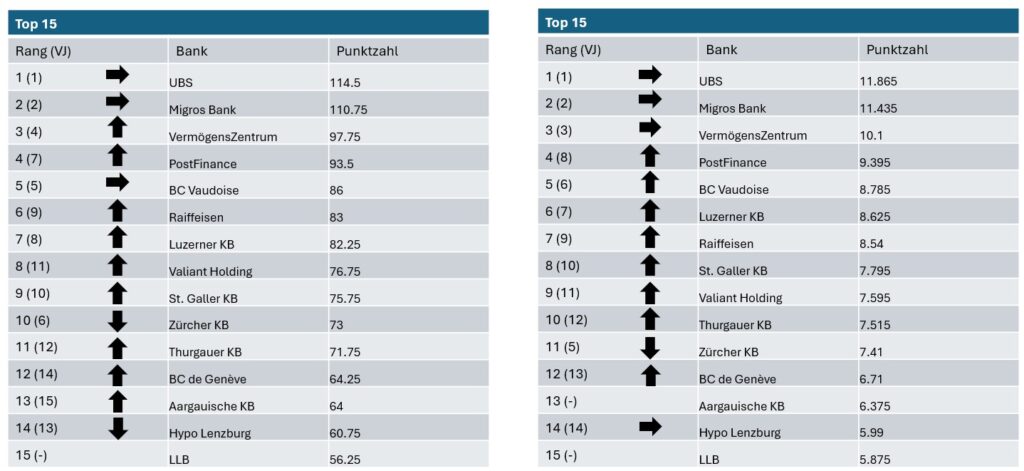
Ranking of the most digital retail banks in Switzerland (left table: unweighted; right: weighted ranking; chart: IFZ)
When focusing solely on digital functionalities in the areas of e-banking, mobile banking, and websites, Migros Bank still outperforms UBS, according to the study.
In both the weighted and unweighted rankings, VZ Depotbank and PostFinance follow in third and fourth place. «PostFinance, in particular, has shown a notable improvement compared to last year,» the study notes. Credit Suisse, which ranked fourth in 2024, was no longer included in the current analysis. BCV retained its fifth position.
Expanded Range of Functions
Of the 47 banks examined, 35 were already part of the previous study. On average, these banks now offer 9,38 percent more functionalities compared to previous results. «28 out of the 35 banks analyzed have improved compared to last year.»
A significant focus has been placed on the use of technology, which also includes the productive implementation of artificial intelligence (AI).
It is striking that the leading banks in digitalization have expanded their functionalities the most. Each of Acrevis, VermögensZentrum, Migros Bank, and UBS introduced more than ten new functions. The three banks already at the digital forefront continued to invest the most.
Overall, the prevalence of various digital features has increased significantly. More banks now offer features such as instant payments, AI, multibanking, customizable menus and interfaces, and digital savings rules. In contrast, features such as voicebots in mobile banking, fractional share trading, and social trading remain rare.
Significant Disparities Remain
«There are still considerable differences between banks in terms of feature coverage and digital maturity,» the study’s authors conclude.
This is also reflected in the scores from the unweighted analysis. Out of a maximum of 139 points, scores ranged from 114,5 to just 9.5 points. 33 out of the 47 banks analyzed achieved less than half the score of UBS.