
These Are the New Trends in the Swiss Office Market
Demand for space on the Swiss office market is intact overall. This conclution is supported by a study published on Tuesday by real estate company Jones Lang LaSalle (JLL) focusing on developments in the five largest cities in Switzerland.
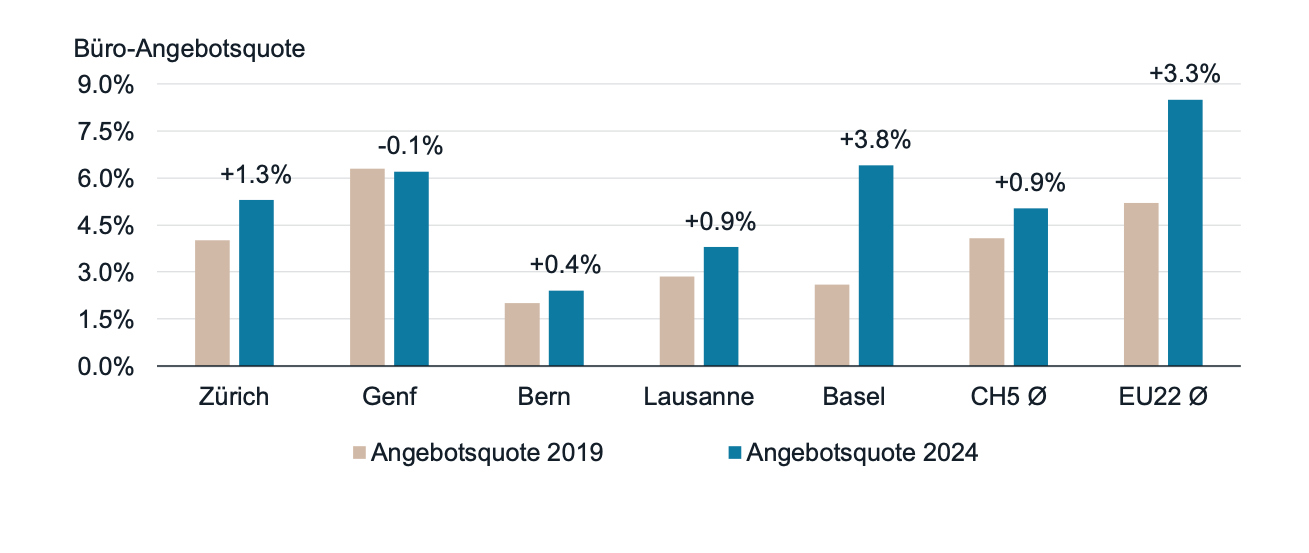
According to the study, the total supply of available office space grew by 9 percent compared to the previous year, reaching 995,500 square meters at the end of 2024.
(Graphic: JLL)
Supply has been rising steadily in recent years. Since the end of 2019, when remote work was not yet widespread, the average supply ratio in Switzerland's five largest office markets has increased from 4.1 percent to 5.0 percent as of the end of 2024.
The report looks in detail at the development of supply ratios, rental prices and new construction activity in Zurich, Geneva, Bern, Lausanne, Basel and Zug. Significant differences exist not only between cities but also within city centers, depending on location and quality.
New Construction and Renovations Increase Supply in Zurich
In Zurich, supply grew by a total of 41,200 square meters last year and the supply ratio rose from 4.8 percent to 5.3 percent. Office supply in the region has therefore increased by more than 120,000 square meters since the end of 2019 to 433,700 square meters by the end of 2024.
The new buildings in Oerlikon and Kloten, in particular, have significantly contributed to the increase in supply. The supply ratio in Opfikon/Glattbrugg was 32.4 percent, while it was only 3.0 percent in District 1. The remarketing of renovated properties (e.g. Zurich West) also had a noticeable effect.
Rental prices across the board have been relatively stable for some time, the report notes. The median rent in the region is 280 francs per square meter per year, while top rents reach 925 francs. In the coming quarters, several high-quality office spaces with sustainability certifications are expected to enter the market in prime locations. According to JLL, «Provided demand for this product remains robust and supply remains limited, prime rents in Zurich, which have been stable since 2022, should then increase.»
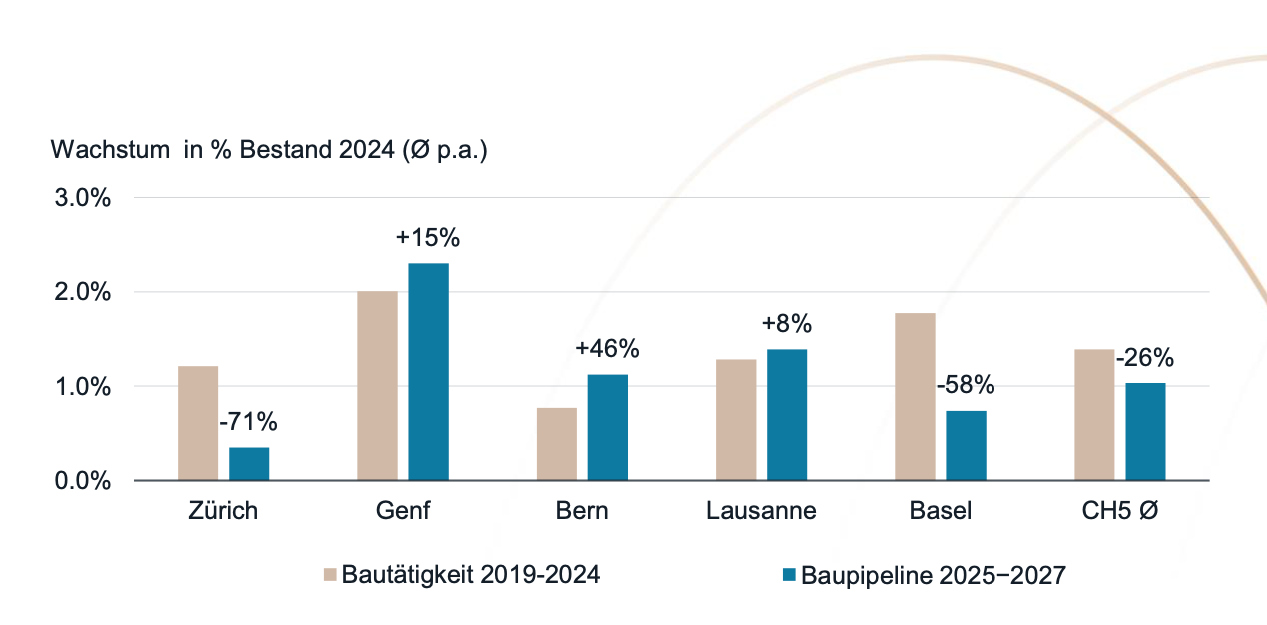
Until 2027, Zurich’s construction pipeline will be significantly smaller compared to previous years. This reduced level of new construction activity is likely to limit further increases in vacancies. However, with additional office space from the existing stock, the supply ratio in the region is likely to remain above 5 percent for the time being.
Higher Prime Rents in Geneva
In the Geneva region, the vacancy rate increased slightly, rising from 6.1 percent to 6.2 percent. Vacancy rates also went up in the city center, including the CBD right bank (2.7 percent) and CBD left bank (4.7 percent) submarkets. Despite this, demand in the city center remained strong.
Rental growth in the prime office segment was reflected in the prime rent, which stood at 975 francs per square meter per year at the end of 2024, continuing the upward trend. The median value is 480 francs in the city and 390 francs in the region. Activity has picked up particularly in the periphery, with completions in the Pont-Rouge district and deals in the airport area being mentioned.
New Construction Has Bottomed Out
Construction activity reached a peak in 2020 with around 343,000 square meters of newly constructed office space, the report continues. It then fell steadily to 57,000 square meters in 2024. «The trough has now been passed, and volumes will rise again every year from 2025 to 2027,» the experts are convinced.
(Graphic: JLL)
Interst from Investors
The prospects for the transaction market are assessed as positive overall despite some opposing factors. «Many market players are confident about the coming months and want to take advantage of the improved investment environment for transactions,» says JLL Switzerland CEO Jan Eckert. «We are seeing this trend in both the quantity and quality of incoming bids. The short-term prospects are more favorable than they have been for three years.»
A number of funds and investment foundations have recently carried out capital increases and are «starting the new year with full wallets». The focus is likely to be on core properties in the catchment area of urban centers that do not require renovation and meet sustainability criteria. A higher willingness to pay coupled with a fundamentally broader interest has been registered. «This and the lower interest rate environment should lead to yield compression and higher transaction volumes this year.»