
Richard Hess: «Combining Trustworthiness With Modern Technology»
Richard Hess, digital banks, and other players are currently competing fiercely with traditional banks to win over Swiss customers. Why do established banks often find it difficult to be perceived as innovative?
Based on my experience at the Swiss Bankers Association (SBA), I see it differently. Many of our members, i.e., «traditional» banks, are highly innovative. They are investing heavily in digital transformation, working together with fintechs, or developing their digital platforms.
However, banks often must meet stringent regulatory requirements, and these can result in complex structures that have an impact on their speed of innovation.
«That is the key to staying competitive in this hard-fought competitive environment»
Some good examples include combating money laundering, monitoring operational risks, and ensuring transparency and data protection for their customers. Mastering this balancing act between innovation and compliance is a challenge, but it’s also a core competence of Swiss banks.
Are Swiss banks managing to keep up with foreign competitors in terms of innovation, or do they risk falling behind?
Not at all. The Swiss financial center and its banks enjoy an excellent reputation globally, especially regarding their high standards of security and data protection and their innovative strength.
The challenge is to make these innovations more visible and to combine the advantages of their years of experience and trustworthiness with modern technology. That is the key to staying competitive in this hard-fought competitive environment.
What is the SBA doing to improve the framework conditions for digital innovation in the Swiss financial center and promote the banks’ innovative power?
The Association is working on a range of measures here. Our focus is on the known key technologies and their impact on the banking industry: artificial intelligence and data processing, open finance and digital identity, and digital currencies and assets.
We regularly bring leading experts from banks, technology firms, and regulatory and supervisory authorities together via our various platforms to discuss the impact of digital technologies on the banking sector, identify opportunities and risks as early as possible, counteract uncertainty in the industry, and support technological change wherever it is feasible and beneficial.
Key Technological Trends in Banking
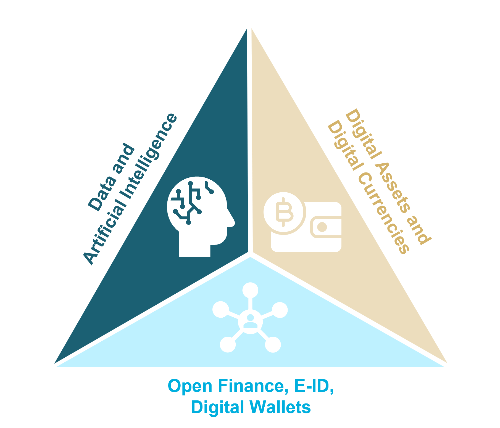
(Illustration: SBA)
How exactly are you doing this?
Our studies, reports, and position papers constitute a vital knowledge base that helps our members to prepare for the future. For example, we recently co-published the Institute of Financial Services Zug’s «Digital Wallets» study, which shows how wallets are becoming central platforms for digital interaction. Banks need to think about the role they want to play in the future wallet ecosystem.
Another example is the report on Quantum Computing in Banking we published in conjunction with QuantumBasel at the start of November. While the technology and its commercial use in the financial sector are still in their infancy, the report makes it clear that political and business leaders alike should be addressing certain aspects today. On top of this, we are – perhaps unsurprisingly – working on a guide to generative AI in the banking industry.
Talking about the digital transformation is one thing. Is it not true that digital innovation is often all about implementation?
That’s right, and that’s precisely one of our ambitions. Together with our members, we’re endeavoring to bridge the gap between knowledge, capability, and execution – as far as we are legally permitted to do so, of course.
We initiate and coordinate joint projects not only to drive the digital transformation forward but also to enhance the banking industry’s resilience. One example here is the SBA’s retail multitasking initiative. Among other things, this is strategically supporting the Federal Council’s open finance targets.
«Banks need to work together in a targeted manner here»
Another is the ongoing proof of concept study to gauge the feasibility and potential benefits of a deposit token for Swiss payment transactions. Yet another is the joint effort to combat fraud and stop ever more sophisticated criminals in their tracks. Banks need to work together in a targeted manner here, and we’re supporting them in that respect.
You spend a lot of time with the Swiss digital finance community. Who or what has impressed you the most recently?
I think three things: First, how bold some Swiss banks are when it comes to integrating technologies like blockchain or AI into their business models. The industry is prepared to take calculated risks to ensure its long-term success, and that’s impressive.
Second, there are many remarkable people behind Swiss fintech start-ups. With their passion and determination, they are driving innovation by identifying gaps in the market and developing effective solutions.
Third, our Digital Finance Day last November: the quality and depth of the discussions convinced me yet again that Switzerland boasts a wealth of know-how for tackling the challenges posed by new technologies in the financial sector head-on. That makes my work for the Association in the interests of an innovative banking industry all the more rewarding.
Richard Hess has been head of Digital Finance at the Swiss Bankers Association (SBA) since July 2020. In this role, he deals with the strategic challenges of digital transformation in the financial industry. He and his team analyze issues at the interface between technology, regulation, and finance and provide decision-making input and recommendations for the sector. Before joining the SBA, he worked as a management consultant, which gave him a solid grounding in the strategic and operational implementation of digital transformation projects. He has a master’s degree in international affairs from the University of St. Gallen and another in international management from Yonsei University in South Korea.