
A Glimpse Into UBS' and Julius Bär's Production Machinery
Boris Scholl, General Manager and Architect in Cloud & AI Engineering at Microsoft, opened the Business Agility Day with a forward-looking keynote on artificial intelligence (AI). «AI will break the stagnant productivity cycle and usher in a new era of innovation,» Scholl predicted, highlighting that 75 percent of knowledge workers now use AI—a doubling in just six months.
Among the highlights was the presentation by UBS executives Katharina Graubner, Head of Agile Working Chapter, and Reto Guler, Managing Director and Head of Touchpoint (Channels) of WMPC Technology. They offered a comprehensive look at UBS’s transformative journey through its Agile Delivery Organization (ADO), launched in 2021.
UBS: From Teams to Mini-Enterprises
Graubner and Guler explained how UBS's ADO began with a foundational build-up in 2021-2022, known as ADO 1.0. This phase established the groundwork for agility across teams.
The subsequent phase, ADO 2.0, ran from 2023 to 2024 and focused on stabilizing these processes to ensure consistent performance and alignment.
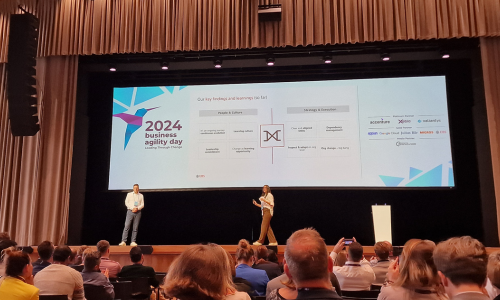
Reto Guler and Katharina Graubner. (Image: Courtesy)
Focus on Delivery
Now, with the introduction of ADO 3.0, UBS has entered a phase of empowerment, where teams operate as independent «crews.» These crews are designed to act as mini-enterprises, taking complete ownership of their products from conception to delivery. This structure allows teams to focus on performance, value creation, and market impact.
Central to this transformation are three key priorities that drive UBS's approach. First, value creation is achieved by emphasizing client-centricity, supported by data-driven strategies and a rigorous discovery phase. This ensures that product development aligns closely with market needs.
Revenue-Generating Product Development
Second, delivery excellence is embedded through a robust product delivery framework, which is bolstered by the integration of expert teams and the adoption of emerging technologies.
Lastly, commercialization takes center stage, with teams tracking data to define and monitor commercial KPIs, enabling them to prioritize revenue-generating product development.
«Continuous Journey»
Graubner emphasized, «Agility is a continuous journey,» underscoring the importance of a culture of learning and leadership commitment. This approach reflects UBS’s dedication to aligning innovation with client needs while maintaining operational excellence.
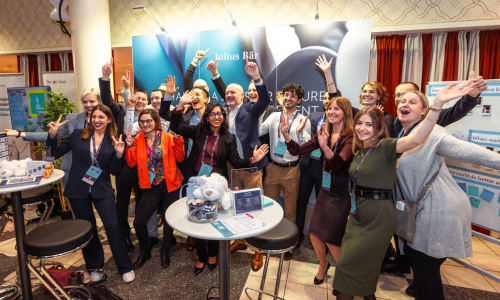
Julius Bär at the Business Agility Day. (Image: Courtesy)
Patricia Kleinle, Director of the Agile Center of Excellence at Julius Baer, contributed her perspective on fostering creative openness. «Companies aspiring to excellence must create environments where questions, opinions, and ideas can be openly shared,» she noted.
Insights from Across Sectors
The conference also featured Albin Kurti, Prime Minister of Kosovo, who shared his country’s progress in digital transformation, including nationwide 5G access and a burgeoning tech sector. Representatives from other companies, including Google Cloud, Appian, and Migros, presented strategies for remaining competitive in a rapidly evolving landscape.

Keynote Speaker Albin Kurti (3rd From Right) with Xebia Executives. (Image: Courtesy)
Bobby Leu, Board Chairman of the Business Agility Day and Managing Director of Xebia Switzerland, concluded with a reflection: «The best organizations don’t just respond to change—they anticipate it. Agility, AI, and innovative management approaches allow us to lead through conscious transformation.»
finews.com was the official media partner of this year's Business Agility Day. The next edition is scheduled for October 30, 2025, in Zurich.