
Martin Schlegel: «Building up Equity Capital Has Priority over Profit Distribution»
According to Martin Schlegel, the Swiss economy frequently follows development patterns that differ from those of other countries. As a result, the Swiss National Bank (SNB) requires a monetary policy framework that offers some flexibility concerning acceptable inflation rates, the new Chairman of the Governing Board stated at this year's «The SNB and ist Watchers» conference in Zurich on Friday, as noted in a press release.
As a small open economy with a safe-haven currency, Switzerland is strongly influenced by fluctuations in the global economy. The effects of global declines in demand on the Swiss economy tend to be exacerbated by an appreciation of the currency, emphasized Schlegel, who took over as head of the central bank from his predecessor Thomas Jordan at the beginning of October..
Foreign Influence on Inflation
In the past, it has been observed that global economic downturns have repeatedly been followed by significant declines in inflation. Developments abroad have a strong influence on domestic inflation.
This is the reason why the SNB defines price stability as an inflation rate between 0 and 2 percent and aims to keep inflation within this range in the medium term.
This allows the SNB to react flexibly to shocks, whereby the costs and benefits of monetary policy measures must be constantly weighed up against each other.
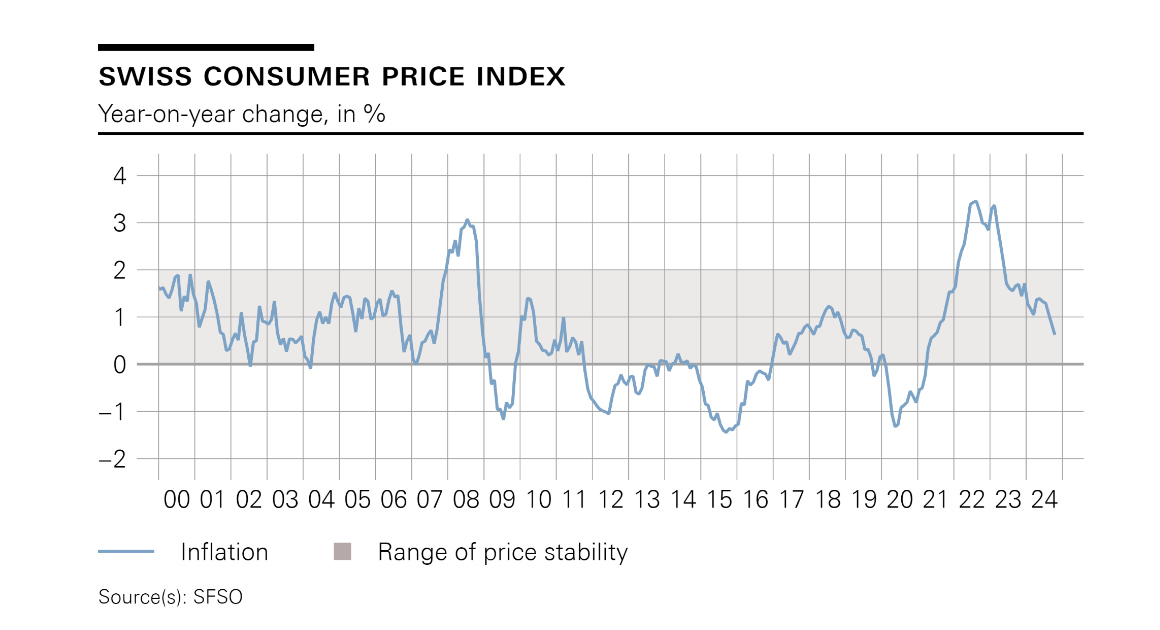
Although there have been phases in which inflation was temporarily outside the price stability range, it has always returned quickly to values within this range.
Key Interest Rate and Intervention in the Foreign Exchange Market
The key interest rate is the central element of SNB policy, flanked by additional measures such as foreign exchange market interventions. This was used both to counteract the risk of deflation and to combat inflation.
Insufficient Equity Capital
A side effect of the foreign currency purchases was the lengthening of the SNB's balance sheet, emphasized the Chairman. This has led to strong fluctuations in the annual result and, in view of the balance sheet risks, the SNB's equity capital is currently far too low. «Building up the SNB's equity capital must therefore take priority over profit distributions,» he said.
Schlegel also considers it a success of central bank policy that the Swiss economy has developed well in recent decades in an international comparison. Price stability has been ensured despite considerable deflation and inflation risks. Ensuring price stability will continue to contribute to favorable economic conditions in Switzerland in the future.