
Bank Profits Not Fully Reflected in Stock Valuations
According to McKinsey's «Global Banking Annual Review,» published on Thursday, the last two years have been the most successful period for the global banking sector since the financial crisis.
In 2023, banks globally recorded profits of $1.15 trillion, an increase of 8 percent from the previous year, making the industry one of the most profitable overall. The sector has also improved its profitability, achieving total revenues of $6.8 trillion and an average Return on Tangible Equity (ROTE) of 11.7 percent, up from 11.5 percent in 2022.
However, this has not been reflected in stock valuations. In 2023, the banking sector has the lowest average price-to-book ratio of 0.9 compared to other industries.
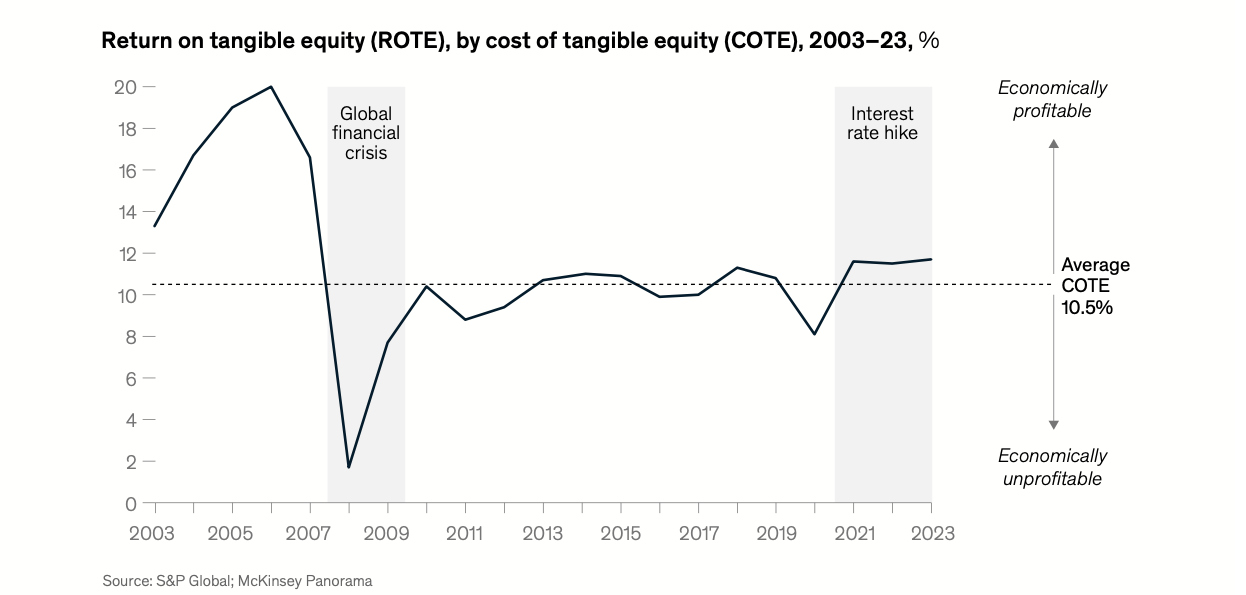
(To zoom in, click on graphic; Source: McKinsey)
Deteriorating Profit Outlook
However, challenges are looming. Traditional institutions face increasing competition from neobanks. Additionally, the outlook for profits in their most lucrative sectors is uncertain due to a weakening interest rate environment.
According to the study, only 14 percent of banks worldwide generate a Return on Equity (ROE) greater than their cost of equity (COE) while also producing a price-to-earnings (P/E) ratio above 13. This group is regarded by experts as the outperformers of the industry.
It is essential to focus on three differentiating factors to ensure long-term competitiveness and achieve appropriate market valuations. These factors are scaling potential, effective geographical positioning, and operations in lucrative sub-sectors.
Swiss Banks as Outperformers
In an international comparison, Swiss banks have achieved stronger net profits and a better long-term ROE. This positions them well to differentiate positively from global trends regarding capital return and cost. Nearly one-third of the observed Swiss banks qualified as outperformers in 2023 based on P/B and P/E criteria, providing these institutions with opportunities for future investment and growth.
«Fee-focused and less capital-intensive businesses, such as wealth management, remain the golden path for the Swiss financial sector according to the current analysis,» said McKinsey-Partner Jan Quensel. A strong service orientation, innovation in products, and growth in international financial centers can counteract competitive and margin pressure.
Better Consideration of Success Factors
The study forecasts revenue growth of just under 2 percent for Swiss banks across sectors from 2023 to 2028. Consequently, efficiency as a success factor gains importance. To maintain today’s return despite low market growth, cost per asset must be reduced by 5 percent annually through cost leverage.
«Swiss banks must not settle for the status quo; they should strengthen their foundations for sustainable returns through scaling, improving efficiency, and maintaining robust risk management, as highlighted by the study's key success factors.»