
Are the Big Years in Asset Management Over?
The asset management industry is facing challenges. This is the conclusion of a study conducted by the consulting firm ZEB, which specializes in the financial sector. Stagnating profit margins, rising cost-to-income ratios, and increasing competition consolidation necessitate significant action from companies.
The study examined 40 large asset managers with a strong European presence, collectively managing assets (AuM) of €42 trillion. This includes six institutions from Switzerland, with UBS emerging as the largest asset manager following its merger with Credit Suisse.
Notably, ZEB did not include the asset management of ZKB under the Swisscanto brand, which had a total managed asset volume of 275 billion Swiss francs as of June 2024.
The Largest 40 Asset Manager in the World
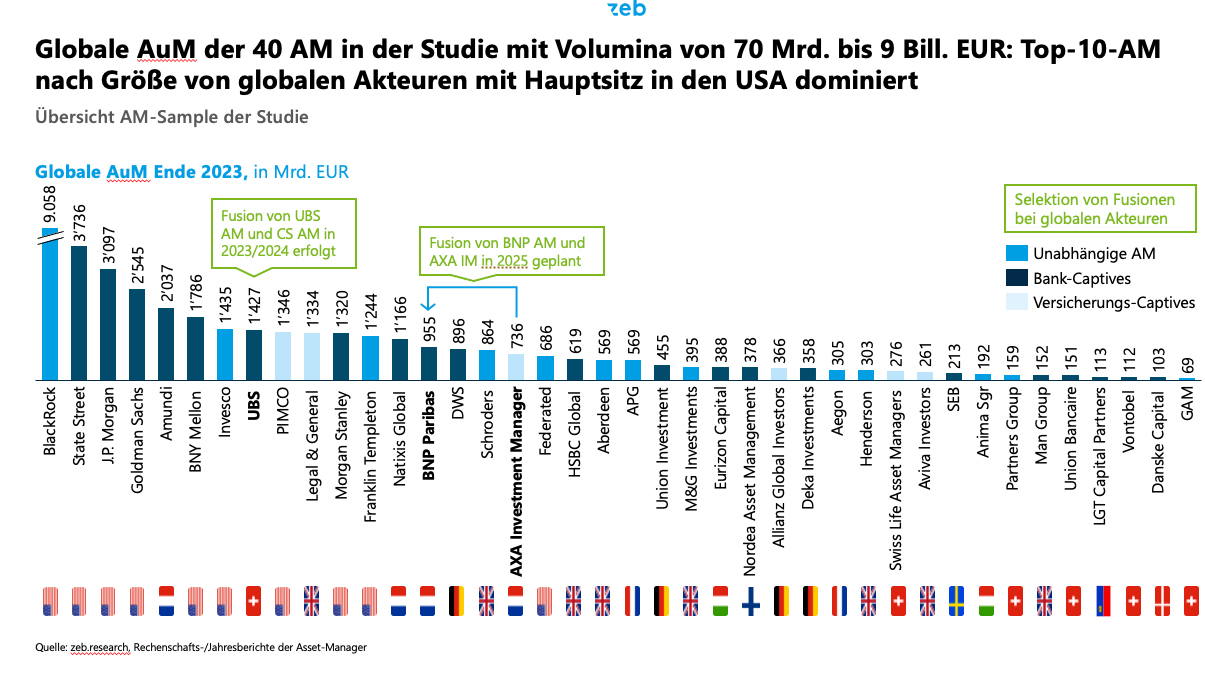
(To zoom in, click on the graphic; Quelle: ZEB)
A Warning Signal for the Industry
The market remains highly concentrated, according to the consulting firm. The top 10 asset managers account for 36 percent of the market in terms of AuM. The largest markets are the USA (50 percent) and Europe (30 percent), with 44 percent of fund assets invested in equities.
A continuous decline in profit margins is seen as a warning signal for future development. Despite the growth of recent years, revenues have not kept pace. The AuM growth over the past five years (2019–2023) has averaged 8.8 percent per annum. However, with costs stagnating, profits have continued to decline.
Smaller and, medium-sized providers in particular, have performed worse than larger firms. While smaller asset managers and big players have achieved a stabilization of profitability, medium-sized firms continue to struggle with costs. They are suffering from a lack of economies of scale and cannot benefit from niche activities.
Focus on Costs
Survey results indicate that cost reduction is primarily viewed as a means to improve results. According to the survey, 33 percent of respondents plan short-term measures (within two years), while 24 percent have longer-term plans.
Asset managers identify digitalization, including AI, as the biggest lever for change, followed by process optimization, project budgets, and workforce reduction. However, achieving long-term savings will also require investments in technology and processes.
Insufficient Knowledge
Two-thirds of respondents rate their own company's level of digitalization as «expandable» and 15 percent as «low». There is often insufficient understanding of AI in the organization.
To strengthen their position, many plan to expand their offerings in alternative investments or target new private and institutional client groups. Expanding ESG positioning or offerings of passive or hybrid products appear to have lower priority.