
Commerzbank: Defense on Shaky Ground
 In light of Unicredit CEO Andrea Orcel's determination, it would be wise for Commerzbank's bankers to start asking their potential colleagues at UniCredit’s subsidiary HypoVereinsbank (HVB) what it’s like to be led by an Italian.
Indications suggest that the battle for Commerzbank may intensify by the end of the year. Commerzbank’s management and the German financial establishment have come to realize that UniCredit is serious about its intention to acquire up to 30 percent of the German rival. As a result, they are now urgently seeking countermeasures and defensive strategies.
Could Deutsche Bank Be the «White Knight»?
One potential strategy would be to find a «white knight» capable of making an offer to block UniCredit’s takeover. The natural candidate would be Deutsche Bank, which reviewed the possibility in 2019 and reportedly expressed interest again last year.
According to «Milano Finanza» Deutsche Bank has enlisted the services of U.S. investment bank Morgan Stanley to explore a potential stake in Commerzbank.
Could it Be Biting Off More Than it Can Chew?
However, Deutsche Bank may be at a disadvantage in this scenario. With Commerzbank’s market capitalization close to €20 billion, it represents a hefty challenge for Deutsche Bank, valued at only €32.4 billion. This, however, poses no issue for UniCredit, which boasts a market value of nearly €65.5 billion.
While UniCredit continues to post record results quarter after quarter, Deutsche Bank, despite finishing 2023 with a profit, still faces a long road to achieving sustainable success.
High Costs
One indicator of this is Deutsche Bank’s persistently high costs. Last year, expenses amounted to €21.7 billion, leading to a cost-income ratio of 75 percent, which is significantly higher than the European average.
In contrast, UniCredit reduced its operating expenses by 0.8 percent to €9.47 billion in 2023, bringing its cost-income ratio down to 39.7 percent.
Controversial Rating Debate
Traditionally, the defense of Commerzbank’s independence falls to its CEO Bettina Orlopp. In a recent interview with the «Handelsblatt» she argued that a merger with UniCredit would be harmful, stating, «Our rating would likely decline, possibly significantly.» She added: «We would lose customers who have certain rating requirements and only do business with banks that have excellent ratings.» finews.ch reported on this.
Orlopp’s concern stems from Commerzbank’s A rating from Standard & Poor’s, compared to UniCredit’s less favorable BBB rating. However, Moody’s recently reaffirmed Commerzbank’s A2 rating with a positive outlook.
She indicated that «while the timing and effects of UniCredit’s increased stake and potential acquisition remain uncertain, we do not expect this to negatively impact Commerzbank’s financial stability or profile.»
Own Goal of Dresdner Bank
Another purely defensive argument from Orlopp backfired dramatically. She highlighted the challenges of merging two large banks, citing Commerzbank’s 2008 acquisition of Dresdner Bank. That merger, she noted, involved long periods harmonizing the IT systems of both banks.
«We cannot afford such a stalemate in today’s world,» Orlopp stated. «Just because a merger looks good on paper doesn’t mean it will be well-executed or create value for our shareholders,» she added.
In contrast, UniCredit’s integration of IT systems during its 2005 merger with HVB was one of the deal’s highlights. Only a few years later, HVB announced that it was fully integrated into UniCredit Group, having successfully completed the implementation of its core banking software.
Little Enthusiasm
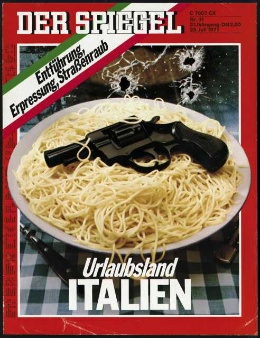
In other words, the days when «Der Spiegel» could use provocative imagery — like a plate of spaghetti and a Wehrmacht pistol — to symbolize German-Italian tensions is long gone.
Nevertheless, the fact remains that many Germans, particularly in banking, are not thrilled by the prospect of being led by Italians, even cosmopolitan figures like Andrea Orcel.