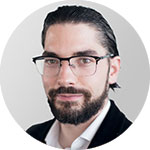
Head of Foreign Banks: «We Are Getting More And More Important»
Mr. Würgler, the financial sector as a whole, including foreign banks, has faced turbulent decades. What key trends have you observed among your members during this period?
Yes, that's correct. Around the turn of the millennium, many banks, even very small ones, maintained subsidiaries in Switzerland – serving wealthy private clients played an important role. Then came the break with international tax transparency, accompanied by increased regulatory complexity. This was a significant cost driver for all banks in Switzerland and impacted the business model. Foreign banks were not immune to this. Overall, however, we are seeing a positive trend.
So the perception that foreign banks have been hit hardest by the banking decline is wrong?
Yes. In fact, their share of the total number of banks has increased, from about one-quarter to one-third.
Where does this impression come from?
When a bank, no matter how small, disappears, it makes headlines. However, when a large corporation relocates a unit with several hundred employees from Switzerland to another country, it gets less attention because the bank still remains on-site.
When would you say was the turning point where foreign banks reoriented themselves?
It varied. In 2013, our association, in collaboration with Capgemini, conducted a study on the future of private banking. We gathered insights from all relevant stakeholders – from bankers to ultra-high-net-worth individuals, other client groups, legal experts, and so on. The takeaway was that clients prefer to rely on a trusted partner to manage their complex needs, ranging from investments, mortgages, corporate banking, retirement planning, and education financing for their children.
«Large foreign banks have realized that Switzerland is an attractive location for corporate banking»
This partner guides the client, often a complex entity, to the most suitable provider for each service. This demands a high level of specialization from the banks. This requires specialization from the banks. At the same time, large foreign banks have realized that Switzerland is a highly attractive location for corporate banking. The Swiss economy is very international, with many complex international structures that require financing through an international network. It's all about balance sheet size and the network.
Can you give an example?
Take the Bank of China. Three years ago, it opened a branch in Switzerland, focusing on trade finance and corporate banking. It offers a lot to the Swiss industry, not only in China but also in regions heavily influenced by China economically, like parts of Africa and Latin America. These companies have their headquarters in Switzerland, so they need to be served here. Many of these companies find a valuable partner in a foreign bank, particularly thanks to their global network.
Has the shift towards corporate banking become more pronounced with the disappearance of Credit Suisse, traditionally a Swiss corporate bank?
This incident has certainly heightened awareness among our members that they offer more to the Swiss economy than just wealth management. Recently, we were with a bank at Swissmem, the Swiss association for the machine industry...
Do you share Swissmem's criticism of UBS, suggesting that financing options for the Swiss industry have become more difficult following UBS's takeover of CS? What do you observe in the market?
I am not fully aware of the detailed interactions our members have with their clients. However, I observe that many foreign banks – some more publicly than others – are signaling a clear interest in this market and see growth opportunities. This is likely a consequence of the reduced offering.
«UBS has traditionally not been positioned as a corporate bank»
UBS has not traditionally positioned itself as a corporate bank, and cultural factors also play a significant role. When a company has production plants or markets spread across the globe, an international network and the bank’s local presence are appealing.
You recently made a public statement, signaling increased efforts by foreign banks to serve corporate clients, including UBS.
That was somewhat exaggerated in the press. We simply want to highlight the attractive options foreign banks offer to corporate clients and how they can support the Swiss economy as partners.
Does it seem like you're aiming to communicate more actively in the future?
I would say we've decided to start communicating at all.
Why now?
The situation with UBS has certainly contributed. But there has been a general shift towards more transparency in the banking sector, and public communication is a part of that.
«The latest foreign bank established in Switzerland last year reflects the desire of clients to deposit part of their wealth here»
We've talked a lot about corporate banking. Are foreign banks phasing out private banking?
Not at all. In geopolitically uncertain times – think of the war in Ukraine – stable countries like Switzerland are in high demand for international wealth management and diversification. The most recent foreign bank to establish itself in Switzerland last year reflects the clients' desire to deposit part of their wealth here.
How many members do you currently have?
Around 100. That means nearly all foreign-controlled banks in Switzerland are our members, and even some Swiss banks. We once had 150 members, but back then there were also 600 banks in Switzerland.
What do you offer your members?
We see ourselves primarily as an information broker and a regulatory interface. We provide our members with concise summaries of current regulatory or tax initiatives. Additionally, we maintain annual discussions with key financial institutions such as FINMA, the Swiss National Bank, SIF, and SECO.
«Our association’s goal is to maintain Switzerland's attractiveness as a banking location in an international context»
We represent our members’ interests in those discussions. We also do the same within the Swiss Bankers Association at every level, from the board, where we have three members, to the committees, where one of our representatives participates, to the secretariat and specialized committees.
Are you satisfied with your influence within the Swiss Bankers Association?
Yes, I would say it reflects our weight in the financial sector.
Do you feel you're being treated fairly?
Absolutely. We are listened to. Of course, there are always trade-offs and sometimes conflicting interests. But our consolidated interest as an association is to maintain Switzerland's attractiveness as a banking location in the international context.
How successful has that been?
In many areas, it's going very well. Switzerland, for instance, has earned an excellent reputation in terms of digitalization. FINMA has built strong expertise and openness in this area and was quick to implement the DLT (distributed ledger technology) legislation. Switzerland wisely chose not to create a separate law for digital financial transactions but rather to adapt existing laws to the new digital landscape. SIX, with its digital exchange, has also done a great job
In retrospect, it was also wise that Switzerland’s ESG regulation was more restrained, allowing for self-regulation and automatic compliance with international standards.
«You can't maintain the discretion you'd like when dealing with international sanctions»
How do you see Switzerland's handling of sanctions?
Regulation is a sovereign task. You can't maintain the discretion you'd like when dealing with international sanctions. It was clear that Switzerland had to align itself with the Western world, to which it belongs economically, culturally, and historically. There was no room for a different path.
There are always concerns about the future of the Swiss banking sector. Competitors in Southeast Asia or the Middle East are positioning themselves.
Yes, there are certainly efforts in financial center marketing. Financial centers in the Middle East are currently doing this, especially in the commodities sector, and seem to be finding some success. The Swiss tend to talk less and act more. Recently, I emptied my wallet and found a Swiss franc coin from 1909. It still looks the same, except for the color. Twenty-five percent of private assets are still held in Switzerland today.
There is indeed a strong sense of continuity. While we shouldn’t become complacent, there's also no need to rush. What sets Switzerland apart from many other financial centers is the presence of many small banks. This fosters close client relationships and accommodates a broad spectrum of cultures and business models. The same applies to foreign banks: Jordanians, Kuwaitis, Saudis – they are all here. From Asia, Pakistan, and various countries in Latin America. It's essential that we nurture this diversity.
Raoul Oliver Würgler has been managing the Association of Foreign Banks in Switzerland (AFBS) since January 1, 2020. He previously worked for the association for 20 years.