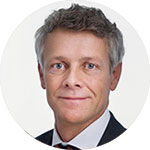
André Helfenstein: «Our Reputation has Suffered Greatly»
I cannot comment on developments at UBS. But I can undoubtedly see great potential in any cooperation between a fintech that is strong in payments with a bank that has a broad client base.
«My only worry is that Switzerland rests too much on its laurels»
But the difference in Switzerland compared with other countries is that the development is an evolutionary one. That is why I think over time there is a place for different models, and it can hold broad platforms such as we have, as well as pure fintechs, and partnerships between banks and fintech.
Half of the private banks in Switzerland have disappeared in the last 12 years. Do you see yourself playing an active role in the consolidation?
Many of the banks that disappeared were active in the offshore segment. For our part, and without any kind of pressure, we are watching developments in the technological and product areas.
Is this market restructuring a result of a worsening industry framework?
In times of crisis, Switzerland has proven advantages as a secure country with a dependable legal system and efficient government administration.
The country continues to enjoy the status of a safe haven, something that is underscored by the inflows of client assets in wealth management. My only worry is that Switzerland rests too much on its laurels.
What about the credit business? What is the situation there?
The commercial banking business is performing well. The interest rate margin business is seeing some pressure because of the monetary tightening that we are currently seeing. But if the key interest rates move up higher into positive territory, I expect that situation to ease again.
The government's price regulator has accused Swiss banks of compensating for declines in the interest rate business with unjustified fee increases. What does that mean for your business?
Prices have indeed increased in certain areas. But it is mostly in broad segments where competition is strong. The fees also reflect the expanded services the banks have introduced in recent years, such as in online banking.
Digitalization doesn't only change the banking business but also its institutional structures. The pandemic has also changed the workplace. What is an appropriate balance between office and remote working for a Swiss bank?
We started reviewing our working models at practically the same time that the pandemic broke out. Given our experience since then, we developed a simple framework for remote work.
«We let employees work from home about 30 percent of the time»
Working from home will continue to be possible in a broad number of cases, with employees and their supervisors having to agree on individual solutions that are also in the interest of the teams they work in and the bank itself. With our framework, we let employees work from home about 30 percent of the time.
Are there no data security issues if employees are working from home and they have access to client data?
It is important to have a healthy internal culture and effective rules related to data access whether a member of staff is at home or in the office. We have not been able to see any particular challenges in that respect that are different from working at an office. But the working models are still new, and we are following them closely and making any changes when needed.
«Credit Suisse, as a group, has created too many negative problems in the past»
Credit Suisse bankers regularly have to hear that they have lost any ability to assess risk. How do you change that?
Like other banks, we have a large credit book in Switzerland which we use to support clients while also keeping a close eye on risk at the same time.
Credit Suisse, as a group, has created too many negative problems in the past. That is why strengthening our risk culture on the board of directors and with senior executives is a top priority.
André Helfenstein is the CEO of the Swiss business of Credit Suisse and a member of the group executive board. Before joining in 2007, he was a partner and managing director of the Boston Consulting Group (BCG) in Zurich and New York for 12 years. He holds a degree in economics from the University of St. Gallen.
- << Back
- Page 2 of 2